
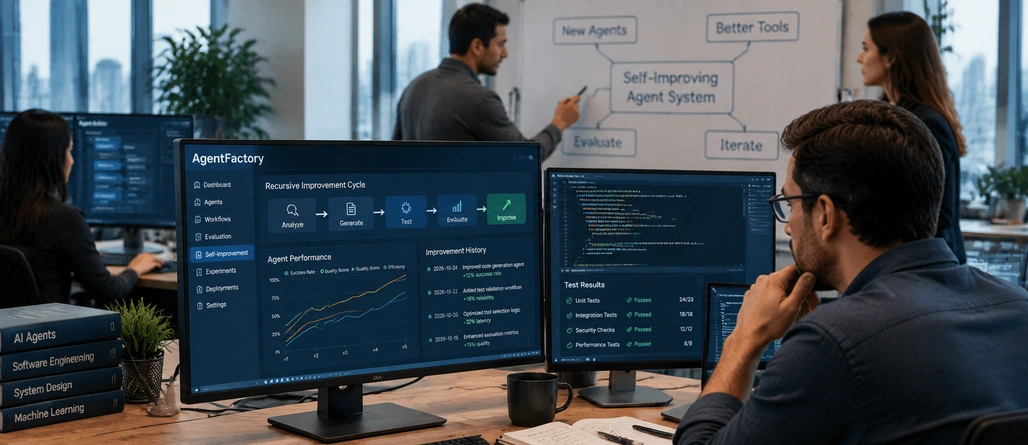
Exploring how meta-agent architectures, autonomous code improvement, and continuous capability development could reshape the future of artificial intelligence
Author: John Godel
Abstract
Artificial intelligence is approaching a fundamental architectural transition. The industry has moved from standalone large language models to tool-using agents capable of planning, executing tasks, and coordinating complex workflows. The next frontier is the development of systems that can evaluate their own performance, identify capability gaps, modify their implementations, and iteratively improve the agents responsible for their operation.
This emerging paradigm is known as Recursive Self-Improvement (RSI).
Gate2Asi AI's AgentFactory represents an architectural approach to exploring this direction by combining autonomous agent creation, performance evaluation, code modification, testing, and iterative refinement into a coordinated system. Rather than treating agents as static configurations wrapped around language models, this approach envisions an evolving ecosystem in which agents can develop, evaluate, and improve other agents.
Three capabilities are central to this vision: autonomous self-modification, meta-agent orchestration, and continuous capability development.
However, the distinction between automated optimization and genuine recursive self-improvement is important. A system that modifies its own code is not necessarily becoming more capable, and an architecture that generates child agents does not automatically produce compounding intelligence. Demonstrating RSI requires measurable improvements across successive generations, reliable evaluation, and controls that prevent regressions or unsafe behavioral changes.
This article examines AgentFactory through that lens, explores its potential architectural significance, and considers the technical and governance challenges that must be addressed on the path toward safe, increasingly autonomous AI systems.
The central thesis is that the next major step in agentic AI may come not only from building more capable models, but from building systems that can systematically improve the agents, tools, and workflows through which intelligence is applied.
1. Introduction: Beyond Static LLM Wrappers
The first generation of widely adopted generative AI applications focused on conversational interaction. Users provided prompts, models generated responses, and applications translated those responses into useful experiences.
The next generation introduced tools, retrieval, memory, planning, and multi-step execution. AI agents could search information, call APIs, manipulate files, execute code, and coordinate activities across multiple systems.
These advances created a new class of software: applications in which an AI model does not merely produce an answer but participates in completing a task.
Yet many agent architectures remain largely static.
Their roles are predefined. Their available tools are configured in advance. Their workflows are constrained by developer-authored logic. Their capabilities depend on existing models, prompts, integrations, and policies. When an agent repeatedly fails at a task, improving it often requires a human to diagnose the problem, modify the implementation, run tests, and deploy a revised version.
This creates a potential bottleneck.
As the number of agents, tools, and operational workflows increases, the cost of manually maintaining every capability can become substantial.
What if an AI system could identify these limitations and participate in resolving them?
What if it could analyze execution traces, propose architectural changes, generate improved code, construct specialized agents, evaluate their performance, and integrate successful improvements into subsequent iterations?
That is the architectural direction explored by AgentFactory.
The objective is not simply to make an agent autonomous in executing tasks. It is to investigate how autonomy can extend to the development and improvement of the agent system itself.
This represents a shift from AI that performs work toward AI systems that can help improve how AI work gets performed.
2. What Is Recursive Self-Improvement?
Recursive Self-Improvement describes a process in which an AI system contributes to improving its own capabilities, and those improvements increase its ability to produce further improvements.
A simplified cycle is:
Execute: Perform a task using the current system.
Evaluate: Measure the outcome against defined success criteria.
Diagnose: Identify limitations, errors, inefficiencies, or capability gaps.
Improve: Modify code, tools, prompts, workflows, agent configurations, or other eligible components.
Validate: Test the proposed changes against relevant benchmarks and safety constraints.
Integrate: Promote approved improvements into the operational system.
Repeat: Use the improved system to pursue the next cycle of development.
The recursive element arises when improvements to the system increase its ability to generate, evaluate, or implement subsequent improvements.
For example, an agent might initially struggle to build reliable data-analysis agents. It could identify deficiencies in its task decomposition, improve its code-generation workflow, introduce better test generation, and create a specialized data-validation agent.
If those changes produce a measurable improvement, the system may become more effective at developing its next generation of agents.
However, several distinctions matter.
Self-modification means a system can change some aspect of its own implementation or configuration.
Automated optimization means a system searches for improvements against a specified objective.
Recursive self-improvement means improvements contribute to a process that can improve the system's subsequent improvement capabilities.
Recursive self-improvement with compounding capability gains requires evidence that improvements persist and produce meaningful, repeatable gains over successive iterations.
These concepts overlap, but they are not interchangeable.
A system may successfully rewrite its code while making its performance worse. It may generate more agents without improving task completion. It may optimize a narrow benchmark while becoming less reliable on real-world tasks.
Consequently, RSI should be evaluated by what the system demonstrably improves—not by how much code it changes or how many agents it creates.
3. AgentFactory: An Architecture for Self-Evolving Agent Systems
AgentFactory can be understood as an architecture for coordinating agent creation, execution, evaluation, and improvement.
Its potential significance lies in connecting these activities into a repeatable engineering lifecycle rather than treating agent development as a sequence of isolated human-driven projects.
A conventional agent framework generally provides an execution environment for predefined agents. A more ambitious agent factory can also participate in developing the agents that populate that environment.
This introduces a meta-agent layer: an agent or coordinated group of agents responsible for designing, creating, testing, refining, and managing other agents.
The architecture can be understood through three principal capabilities.
3.1 Autonomous self-modification
In a self-modifying architecture, the system can inspect relevant aspects of its own implementation, identify potential weaknesses, and propose or apply changes within its authorized scope.
The process may involve:
Analyzing failed tasks and execution traces.
Identifying defects in code, prompts, tool definitions, or workflow logic.
Proposing implementation changes.
Generating patches or alternative implementations.
Creating regression tests.
Running tests in an isolated environment.
Comparing the revised implementation with the baseline.
Promoting validated changes through a controlled release process.
For example, suppose a software-development agent repeatedly generates database queries that fail against a particular schema.
A self-improvement workflow could identify the recurring error, investigate whether the agent lacks schema context or query-validation logic, generate an improvement, and test it against a representative collection of database tasks.
If the revised agent produces better results without introducing unacceptable regressions, the improvement can be retained.
This is materially different from asking a model to rewrite its own instructions and assuming the new version is better.
The key is the feedback loop connecting observed failures to targeted changes and independently measured outcomes.
3.2 Meta-agent architecture
The second capability is the ability to create and coordinate specialized agents dynamically.
Instead of assigning every task to a single general-purpose agent, a meta-agent can decompose a problem into smaller responsibilities and determine whether specialized agents would improve the outcome.
For example, a software-engineering workflow might use:
A requirements-analysis agent to clarify the intended behavior.
A software-design agent to propose the architecture.
A coding agent to implement the changes.
A testing agent to construct and execute validation scenarios.
A security-review agent to inspect potential vulnerabilities.
A coordination agent to integrate results and resolve dependencies.
The meta-agent manages the relationships between these roles, their inputs and outputs, and the criteria for determining whether the overall task is complete.
In an evolving system, the meta-agent could also recognize recurring weaknesses in its existing agent portfolio and propose new specialized agents or revise existing ones.
This creates an important architectural distinction: the system is not merely orchestrating work among a fixed collection of agents. It can participate in evolving the collection itself.
However, agent proliferation is not inherently beneficial. Additional agents introduce communication overhead, duplicated work, conflicting outputs, more complex permissions, and additional failure modes.
The relevant objective is not to maximize the number of agents. It is to identify the smallest effective set of specialized capabilities that reliably achieves the desired outcome.
3.3 Continuous capability development
The third capability is the ability to improve system performance through repeated, measurable iterations.
A mature implementation would maintain an explicit improvement lifecycle involving:
Baseline measurements.
Failure classification.
Hypothesis generation.
Candidate implementation.
Automated testing.
Comparative evaluation.
Regression detection.
Controlled deployment.
Post-deployment monitoring.
Over time, this process could improve not only individual agents but also the mechanisms used to develop and maintain them.
For example, an improvement to test-generation capabilities could help validate future code changes more effectively. Better failure analysis could improve the quality of subsequent diagnoses. A more effective agent-selection mechanism could reduce the overhead of future workflows.
These are potential sources of compounding engineering productivity.
The defining requirement is evidence: the system must demonstrate that its improvements generalize beyond the immediate task and remain effective across subsequent iterations.
4. Why the Meta-Agent Layer Matters
A central insight behind AgentFactory is that an agent ecosystem can itself become an object of engineering.
Traditional development processes distinguish between the software being developed and the tools used to develop it. Developers write application code, testing systems validate that code, and deployment infrastructure releases approved versions.
An agent factory introduces the possibility that AI systems can participate in multiple layers of this lifecycle.
<box gap={2}>
<row align=start gap={3}>
<AsyncImage query="software engineer reviewing code on computer monitor modern realistic office" aspectRatio="3:4" maxWidth="108px"/>
<box flex="1" gap={1}>
**Layer 1 — Task execution**
  Agents perform the work: analyzing information, writing code, querying data, or operating approved tools.
</box>
</row>
<divider color="subtle"/>
<row align=start gap={3}>
<AsyncImage query="software engineering team examining application architecture diagrams and code on monitors realistic office" aspectRatio="3:4" maxWidth="108px"/>
<box flex="1" gap={1}>
**Layer 2 — Agent development**
  Meta-agents design, generate, configure, test, and refine agents for specific responsibilities.
</box>
</row>
<divider color="subtle"/>
<row align=start gap={3}>
<AsyncImage query="software reliability engineer analyzing automated test results monitoring dashboard realistic office" aspectRatio="3:4" maxWidth="108px"/>
<box flex="1" gap={1}>
**Layer 3 — Improvement-system development**
  The system improves the methods used to develop, evaluate, and maintain agents, potentially making subsequent improvement cycles more effective.
</box>
</row>
</box>
Figure 1. A conceptual progression from task execution to agent development and improvement of the improvement process.
This layered architecture could enable a system to address problems at different levels.
A task failure might require a better prompt, a new tool, a specialized agent, a revised workflow, or an improvement to the testing framework itself.
The meta-agent layer can help identify the appropriate level of intervention rather than repeatedly applying the same local fix.
Over time, this could turn agent development into a more systematic, feedback-driven engineering process.
5. From Static Frameworks to Adaptive Agent Ecosystems
The potential difference between a conventional agent framework and a self-evolving agent factory is not simply whether either system can use tools or delegate work.
It is whether the system can systematically change its own capability structure based on observed performance.
Dimension | Predominantly static agent framework | Self-evolving agent-factory approach |
|---|---|---|
Agent definitions | Primarily predefined | Can be generated or revised within defined constraints |
Improvement process | Often initiated by developers | Can include autonomous diagnosis and candidate generation |
Testing | Developer-configured or automated | Can include test generation and comparative evaluation |
Specialization | Usually configured in advance | Can include dynamic creation of specialized agents |
Architecture changes | Primarily human-authored | Can include AI-proposed and AI-generated changes |
Deployment | Controlled release process | Potentially automated after policy-compliant validation |
Learning from failures | Manual analysis or predefined feedback loops | Can include systematic failure analysis and improvement hypotheses |
This comparison describes architectural tendencies, not universal properties of every existing framework. Conventional systems can already support automated testing, dynamic agents, and sophisticated optimization loops.
Likewise, an agent factory may still depend on human-designed objectives, fixed evaluation criteria, external models, and predefined execution infrastructure.
The meaningful distinction is therefore the degree to which the system can autonomously improve its own capabilities and the mechanisms by which those improvements are verified.
6. What Would Demonstrate Genuine Recursive Self-Improvement?
Claims about RSI require a rigorous evaluation framework.
A system that creates agents, edits code, or completes tasks autonomously may be highly useful without satisfying the stronger definition of recursive self-improvement.
To substantiate that stronger claim, an implementation such as AgentFactory would need to demonstrate several properties.
6.1 Measurable capability gains
The system should show that successive approved iterations improve performance on representative tasks.
Useful metrics include task success rate, defect rate, test coverage, cost per successful task, execution latency, recovery effectiveness, and robustness to previously unseen scenarios.
The metrics should reflect the intended application rather than a single narrow benchmark.
6.2 Improvement of the improvement process
A stronger demonstration would show that the system becomes better at identifying weaknesses, generating useful candidate changes, evaluating those candidates, or producing effective specialized agents.
For example, later iterations might consistently identify relevant defects with fewer evaluation cycles or generate changes that achieve better results under the same computational budget.
This is closer to the recursive property than simply showing that application code improves.
6.3 Generalization beyond training and evaluation examples
The system must avoid merely optimizing against known tests.
Evaluation should include held-out tasks, adversarial scenarios, changing requirements, and independent test suites. Where feasible, external evaluators should assess whether the observed gains are real and reproducible.
6.4 Stability and regression control
Improvements must be measured against a baseline, and changes that reduce overall reliability should be rejected or rolled back.
A candidate that improves coding speed but introduces security vulnerabilities, increases failure rates, or degrades unrelated capabilities should not be considered an unqualified improvement.
6.5 Resource efficiency
An increasingly complex agent system may consume more compute, tokens, storage, and orchestration time than it saves.
The evaluation should therefore measure improvements relative to the resources required to achieve them.
A system that obtains a marginal accuracy improvement by increasing its operating cost tenfold may not represent a practical advance.
6.6 Evidence of repeatable iteration
Finally, the system should demonstrate that the improvement process can operate repeatedly under controlled conditions, rather than succeeding in a single curated demonstration.
These criteria provide a basis for distinguishing an interesting architectural concept from a validated RSI implementation.
Whether AgentFactory satisfies the full set depends on empirical evidence from its implementation and evaluation. Its architectural direction is a useful basis for investigation, but a definitive claim that it is the world's first true RSI system would require a clear definition of RSI and a comparative assessment of relevant prior systems.
7. The Role of Models: Self-Improving Software Does Not Necessarily Mean Self-Improving Intelligence
One of the most important distinctions in this field concerns what is actually changing.
An agent factory may improve its performance by modifying:
Application code.
System prompts and role instructions.
Tool interfaces.
Retrieval strategies.
Workflow orchestration.
Agent composition.
Memory-management policies.
Test-generation procedures.
Model selection and routing.
These changes can produce meaningful improvements without changing the underlying model weights.
For example, a better tool interface or more effective task decomposition can allow an existing model to solve problems that it previously handled poorly.
This is a legitimate form of system-level capability improvement.
However, it is different from recursively improving the underlying foundation model itself.
Changes to model weights through fine-tuning, continued training, or other optimization processes introduce additional technical requirements, including training-data quality, evaluation integrity, compute allocation, and model-version management.
The distinction matters because improvements to an application may eventually reach the limits imposed by its underlying models, available tools, or environment.
A system may improve how effectively it uses existing intelligence without necessarily increasing the intelligence of the underlying model.
The broader RSI question is whether improvements to the system can repeatedly expand the range and quality of tasks it can solve—and whether those gains eventually include improvements to the mechanisms that generate further gains.
8. The Engineering Challenges of Self-Evolving Systems
Autonomous modification creates significant opportunities, but it also introduces failure modes that are less prominent in static applications.
8.1 Objective misspecification
A system optimizes the objective it is given, not necessarily the outcome its designers intended.
If an agent is rewarded primarily for speed, it may skip important verification steps. If it is evaluated only on benchmark accuracy, it may exploit weaknesses in the benchmark.
A robust system requires multiple evaluation dimensions, explicit constraints, and tests that measure unintended consequences.
8.2 Self-evaluation bias
An agent that generates a change and evaluates that change using the same model and assumptions may fail to recognize its own errors.
Independent test suites, external evaluators, deterministic checks where appropriate, and human review for high-impact changes can reduce this risk.
8.3 Regression and architectural drift
Repeated modifications can accumulate technical debt, create incompatible interfaces, weaken security boundaries, or produce unpredictable interactions between agents.
Version control, change isolation, regression testing, architecture constraints, and rollback mechanisms are essential.
8.4 Unbounded autonomy
An unrestricted self-modifying system could make changes faster than operators can inspect them.
Practical implementations should define resource budgets, maximum iteration counts, execution permissions, approval thresholds, and explicit stopping conditions.
8.5 Security and supply-chain risks
A self-modifying system introduces questions about code provenance, dependency integrity, secrets management, tool permissions, and deployment authority.
Candidate code should be generated and tested in isolated environments. Production credentials and unrestricted deployment privileges should not be exposed to agents simply because they can generate code.
8.6 Evaluation saturation
A system can become highly optimized for its existing evaluation suite while failing to improve on real-world tasks.
Maintaining hidden or held-out evaluations, periodically refreshing test sets, and validating results against operational outcomes can reduce this risk.
These challenges do not invalidate the RSI direction. They establish why self-improvement must be treated as a controlled engineering capability rather than an unrestricted permission to rewrite a running system.
9. Safe Recursive Self-Improvement: Governance as an Architectural Requirement
Safety cannot be added only after a system has become highly autonomous.
The ability to change code, create agents, alter workflows, or modify tool use should be governed from the beginning.
A practical design can separate the system into distinct environments.
Development environment: Agents analyze failures and generate candidate modifications.
Evaluation environment: Candidate changes run against isolated test data, regression suites, security checks, and predefined acceptance criteria.
Approval and promotion environment: Changes that meet the required criteria are authorized for release under the institution's governance policy.
Production environment: Only approved artifacts operate within their assigned permissions, budgets, and execution boundaries.
This separation reduces the possibility that a candidate can validate itself and immediately grant itself broader production authority.
Other safeguards include:
Immutable records of changes and their provenance.
Explicit model, agent, and policy versions.
Least-privilege execution identities.
Independent authorization for sensitive operations.
Reproducible tests and deployment artifacts.
Resource and iteration limits.
Continuous monitoring for regressions.
Reliable rollback and recovery procedures.
Human approval for defined high-impact changes.
A central principle is that the system may be permitted to propose and test improvements without automatically receiving permission to approve or deploy every improvement.
As evidence accumulates and a particular class of changes becomes well understood, more of the process may be automated. The scope of autonomy should expand according to demonstrated reliability, not simply because the system is capable of making changes.
10. From AgentFactory to an AI Development Flywheel
The long-term opportunity is the possibility of creating a positive feedback loop between task execution, performance measurement, and agent development.
Consider a system that initially builds agents for a limited set of software tasks.
It observes which tasks fail, groups the failures by cause, and identifies a recurring weakness in test generation. It improves its test-generation mechanism and evaluates the revised process against an independent benchmark.
If the revised process produces more effective tests, the system may identify additional defects in future agent implementations. Better defect detection may, in turn, support more reliable agent generation.
The resulting loop is:
Better evaluation → Better diagnosis → Better modifications → Better agents → Better evaluation
<box border radius="xl" padding={4} gap={3}>
<box background="surface-secondary" radius="lg" padding={3} align="center" gap={1}>
<icon name="target" size="xl"/>
**Execute and measure**
<text textAlign="center" color="secondary" size="sm">Observe outcomes against explicit objectives</text>
</box>
<box align="center">
<icon name="arrow-down" size="lg" color="secondary"/>
</box>
<box background="surface" border radius="lg" padding={3} align="center" gap={1}>
<icon name="search-check" size="xl"/>
**Diagnose and generate improvements**
<text textAlign="center" color="secondary" size="sm">Identify capability gaps and create candidate changes</text>
</box>
<box align="center">
<icon name="arrow-down" size="lg" color="secondary"/>
</box>
<box background="surface" border radius="lg" padding={3} align="center" gap={1}>
<icon name="shield-check" size="xl"/>
**Test and validate**
<text textAlign="center" color="secondary" size="sm">Check correctness, safety, regressions, and resource use</text>
</box>
<box align="center">
<icon name="arrow-down" size="lg" color="secondary"/>
</box>
<box background="surface-secondary" radius="lg" padding={3} align="center" gap={1}>
<icon name="git-merge" size="xl"/>
**Promote approved improvements**
<text textAlign="center" color="secondary" size="sm">Integrate validated changes and begin the next iteration</text>
</box>
</box>
Figure 2. A governed improvement flywheel. Each iteration must demonstrate measurable benefit before its changes are promoted.
If the feedback loop improves the quality and efficiency of future improvement cycles, the system may begin to exhibit compounding engineering productivity.
However, positive feedback is not guaranteed. Errors can also compound. A defective evaluator can approve defective code; that code can weaken future testing; and subsequent iterations can become progressively less reliable.
The purpose of the governance layer is to preserve the integrity of the feedback loop and ensure that improvement remains measurable.
11. Implications for Enterprise AI and Financial Services
Although self-evolving agent architectures are relevant to software development, their potential extends to other enterprise domains.
In banking, for example, an agent factory could develop specialized agents for reconciliation, payment investigation, regulatory reporting support, operational incident analysis, and customer-service workflows.
Each specialist would operate within the permissions and business rules of its assigned function. The system could analyze performance, identify recurring failure patterns, propose improvements to retrieval, task decomposition, or validation, and evaluate those changes before deployment.
In enterprise architecture, an agent factory could generate and validate architecture artifacts, evaluate integration patterns, test implementation alternatives, and improve the workflows used to maintain architecture standards.
In software engineering, it could help create agents for code analysis, test generation, migration, security review, and defect resolution.
In each domain, the same principle applies: the system should improve not only the execution of individual tasks but also the methods used to develop and validate the agents performing those tasks.
The implementation requirements differ by domain. Financial operations, for example, demand stronger transaction-integrity controls, evidence requirements, auditability, and authorization boundaries than many low-risk internal automation tasks.
A shared self-improvement architecture therefore needs domain-specific governance rather than a universal autonomy policy.
12. Is AgentFactory the World's First True RSI System?
The question is worth examining, but it cannot be resolved by architecture alone.
The AI field has explored self-modifying software, automated program synthesis, evolutionary optimization, meta-learning, automated machine learning, and iterative agent improvement. These approaches overlap with parts of the RSI concept, although they differ in scope, autonomy, and the kinds of capabilities they improve.
To substantiate a claim that AgentFactory is the first true RSI system, several questions would need to be answered:
What precise operational definition of RSI is being used?
Does the system autonomously modify its own implementation or only external task artifacts?
Can it improve the mechanisms responsible for producing subsequent improvements?
Are capability gains independently measured across successive iterations?
Do those gains generalize beyond the system's immediate evaluation tasks?
Can the process operate repeatedly without relying on humans to perform the essential improvement steps?
How does the system compare with documented prior approaches under equivalent evaluation criteria?
A system may be an important architectural contribution without establishing historical priority or demonstrating unrestricted recursive improvement.
The stronger scientific approach is to document the system's capabilities, publish reproducible evaluation results where feasible, identify the degree of human intervention, and compare its performance against well-defined baselines.
This would allow the community to evaluate AgentFactory on its technical merits rather than on the strength of its terminology.
The more consequential question may not be whether a particular system earns the label of the first RSI implementation, but whether it demonstrates a practical, reliable, and increasingly autonomous improvement loop.
13. The Road Ahead: From Agent Orchestration to Self-Evolving Intelligence
The development of agentic AI is creating new opportunities to automate not only business tasks but also parts of the engineering process through which AI systems are built and maintained.
Gate2Asi AI's AgentFactory points toward an architecture in which agents can participate in creating specialized agents, evaluating their performance, improving their implementations, and refining the methods used to develop subsequent generations.
If implemented effectively, this could reduce the human effort required to develop and maintain complex agent ecosystems. It could also create new mechanisms for systematic experimentation, domain specialization, and continuous software improvement.
But the transition from useful automation to genuine recursive self-improvement will require more than self-modifying code and dynamic agent creation.
It will require measurable capability gains, robust evaluation, reliable generalization, disciplined resource management, and controls that prevent increasingly autonomous systems from compounding their own mistakes.
It will also require clarity about what is improving: an application, an agent architecture, a development process, or the underlying model itself.
These distinctions are essential for both scientific credibility and practical engineering.
Conclusion
Gate2Asi AI's AgentFactory raises an important architectural question for the future of AI: what happens when the systems that execute tasks can also participate in improving the agents, tools, and workflows through which those tasks are performed?
Its emphasis on autonomous self-modification, meta-agent architecture, and continuous capability development points toward a model of AI engineering in which improvement becomes an explicit, repeatable process rather than an activity performed exclusively by human developers.
The potential benefits are substantial. Agent ecosystems could become easier to specialize, more responsive to recurring failures, and more efficient to maintain. Improvements to evaluation and development methods could, in turn, increase the effectiveness of subsequent improvement cycles.
Yet the defining milestone is not the ability to generate code or instantiate agents. It is the ability to demonstrate that successive iterations produce reliable, generalizable, and independently verified capability gains.
The path to recursive self-improvement must therefore combine autonomy with measurement, experimentation with reproducibility, and rapid iteration with strong governance.
The next frontier of agentic AI may not be defined solely by agents that can do more. It may be defined by systems that can reliably improve how they learn to do more.
If AgentFactory can demonstrate that capability through rigorous evaluation, it could contribute meaningfully to the evolution from static agent frameworks toward self-evolving AI architectures.
The question is no longer simply how to build a better agent.
It is how to build an agent-development system that becomes better at building better agents—and how to ensure that every step forward is real, measurable, and safe.

Join the conversation! Your thoughts help the community grow.