
How Artificial Intelligence Is Transforming Work, Skills, and Careers Rather Than Eliminating Them
"AI won't replace people. People who know how to use AI effectively will outperform those who don't."
Artificial Intelligence (AI) has become one of the most discussed technologies of our generation. Every day, headlines predict that AI will replace developers, marketers, designers, analysts, accountants, and even executives.
This has sparked a familiar debate:
"Will AI take my job?"
It's a valid concern—but it's also the wrong question.
A better question is:
"How will AI transform the way I work?"
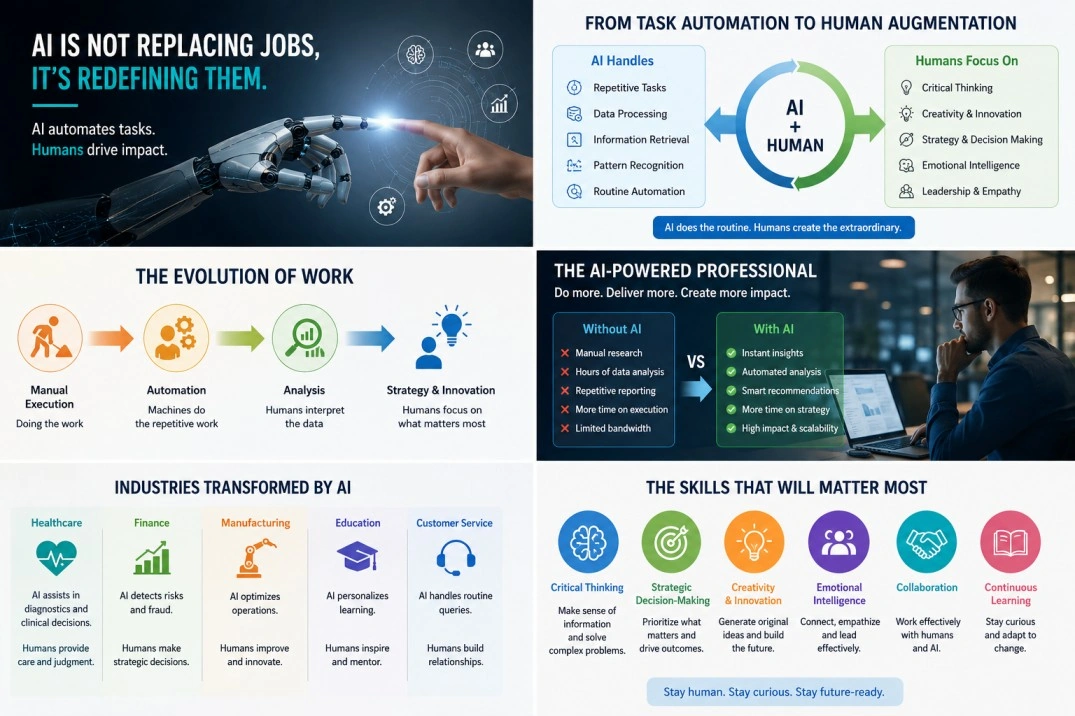
History teaches us that every major technological breakthrough changes jobs far more often than it eliminates them. AI is following the same pattern. Rather than replacing entire professions, it's automating repetitive tasks, augmenting human capabilities, and creating opportunities for professionals to focus on higher-value work.
In this article, we'll explore how AI is reshaping careers across industries, the skills that will define the future workforce, and why professionals who embrace AI will have a significant advantage.
Every Technological Revolution Has Changed Work
Whenever a transformative technology emerges, fear follows.
During the Industrial Revolution, machines were expected to replace factory workers.
When computers entered offices, many believed administrative jobs would disappear.
The rise of the Internet sparked concerns that traditional businesses and professions would become obsolete.
Yet history tells a different story.
Technology rarely eliminates human work entirely—it changes how work gets done.
AI is simply the next chapter in that evolution.
Jobs Are Made of Tasks—Not a Single Responsibility
One of the biggest misconceptions about AI is that it replaces entire jobs.
In reality, most jobs are made up of dozens of individual tasks.
For example, a Product Manager doesn't just write requirements. They also:
Research customer needs
Prioritize features
Communicate with stakeholders
Analyze market trends
Define product strategy
Collaborate with engineering teams
Make business decisions
AI can automate or accelerate some of these activities, but it cannot replace the strategic thinking, leadership, and judgment required to perform the role successfully.
The same pattern exists across nearly every profession.
AI replaces tasks—not people.
The Shift from Automation to Augmentation
The real power of AI isn't replacing humans—it's amplifying human productivity.
Think of AI as a highly capable digital assistant that excels at:
Processing massive amounts of data
Finding patterns
Summarizing information
Generating first drafts
Automating repetitive workflows
Meanwhile, humans continue to provide:
Creativity
Critical thinking
Contextual decision-making
Emotional intelligence
Leadership
Ethical judgment
Innovation
This combination creates what many organizations now call the Human + AI Collaboration Model.
Instead of asking:
"Can AI do this?"
Organizations are increasingly asking:
"How can AI help our people do this better?"
How AI Is Transforming Different Professions
👨💻 Software Development
Software development has changed dramatically over the last few years.
Developers now use AI to:
Generate code snippets
Explain unfamiliar code
Detect bugs
Write unit tests
Create documentation
Suggest code improvements
But developers are still responsible for:
System architecture
Security
Performance optimization
Business logic
Software design
Technical leadership
The role is evolving from writing every line of code to designing intelligent systems.
📊 Product Management
Product Managers are increasingly relying on AI throughout the product lifecycle.
AI can help with:
Customer feedback analysis
Requirement gathering
User Story generation
PRD creation
Roadmap planning
Release notes
Product analytics
Meeting summaries
However, AI cannot replace:
Customer empathy
Product vision
Strategic prioritization
Business trade-offs
Cross-functional leadership
Great Product Managers use AI to eliminate repetitive work while spending more time solving customer problems.
📣 Marketing
Marketing professionals have quickly adopted AI to improve productivity.
AI assists with:
Content creation
Campaign optimization
Audience segmentation
Keyword research
SEO recommendations
Performance analysis
Human marketers continue to focus on:
Brand positioning
Creative storytelling
Customer relationships
Innovation
Market strategy
The outcome isn't fewer marketers.
It's more effective marketers.
🎧 Customer Service
Customer support has become one of the clearest examples of Human-AI collaboration.
AI-powered assistants now handle:
Frequently asked questions
Ticket categorization
Knowledge-base searches
Routine customer queries
Initial troubleshooting
Human agents focus on:
Complex issues
Escalations
Emotional conversations
Customer retention
Relationship building
Customers receive faster responses while support professionals can dedicate more attention to situations where human judgment matters most.
🏥 Healthcare
Healthcare professionals are using AI to improve patient outcomes—not replace doctors.
AI assists with:
Medical imaging analysis
Disease prediction
Clinical documentation
Drug discovery
Risk assessment
Doctors remain responsible for:
Diagnoses
Treatment planning
Ethical decisions
Patient communication
Clinical expertise
Technology enhances healthcare professionals—it doesn't replace them.
💰 Finance
Financial institutions increasingly rely on AI for:
Fraud detection
Credit risk analysis
Investment modeling
Compliance monitoring
Predictive analytics
Financial professionals continue to provide:
Strategic planning
Regulatory expertise
Client advisory services
Investment decisions
Relationship management
🏭 Manufacturing
Modern manufacturing combines automation with human expertise.
AI helps with:
Predictive maintenance
Quality control
Demand forecasting
Inventory optimization
Supply chain visibility
Human workers increasingly manage, optimize, and improve intelligent systems rather than performing repetitive manual work.
🎓 Education
Education is also evolving through AI.
Teachers now use AI for:
Personalized learning
Automated assessments
Lesson planning
Student performance analysis
Content generation
Teachers continue to provide:
Mentorship
Motivation
Classroom leadership
Emotional support
Critical thinking development
Learning becomes more personalized without losing the human connection.
The Rise of the AI-Powered Professional
Imagine two business analysts.
Analyst A
Collects data manually
Reads every report
Creates presentations from scratch
Summarizes meetings manually
Analyst B
Uses AI to:
Summarize reports
Analyze trends
Build dashboards
Draft presentations
Automate repetitive analysis
Both possess similar business knowledge.
The difference?
Analyst B spends significantly more time generating insights instead of preparing information.
That's the competitive advantage AI creates.
The future belongs to professionals whose expertise is amplified by AI.
The Skills That Will Matter Most in the AI Era
As AI handles more routine work, organizations are placing greater value on uniquely human capabilities.
The most important skills include:
🧠 Critical Thinking
AI provides answers.
Humans decide whether those answers make sense.
🎯 Strategic Decision-Making
Business priorities, customer needs, and long-term vision still require human judgment.
💡 Creativity
Original ideas, innovation, and product vision remain difficult for AI to replicate.
❤️ Emotional Intelligence
Empathy, communication, negotiation, and leadership become even more valuable.
🤝 Collaboration
Future workplaces will require professionals who collaborate effectively with both people and AI systems.
📚 Continuous Learning
AI evolves rapidly.
The professionals who keep learning will continue to thrive.
The Real Risk Isn't AI
Many professionals fear AI will replace them.
History suggests something different.
Technology rarely replaces people who evolve alongside it.
Instead, it replaces outdated processes and inefficient ways of working.
The greatest career risk today isn't AI.
It's refusing to adapt.
Those who continuously learn, experiment, and integrate AI into their workflows will remain valuable regardless of how technology evolves.
Practical Steps to Stay Relevant
If you're wondering where to start, focus on these actions:
Learn how AI tools can support your current role.
Automate repetitive, low-value tasks.
Strengthen skills that AI cannot easily replicate, such as communication, leadership, and strategic thinking.
Stay curious and experiment with new AI technologies.
View AI as a collaborator, not a competitor.
Small, consistent improvements in AI literacy can compound into a significant professional advantage over time.
Conclusion
Artificial Intelligence is not the end of human work.
It marks the beginning of a new era of Human-AI collaboration.
Organizations that use AI to augment their workforce—not replace it—will unlock greater productivity, innovation, and competitive advantage.
Likewise, professionals who combine AI literacy with uniquely human skills will be better positioned for long-term success.
The future of work won't be defined by Humans vs. AI.
It will be defined by Humans working with AI.
And that distinction changes everything.
Join the Conversation
How has AI changed the way you work?
Which AI tools have become part of your daily workflow?
What tasks has AI helped you automate?
Which human skills do you believe will become even more valuable in the AI era?
Share your thoughts and experiences in the comments. Let's learn from each other and shape the future of work together.

Join the conversation! Your thoughts help the community grow.