
Introduction
In Accounting and Financial Management, a critical disconnect exists between how stakeholders ask questions and how financial data is structured. A CFO might ask, "Why are our margins squeezing?" while the underlying ERP data only contains GL codes like 6200-COGS and metadata tags like variance_unfavorable. Standard RAG systems fail here because vector similarity matches keywords, not business intent. To solve this, enterprises must treat historical analyst commentary ("review text") and enriched ledger descriptions as an intent alignment layer. This article demonstrates how to operationalize these unstructured assets to bridge the semantic gap. We provide a complete end-to-end implementation using LangGraph and Chroma, featuring a multi-agent architecture where a dedicated "Intent Alignment Agent" dynamically maps natural language queries to precise financial structures before retrieval, ensuring that variance analysis, audit inquiries, and management reporting return contextually accurate results rather than keyword-matched noise.
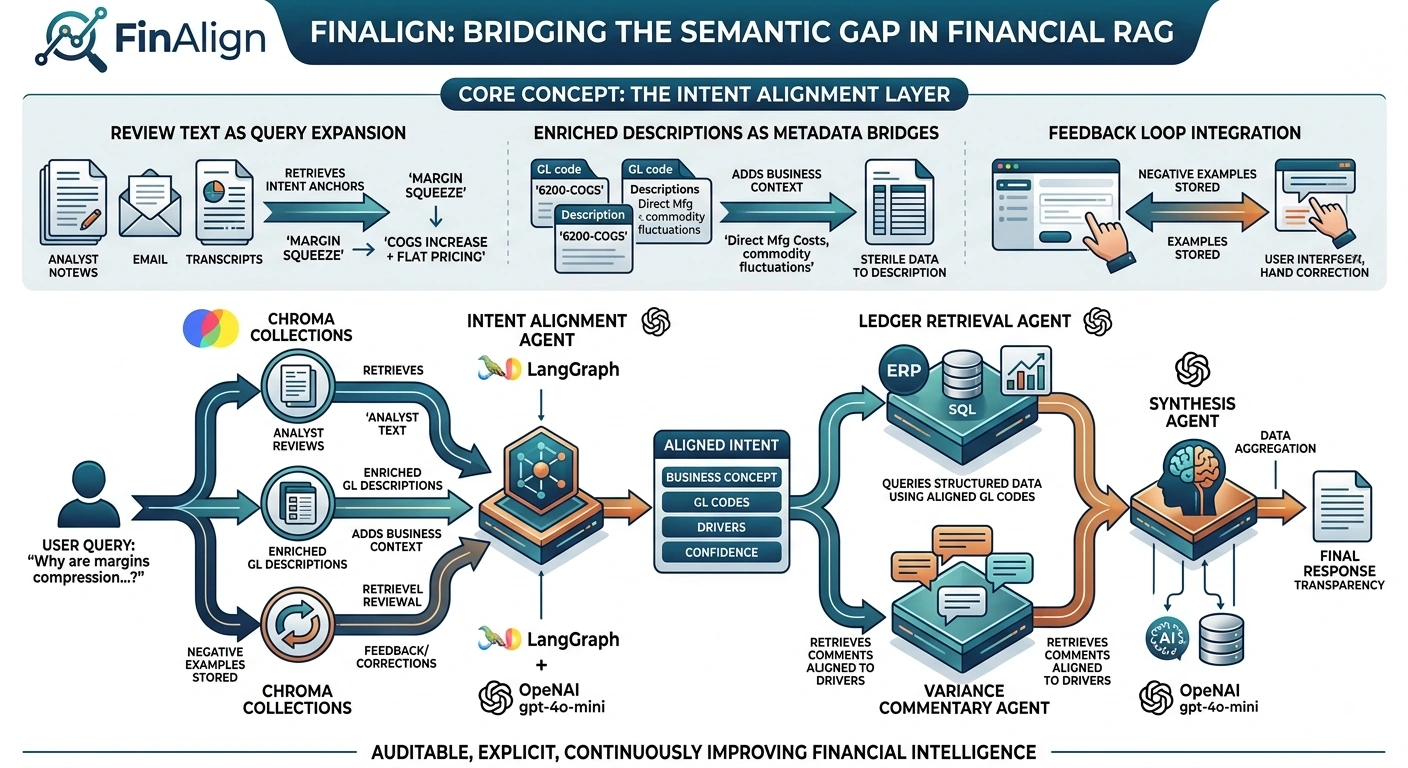
Core Concept: The Intent Alignment Layer
Before diving into code, it is essential to understand how review text and descriptions drive alignment:
Review Text as Query Expansion: Historical analyst notes (e.g., Q3 earnings call transcripts, variance commentary emails) contain the exact phrasing humans use to describe financial phenomena. These are embedded alongside structured data to create "semantic anchors." When a user asks about "margin squeeze," the system retrieves the analyst note explaining that margin squeeze = COGS increase + flat pricing, then uses those terms to query the structured ledger.
Enriched Descriptions as Metadata Bridges: Raw GL descriptions (
6200 - Cost of Goods Sold) are insufficient. Enriched descriptions add business context:"6200-COGS: Direct manufacturing costs including raw materials, direct labor, and factory overhead. Variance driver: commodity price fluctuations."This enrichment is stored as both embedding text AND structured metadata, enabling hybrid search that understands both the accounting term and the business phenomenon.Feedback Loop Integration: When analysts correct agent responses (e.g., "No, I meant operating margin, not gross margin"), these corrections are stored as negative examples in a separate collection. The Intent Alignment Agent consults this collection to avoid repeating misalignments.
End-to-End Implementation: "FinAlign" – Intent-Aware Financial Analysis Platform
Use Case Scenario
A regional manufacturing CFO asks during monthly review: "What's driving the margin compression in our Industrial division this quarter compared to budget?"
This requires:
Intent Alignment Agent: Maps "margin compression" →
{gross_margin_variance, cogs_overrun, pricing_shortfall}using historical review text.Ledger Retrieval Agent: Queries actuals vs. budget with aligned GL codes and division filters.
Variance Commentary Agent: Retrieves relevant analyst notes and prior-period explanations.
Synthesis Agent: Combines quantitative data with qualitative context, citing sources.
Architecture Diagram
Step 1: Define Financial State with Intent Alignment Fields
from typing import Annotated, TypedDict, Literalfrom langgraph.graph.message import add_messages
from pydantic import BaseModel, Field

class AlignedIntent(BaseModel):
    """Structured output from intent alignment"""
    business_concept: str = Field(description="Mapped financial concept")
    gl_codes: list[str] = Field(description="Relevant GL account codes")
    variance_drivers: list[str] = Field(description="Known drivers from review text")
    confidence: float = Field(ge=0.0, le=1.0)

class FinancialAnalysisState(TypedDict):
    messages: Annotated[list, add_messages]
    division: str | None
    fiscal_period: str | None
    aligned_intent: AlignedIntent | None
    ledger_data: list[dict] | None
    review_excerpts: list[str] | None
    feedback_warnings: list[str] | None  # Past corrections to avoid
    final_response: str | None
Step 2: Configure Chroma Collections for Intent Alignment
import chromadb
from langchain_chroma import Chroma
from langchain_openai import OpenAIEmbeddings

client = chromadb.PersistentClient(path="./chroma_fin_align")

# Collection 1: Analyst Review Text (intent anchors)
review_collection = client.get_or_create_collection(
    name="analyst_reviews_v2025Q3",
    metadata={"hnsw:M": 32, "content_type": "commentary"}
)

# Collection 2: Enriched GL Descriptions (semantic bridge)
gl_desc_collection = client.get_or_create_collection(
    name="enriched_gl_descriptions",
    metadata={"hnsw:M": 48, "content_type": "chart_of_accounts"}
)

# Collection 3: Feedback/Corrections (negative alignment)
feedback_collection = client.get_or_create_collection(
    name="analyst_feedback",
    metadata={"hnsw:M": 16, "content_type": "corrections"}
)

review_store = Chroma(client=client, collection_name="analyst_reviews_v2025Q3",
                      embedding_function=OpenAIEmbeddings(model="text-embedding-3-small"))
gl_desc_store = Chroma(client=client, collection_name="enriched_gl_descriptions",
                       embedding_function=OpenAIEmbeddings(model="text-embedding-3-small"))
feedback_store = Chroma(client=client, collection_name="analyst_feedback",
                        embedding_function=OpenAIEmbeddings(model="text-embedding-3-small"))
Step 3: Implement the Intent Alignment Agent
This is the core innovation — it uses review text and descriptions to translate business language into financial structure before any ledger query occurs.
from langchain_openai import ChatOpenAI
from langchain_core.messages import SystemMessage, HumanMessage

llm = ChatOpenAI(model="gpt-4o-mini", temperature=0)

async def intent_alignment_agent(state: FinancialAnalysisState) -> dict:
    """Maps natural language to financial structure using reviews + GL descriptions"""
    query = state["messages"][-1].content

    # 1. Retrieve relevant analyst review excerpts (intent anchors)
    reviews = review_store.similarity_search(query=query, k=5)
    review_context = "\n---\n".join([r.page_content for r in reviews])

    # 2. Retrieve enriched GL descriptions matching the concept
    gl_matches = gl_desc_store.similarity_search(query=query, k=8)
    gl_context = "\n".join([
        f"[{r.metadata['gl_code']}] {r.page_content}" for r in gl_matches
    ])

    # 3. Check feedback history for known misalignments to avoid
    warnings = feedback_store.similarity_search(query=query, k=3)
    feedback_warnings = [w.page_content for w in warnings
                         if w.metadata.get("correction_type") == "intent_mismatch"]

    # 4. LLM synthesizes alignment using all three signals
    alignment_prompt = f"""You are a financial intent alignment specialist.

USER QUERY: {query}

ANALYST REVIEW EXCERPTS (show how humans describe this concept):
{review_context}

ENRICHED GL DESCRIPTIONS (structured financial mapping):
{gl_context}

KNOWN MISALIGNMENTS TO AVOID (from past corrections):
{chr(10).join(feedback_warnings) if feedback_warnings else "None"}

Map the user's business language to precise financial structure.
Return JSON matching the AlignedIntent schema."""

    response = await llm.with_structured_output(AlignedIntent).ainvoke([
        SystemMessage(content=alignment_prompt),
        HumanMessage(content=query)
    ])

    return {
        "aligned_intent": response,
        "feedback_warnings": feedback_warnings,
        "review_excerpts": [r.page_content for r in reviews[:3]]
    }
Step 4: Ledger & Commentary Agents Using Aligned Intent
async def ledger_retrieval_agent(state: FinancialAnalysisState) -> dict:
    """Queries structured data using aligned GL codes, NOT raw query"""
    intent = state.get("aligned_intent")
    if not intent or not intent.gl_codes:
        return {"ledger_data": []}

    # Use aligned GL codes for precise metadata-filtered retrieval
    # In production: this would be a SQL/API call to ERP using the GL codes
    mock_ledger = [
        {"gl_code": "6200", "account": "COGS - Raw Materials",
         "actual": 2450000, "budget": 2200000, "variance_pct": 11.4},
        {"gl_code": "6210", "account": "COGS - Direct Labor",
         "actual": 1850000, "budget": 1900000, "variance_pct": -2.6},
    ]
    return {"ledger_data": mock_ledger}

async def variance_commentary_agent(state: FinancialAnalysisState) -> dict:
    """Retrieves temporal commentary aligned to identified variance drivers"""
    intent = state.get("aligned_intent")
    drivers = intent.variance_drivers if intent else []

    # Search reviews specifically for identified drivers
    driver_queries = [f"{driver} variance explanation" for driver in drivers]
    all_excerpts = []
    for dq in driver_queries:
        results = review_store.similarity_search(query=dq, k=3,
                                                  filter={"period": "2025-Q3"})
        all_excerpts.extend([r.page_content for r in results])

    return {"review_excerpts": state.get("review_excerpts", []) + all_excerpts}

async def synthesis_agent(state: FinancialAnalysisState) -> dict:
    """Generates response with intent alignment transparency"""
    intent = state.get("aligned_intent")
    system_prompt = f"""You are FinAlign, a financial analysis assistant.

ALIGNED INTENT: {intent.business_concept if intent else 'UNMAPPED'}
GL CODES USED: {intent.gl_codes if intent else []}
VARIANCE DRIVERS IDENTIFIED: {intent.variance_drivers if intent else []}
LEDGER DATA: {state.get('ledger_data', [])}
REVIEW EXCERPTS: {state.get('review_excerpts', [])}
FEEDBACK WARNINGS: {state.get('feedback_warnings', [])}

RULES:
1. Begin by stating how you interpreted the query (intent alignment transparency).
2. Present quantitative findings BEFORE qualitative commentary.
3. Cite specific GL codes and review excerpt sources.
4. If confidence < 0.7, explicitly state uncertainty and suggest clarification.
5. Never present aligned intent as fact — frame it as interpretation."""

    response = await llm.ainvoke([
        SystemMessage(content=system_prompt),
        *state["messages"]
    ])
    return {"final_response": response.content, "messages": [response]}
Step 5: Build LangGraph Workflow with Feedback Capture
from langgraph.graph import StateGraph, START, END
from langgraph.checkpoint.postgres import PostgresSaver

workflow = StateGraph(FinancialAnalysisState)

workflow.add_node("intent_alignment", intent_alignment_agent)
workflow.add_node("ledger_retrieval", ledger_retrieval_agent)
workflow.add_node("variance_commentary", variance_commentary_agent)
workflow.add_node("synthesis", synthesis_agent)

workflow.add_edge(START, "intent_alignment")
workflow.add_edge("intent_alignment", "ledger_retrieval")
workflow.add_edge("intent_alignment", "variance_commentary")  # Parallel execution
workflow.add_edge("ledger_retrieval", "synthesis")
workflow.add_edge("variance_commentary", "synthesis")
workflow.add_edge("synthesis", END)

checkpointer = PostgresSaver.from_conn_string("postgresql://fin_align:***@localhost:5432/finalign")
app = workflow.compile(checkpointer=checkpointer)
Step 6: Execute with Feedback Loop Demonstration
import asyncio

async def demo():
    config = {"configurable": {"thread_id": "cfo-session-2025Q3-industrial"}}

    # Turn 1: Natural language query requiring intent alignment
    result = await app.ainvoke({
        "messages": [HumanMessage(
            content="What's driving margin compression in Industrial division Q3 vs budget?"
        )],
        "division": "Industrial",
        "fiscal_period": "2025-Q3"
    }, config=config)

    print(f" Response:\n{result['final_response']}\n")
    print(f" Aligned Intent: {result['aligned_intent']}")
    print(f" Feedback Warnings Checked: {len(result.get('feedback_warnings', []))}")

    # Turn 2: Analyst provides correction → captured for future alignment
    correction = await app.ainvoke({
        "messages": [HumanMessage(
            content="Correction: I meant operating margin, not gross margin. "
                    "Include SG&A allocation variances."
        )]
    }, config=config)

    # In production: store this correction in feedback_collection
    # feedback_store.add(documents=[correction_msg],
    #                    metadatas=[{"correction_type": "intent_mismatch",
    #                               "original_intent": "gross_margin",
    #                               "corrected_intent": "operating_margin"}])
    print(f"\n Correction captured for future intent alignment")

asyncio.run(demo())
Key Enterprise Takeaways
| Technique | Purpose in Financial RAG | Implementation Detail |
|---|---|---|
| Review Text as Intent Anchors | Bridges business language ↔ accounting structure | Embedded analyst commentary retrieved before ledger query |
| Enriched GL Descriptions | Adds business context to sterile chart of accounts | Stored as both embedding text AND structured metadata |
| Feedback Collection | Prevents repeated misalignments | Negative examples consulted during alignment phase |
| Structured Intent Output | Forces explicit mapping before retrieval | Pydantic model with confidence score enables routing logic |
| Alignment Transparency | Builds trust with financial professionals | Synthesis prompt requires stating interpretation upfront |
| Parallel Agent Execution | Reduces latency for complex analyses | Ledger + commentary agents run concurrently after alignment |
| Postgres-Backed Memory | Maintains session context across multi-turn analysis | Audit-compliant persistence for regulatory review |
Conclusion
Intent alignment is the missing layer in financial RAG systems. By treating analyst review text as semantic anchors and enriched ledger descriptions as structural bridges, organizations can transform vague business questions into precise financial queries without requiring users to learn GL codes or accounting terminology. The multi-agent architecture demonstrated here makes this alignment explicit, auditable, and continuously improving through feedback capture. For accounting and financial management teams deploying AI, this approach moves beyond keyword matching toward genuine business understanding delivering insights that are not just retrieved, but correctly interpreted. The investment in building and maintaining these alignment layers pays compounding returns as the system learns the organization’s unique financial dialect and evolves alongside its chart of accounts, reporting standards, and analytical conventions.

Join the conversation! Your thoughts help the community grow.