
by John Gödel
Abstract
The increasing digitization of healthcare records creates an opportunity to develop mobile applications that simplify the capture, processing, organization, and management of existing medical imaging materials. MRI images and X-ray films are frequently exchanged between healthcare facilities, physicians, diagnostic centers, and patients in both digital and physical formats. Managing these materials efficiently requires more than a conventional mobile camera application. It requires a secure, intelligent, and professionally governed platform capable of preserving image integrity, maintaining patient associations, supporting interoperability, and assisting healthcare professionals.
This article explores how Gate2Asi AI's (Formerly AlpineGate AI) AgentFactory, GSCP-15 (Gödel's Scaffolded Cognitive Prompting), and PT-SLM (Private Tailored Small Language Model) can be combined to build a professional Mobile MRI and X-Ray Imaging Management Application. The proposed application is designed to capture existing MRI images and X-ray films using smartphones and tablets, digitize physical films, enhance image presentation, organize patient imaging records, and provide specialized AI-assisted workflows. It does not perform MRI examinations or generate X-ray exposures. Its purpose is to process and manage images produced by existing medical imaging equipment.
AgentFactory provides the Digital Workforce and software development orchestration capabilities, GSCP-15 establishes cognitive governance and controlled execution, and PT-SLMs provide specialized intelligence for image intake, image-quality assessment, documentation, workflow management, and healthcare information assistance. Their integration creates an architectural foundation for developing scalable healthcare applications that combine specialized intelligence with professional accountability, security, and human oversight.
The article also examines mobile imaging workflows, DICOM and PACS interoperability, healthcare security, regulatory considerations, implementation phases, and commercial opportunities.
Keywords: AgentFactory, GSCP-15, PT-SLM, Mobile Healthcare, MRI Digitization, X-Ray Film Digitization, Medical Imaging, Digital Workforce, Artificial Intelligence, Healthcare Interoperability, DICOM, PACS.
1. Introduction
Healthcare is increasingly moving toward mobile, connected, and intelligent digital workflows. Medical professionals need faster and more convenient ways to digitize, organize, access, review, manage, and share medical imaging records. MRI images and X-ray films are particularly important because they frequently exist in different formats, including digital image files, printed films, scanned documents, CDs, and images captured from existing imaging systems.
A new generation of mobile healthcare applications can address this challenge by combining mobile imaging technology, artificial intelligence, specialized digital intelligence, and enterprise-grade governance.
AgentFactory, GSCP-15, and PT-SLM provide a powerful architectural foundation for building such an application.
The proposed solution is a professional Mobile MRI and X-Ray Imaging Management Platform. Its purpose is not to perform MRI examinations, generate X-ray exposures, or replace medical imaging equipment. Instead, it focuses on capturing and digitizing existing MRI images and X-ray films using a mobile device, processing those images, organizing patient imaging records, supporting authorized clinical review, and providing intelligent assistance to healthcare professionals.
This distinction is fundamental: the application operates on existing medical images rather than performing the medical imaging examination itself.
The combination of these three technologies creates an architecture in which AgentFactory manages the Digital Workforce and application development lifecycle, GSCP-15 governs intelligence and operational execution, and PT-SLMs provide specialized, private, domain-specific intelligence.
Together, they can support the development of a scalable, secure, maintainable, and professionally governed healthcare application.
2. The Application Concept: Mobile MRI and X-Ray Digitization
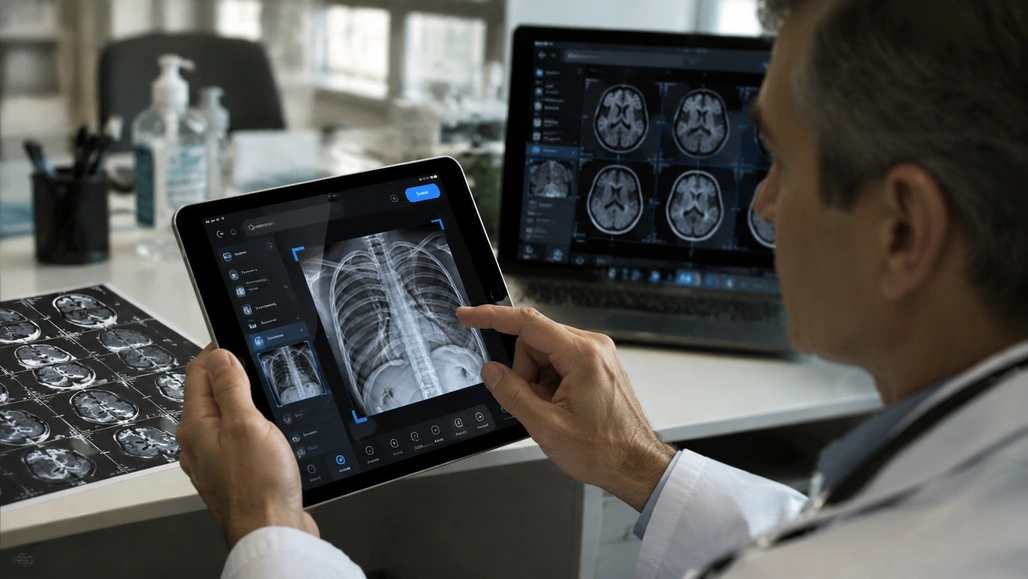
The application would allow an authorized healthcare professional to use a smartphone or tablet to capture an existing MRI image or X-ray film.
For example, a clinic might receive an X-ray film from another medical facility, while a patient might bring printed MRI images from an earlier examination. Instead of relying on manual photography, disconnected storage, or paper-based recordkeeping, the application would provide a structured process for digitizing and managing these images.
2.1 Mobile Image Acquisition
The mobile application would use the device camera to capture existing X-ray films and MRI images. It would also support importing existing digital imaging files from device storage and receiving images from authorized external systems.
The capture experience should guide users toward appropriate lighting, camera positioning, focus, and image alignment. Computer vision capabilities could automatically identify the imaging area, detect film boundaries, correct perspective distortion, and assess whether the image is sufficiently clear for its intended use.
Particular attention should be given to glare, reflections, blur, uneven illumination, and incomplete image capture. Rather than accepting every photograph, the application should provide immediate feedback and request a new capture when the image quality is inadequate.
2.2 Image Enhancement and Processing
Once an image has been captured, the application can perform controlled image-processing operations, including perspective correction, rotation, geometric alignment, cropping, contrast adjustment, noise reduction, sharpening, and individual image extraction from multi-image films.
The original captured image must remain preserved. Enhanced versions should be stored as separate derived images, with processing parameters, timestamps, and provenance maintained for traceability.
This is especially important in medical imaging because enhancement must not silently introduce misleading information or change the clinical meaning of an image.
2.3 Patient and Examination Management
Each imaging record should be associated with an appropriately verified patient and examination. The application would maintain patient identification, examination date, imaging modality, anatomical region, referring healthcare professional, healthcare facility, original imaging source, and associated image collections.
It should also maintain processing history, authorized review history, clinical notes, reports, and relevant attachments.
This creates a structured medical imaging record rather than simply storing photographs in a mobile device gallery.
2.4 Clinical Image Viewing
Healthcare professionals could use the application to view captured or imported imaging records. The viewing experience could include zooming, panning, image rotation, brightness and contrast controls, side-by-side comparison, examination history, multiple image series, and authorized annotations.
Additional capabilities could include measurement tools where clinically validated, secure image sharing, and the generation of structured imaging reports.
The interface should be designed around the requirements of radiologists, physicians, imaging technicians, clinics, and diagnostic centers.
3. AgentFactory: Building the Application Through a Governed Digital Workforce
AgentFactory provides the development and operational orchestration environment for creating the application.
Rather than depending entirely on a conventional development team in which every task is performed manually, AgentFactory can organize specialized Digital Professionals into a coordinated Digital POD (Professional Operating Division).
Each professional has a defined responsibility, skills, knowledge, permitted tools, operational boundaries, and deliverable requirements.
For this application, AgentFactory could coordinate a multidisciplinary team consisting of a Product Manager, Business Analyst, Healthcare Domain Specialist, Solution Architect, UX/UI Designer, Mobile Developer, Backend Developer, Imaging Processing Specialist, AI Engineer, Database Developer, Security Engineer, QA Engineer, Compliance Specialist, and DevOps Engineer.
The Product Manager would establish the product vision and delivery roadmap, while the Business Analyst would translate healthcare workflows into functional and technical requirements. The Solution Architect would define the overall application architecture and integration boundaries.
The Mobile Developer would implement camera acquisition and the mobile user experience. The Imaging Processing Specialist would develop image correction and enhancement capabilities, while the AI Engineer would integrate the appropriate intelligence services. Database and Backend Developers would implement patient records, examination management, image storage, and application APIs.
Security, QA, and compliance professionals would provide independent oversight of security requirements, functionality, image integrity, operational reliability, and regulatory considerations.
3.1 Coordinated Development and Delivery
AgentFactory can coordinate these professionals through governed Work Orders. For example, the Business Analyst can define requirements for mobile film capture, the Solution Architect can establish the imaging pipeline, and the Mobile Developer can implement the capture interface.
The Imaging Processing Specialist can then implement image-correction workflows, while the Security Engineer establishes access boundaries and QA validates the resulting application.
The important distinction is that AgentFactory does not simply generate source code. It manages responsibilities, dependencies, validation, approvals, deliverables, and controlled improvements throughout the application lifecycle.
AgentFactory can also support iterative development. The initial application can be divided into manageable Work Orders covering mobile capture, image processing, patient management, secure storage, AI assistance, reporting, and external integrations.
Each Work Order can have defined acceptance criteria, required artifacts, and independent validation. Defects can be addressed through controlled repair cycles, with approvals required before changes are promoted.
This approach is particularly valuable in healthcare because a successful software build does not automatically mean that the application is safe, clinically appropriate, or ready for deployment.
4. GSCP-15: Governing Intelligence, Imaging Workflows and Clinical Boundaries
GSCP-15 (Gödel's Scaffolded Cognitive Prompting) provides the cognitive governance framework for the application.
It establishes how specialized intelligence should interpret a task, identify relevant evidence, respect constraints, use authorized tools, validate results, and handle uncertainty.
In a medical imaging application, this distinction is extremely important.
An AI system may be capable of describing an image, identifying an anatomical structure, or suggesting that an image has poor quality. However, capability does not automatically grant permission to make a clinical diagnosis or recommend treatment.
GSCP-15 provides a framework for maintaining these boundaries.
4.1 Applying GSCP-15 to Medical Image Workflows
Consider a healthcare professional capturing an existing X-ray film. The application first receives the image and establishes the examination context. It then determines which operations are authorized, such as image correction, digitization, quality assessment, storage, and preparation for professional review.
The system collects relevant image metadata, capture information, patient association, and examination context. Authorized image-processing functions perform perspective correction, cropping, rotation, contrast adjustment, and other validated transformations.
The resulting image is then evaluated for quality and completeness. If the capture contains excessive glare, blur, or missing information, the application can request a new photograph rather than allowing a potentially inadequate image to proceed unnoticed.
The appropriate PT-SLM can subsequently receive the task and permitted information. Its output is evaluated against the applicable workflow requirements, and the application checks image integrity, processing provenance, metadata consistency, and output completeness.
Finally, an authorized healthcare professional reviews the result and makes decisions within their professional responsibilities. Once approved, the imaging record is stored and made accessible according to organizational permissions.
4.2 Why Cognitive Governance Matters
Without governance, AI-driven imaging applications can introduce risks such as incorrect patient-to-image associations, unrecorded image modifications, unsupported image interpretations, unauthorized access to medical records, and inconsistent AI-generated recommendations.
There is also a fundamental difference between enhancing an image and interpreting a medical condition. These activities must not be confused.
GSCP-15 makes it possible to establish explicit boundaries between image acquisition, image processing, information extraction, clinical interpretation, and authorized human decisions.
It also supports an auditable history of what was received, what was processed, which intelligence was used, what was validated, and who approved the resulting record.
Its broader governance framework can be applied to alternative evaluation, execution controls, exception handling, telemetry, organizational learning, and session continuity.
5. PT-SLM: Creating Specialized Medical Imaging Intelligence
PT-SLM stands for Private Tailored Small Language Model.
Within the AgentFactory architecture, a PT-SLM is more than a general-purpose language model with a different prompt. It represents a specialized Digital Professional with its own professional identity, domain knowledge, skills, permissions, memory, tools, and governance boundaries.
The underlying model does not necessarily need to be independently trained from scratch. Specialization can be established through controlled instructions, private knowledge, retrieval, adapters, evaluation, and governed learning.
For the proposed mobile application, multiple PT-SLM professionals could provide distinct capabilities.
5.1 Medical Imaging Intake PT-SLM
The Medical Imaging Intake professional would manage incoming imaging materials. It could identify whether submitted material is an MRI image, X-ray film, or another supported imaging format, organize image collections, extract available examination information, and identify missing metadata.
It could also assist with patient and examination record association while flagging inconsistencies for human verification.
5.2 Image Quality PT-SLM
The Image Quality professional would focus on the technical quality of captured images. It could evaluate blur, glare, reflections, incomplete capture, and other image-quality limitations.
Rather than merely accepting or rejecting an image, it could explain why the capture may be inadequate and recommend corrective actions such as changing the camera angle, adjusting lighting, or retaking the photograph.
Its responsibility would be to assess capture quality, not to determine whether a medical condition exists.
5.3 Imaging Workflow PT-SLM
The Imaging Workflow professional would organize images by examination, anatomical region, and imaging series. It could assist with examination documentation, identify potentially related images, maintain consistent terminology, and prepare structured examination summaries.
This would reduce administrative effort and help healthcare professionals manage imaging records more consistently.
5.4 Medical Imaging Knowledge PT-SLM
The Medical Imaging Knowledge professional would provide access to approved technical knowledge about MRI and X-ray imaging, common terminology, institutional procedures, and relevant imaging documentation.
It could assist healthcare professionals in understanding technical information while recognizing when a question requires qualified clinical judgment.
5.5 Clinical Documentation PT-SLM
The Clinical Documentation professional would prepare structured examination records, organize healthcare professional notes, draft administrative and technical summaries, and produce reports for professional review.
It should maintain traceability between original source images, derived images, and generated documentation.
5.6 Privacy and Compliance PT-SLM
The Privacy and Compliance professional would support access-policy checks, identify potentially inappropriate disclosures, assist with audit documentation, and flag possible policy violations.
It would operate within the organization's established security policies rather than independently granting access or changing permissions.
5.7 Medical Imaging Integration PT-SLM
The Integration professional would assist with DICOM metadata, image transfers, PACS connectivity, healthcare-system interoperability, and data exchange validation.
It could help identify missing metadata, integration failures, and inconsistencies between external systems and the mobile application.
5.8 The Value of Specialization
A single general-purpose AI model attempting to perform every function creates unnecessary complexity.
A specialized PT-SLM architecture separates responsibilities and reduces role confusion. The Image Quality professional should not independently authorize clinical diagnoses. The Privacy professional should not modify patient records without permission. The Documentation professional should not silently alter original imaging data.
Each professional operates within a defined capability and authority envelope.
This makes the overall application more predictable, manageable, and auditable.
6. The Combined Architecture: How the Three Technologies Work Together
The real opportunity emerges when AgentFactory, GSCP-15, and PT-SLM operate as one integrated architecture.
AgentFactory provides the Digital Workforce and orchestration layer. GSCP-15 provides the cognitive governance and execution framework. PT-SLMs provide the specialized intelligence required by individual application functions.
The mobile application sits above these capabilities, providing the interface through which healthcare professionals interact with the platform.
The underlying architecture would include a mobile application layer, an API and application-services layer, an imaging-processing layer, a specialized intelligence layer, a governance and orchestration layer, and a secure data and interoperability layer.
These components should communicate through authenticated, documented interfaces rather than relying on uncontrolled direct access to patient information.
6.1 Mobile Application Layer
The mobile application would provide camera capture, image import, patient and examination selection, image previews, image-quality feedback, and secure access to previously stored imaging records.
It should support modern smartphones and tablets, with a responsive interface that adapts to different screen sizes.
6.2 Imaging-Processing Layer
This layer would perform image acquisition, image correction, enhancement, segmentation, quality assessment, and conversion into supported formats.
It would preserve original source images and maintain separate derived versions, including processing metadata.
6.3 Intelligence and Governance Layer
This layer would integrate the specialized PT-SLM professionals and apply GSCP-15 governance to their activities.
The application would determine which professional is appropriate for a given task, what information can be provided, which tools may be used, and what verification or human approval is required.
6.4 Data and Interoperability Layer
This layer would maintain patient records, examination metadata, imaging files, reports, audit information, and access permissions.
It would also provide integration with external healthcare systems through supported interoperability standards.
6.5 Architectural Overview
The architecture can be represented as a sequence of interconnected capabilities:
Mobile Healthcare Application
Capture, Import, View, Organize, Review and Share
↓
Application Services and Imaging Pipeline
Image Processing, Quality Assessment, Metadata and Patient Records
↓
GSCP-15 Cognitive Governance
Task Definition, Evidence, Permissions, Verification and Escalation
↓
Specialized PT-SLM Digital Professionals
Intake, Image Quality, Workflow, Knowledge, Documentation, Privacy and Integration
↓
AgentFactory Digital Workforce and Orchestration
Work Orders, Professional Responsibilities, Development, Validation, Approvals and Continuous Improvement
↓
Secure Healthcare Data and External Systems
DICOM, PACS, RIS, EHR, Secure Image Storage and Audit Records
The architecture is modular. Individual components can evolve without requiring the entire platform to be redesigned.
7. DICOM, PACS and Healthcare Interoperability
A professional medical imaging application should not be designed as an isolated image-storage system.
Healthcare organizations already use established imaging and information systems. The proposed platform should therefore support integration with appropriate healthcare standards and existing infrastructure.
DICOM (Digital Imaging and Communications in Medicine) is particularly important because it provides a standardized approach to medical imaging data, including image representation, metadata, and communication.
The application should support importing and exporting compatible DICOM objects and preserving relevant patient, examination, series, and image identifiers.
For printed MRI and X-ray films captured through a mobile camera, the application must distinguish between the original digital DICOM image and a photographic digitization of a film. A photograph should not automatically be treated as an equivalent substitute for the original diagnostic-quality DICOM data.
Where possible, original DICOM data should be preferred over photographs.
PACS (Picture Archiving and Communication System) integration would allow authorized users to retrieve and store imaging records in an existing institutional imaging environment.
RIS (Radiology Information System) and EHR (Electronic Health Record) integrations could provide examination context and patient information.
FHIR (Fast Healthcare Interoperability Resources) could support exchange of relevant clinical and administrative information with compatible healthcare systems.
These integrations would make the platform more useful in hospitals, radiology practices, imaging centers, and multi-location healthcare organizations.
8. The Professional Mobile User Experience
A healthcare application must be designed around the realities of clinical environments.
Healthcare professionals often operate under time pressure, handle multiple patients, and need to access information quickly. The interface must therefore be intuitive, consistent, and designed to minimize unnecessary interactions.
The home screen could provide access to patient records, new imaging capture, imported examinations, recent imaging records, pending reviews, and reports.
When starting a new capture, the user would select or verify the patient and examination before photographing the existing film. The application would then guide the user through image capture and quality assessment.
After capture, the user could review the image, apply permitted corrections, and save the result as part of the examination record.
The imaging viewer should provide familiar controls for zooming, panning, rotating, adjusting contrast, and comparing images. The application should also clearly distinguish original images from enhanced versions.
A dedicated examination screen could bring together the patient record, imaging series, examination metadata, clinical notes, and review history.
The application should support role-based experiences for radiologists, physicians, imaging technicians, administrators, and other authorized healthcare personnel.
Accessibility, responsive design, clear navigation, and appropriate visual contrast should be treated as essential product requirements rather than optional enhancements.
9. Security, Privacy and Regulatory Considerations
Medical imaging records contain sensitive patient information. Consequently, security and privacy must be built into the application architecture from the beginning.
The platform should implement strong authentication, role-based access control, encryption in transit and at rest, secure image storage, session management, and comprehensive audit logging.
Patient information should not be exposed unnecessarily to AI services. Each intelligence operation should receive only the information required for its authorized task.
The application should also maintain clear data-retention policies, secure deletion procedures, consent management where applicable, and controls for sharing imaging records with external professionals.
AI-generated information must be clearly identified as AI-generated. Clinical decisions must remain under the authority of appropriately qualified healthcare professionals.
Regulatory obligations depend on the intended purpose, functionality, deployment location, and claims made about the application.
For a United States deployment, the development team should evaluate applicable HIPAA Privacy, Security, and Breach Notification requirements, including whether the organization and its service providers are covered entities or business associates.
If the application is intended to support diagnostic interpretation, clinical measurements, or treatment decisions, the team must separately assess whether the functionality constitutes regulated Software as a Medical Device under applicable FDA requirements.
Image digitization, storage, and administrative management should not be assumed to have the same regulatory classification as diagnostic software.
The application should also undergo appropriate security assessments, penetration testing, privacy reviews, clinical workflow validation, and documented software quality assurance before production deployment.
GSCP-15 can provide the operational governance framework, AgentFactory can coordinate implementation and validation, and specialized PT-SLMs can assist with documentation and compliance workflows. However, these technologies do not automatically confer regulatory approval or replace qualified legal, clinical, and compliance oversight.
10. A Practical Implementation Roadmap
The most effective way to build this platform would be through controlled development phases, beginning with the fundamental digitization workflow before introducing more advanced intelligence.
Phase 1: Mobile Imaging Foundation
The first release would focus on mobile capture of existing MRI and X-ray films, importing existing image files, patient and examination management, image correction, and secure storage.
It would establish the basic user experience and provide a reliable way to digitize and retrieve imaging records.
Phase 2: Intelligent Image Processing
The second phase would introduce advanced image-quality assessment, automatic film boundary detection, perspective correction, segmentation, and controlled image enhancement.
The objective would be to reduce manual effort while improving capture consistency and image usability.
Phase 3: PT-SLM Integration
The third phase would introduce specialized Digital Professionals for imaging intake, image quality, workflow assistance, documentation, and medical imaging knowledge.
Each professional would operate under defined permissions and GSCP-15 governance.
Phase 4: Healthcare Interoperability
The fourth phase would establish DICOM support and integration with compatible PACS, RIS, and EHR systems.
This would allow the application to participate in established healthcare imaging workflows rather than functioning as a standalone mobile utility.
Phase 5: Advanced Clinical Assistance
The final phase could introduce carefully validated clinical decision-support capabilities, advanced image comparison, professional annotations, and additional AI-assisted workflows.
Any diagnostic or treatment-related functionality would require separate clinical validation, regulatory assessment, and appropriate human oversight.
This phased approach allows the organization to deliver practical value early while building toward a more sophisticated healthcare platform.
11. Business Opportunities and Commercial Applications
A professionally developed mobile MRI and X-ray digitization application could serve multiple healthcare market segments.
Independent radiology clinics could use it to digitize historical film records and improve access to existing examinations. Hospitals could use it as an additional tool for managing incoming external imaging materials. Smaller healthcare facilities could use it to organize imaging records without immediately replacing their existing imaging infrastructure.
Specialist practices could benefit from a structured way to receive, organize, and review imaging materials brought by patients.
Medical imaging service providers could also use the platform as part of a broader digital records-management offering.
The commercial model could include subscription-based licensing for individual professionals, clinics, imaging centers, and hospital organizations.
Enterprise customers could receive dedicated deployments, integrations with existing healthcare infrastructure, organizational governance policies, and customized workflows.
Additional commercial opportunities could include secure imaging storage, interoperability services, enterprise administration, advanced workflow automation, and specialized AI assistance.
The platform could be offered as a cloud-hosted service, a private enterprise deployment, or a hybrid architecture depending on customer security, privacy, and infrastructure requirements.
The most important commercial distinction is that the application would not compete with MRI or X-ray equipment manufacturers. It would address the separate problem of digitizing, organizing, processing, and managing existing medical imaging materials.
12. Why the Combination of AgentFactory, GSCP-15 and PT-SLM Is Different
Traditional application development focuses primarily on software components, features, and technical implementation.
The proposed architecture introduces another dimension: a governed Digital Workforce that can participate in building, operating, maintaining, and continuously improving the application.
AgentFactory provides the organizational and execution capability to coordinate specialized Digital Professionals. GSCP-15 establishes a consistent framework for cognitive execution, evidence evaluation, permissions, validation, and accountability. PT-SLMs provide specialized intelligence that can be assigned to individual professional responsibilities.
This separation of concerns is particularly valuable in healthcare.
For example, when the application receives a photograph of an X-ray film, the image-processing component handles geometric correction, the Image Quality PT-SLM evaluates capture suitability, the Intake PT-SLM assists with examination organization, and the Documentation PT-SLM prepares relevant records.
GSCP-15 governs how these capabilities are invoked and what actions are permitted. AgentFactory provides the broader infrastructure for developing and maintaining these capabilities through coordinated Digital Professionals.
The result is not simply another AI-powered mobile application. It is a governed healthcare software platform designed around specialized intelligence, defined responsibilities, controlled execution, and professional accountability.
13. Conclusion
The digitization and management of existing MRI images and X-ray films represent a meaningful opportunity for mobile healthcare innovation.
A smartphone or tablet can become a practical interface for capturing existing imaging materials, correcting photographic distortions, organizing patient records, and providing authorized healthcare professionals with convenient access to medical imaging information.
However, delivering a professional healthcare application requires considerably more than camera integration and image-processing software. It requires a carefully engineered application architecture, reliable data management, healthcare interoperability, privacy protection, image integrity, clinical boundaries, and continuous validation.
AgentFactory, GSCP-15, and PT-SLM provide complementary capabilities for addressing these requirements.
AgentFactory brings the Digital Workforce. GSCP-15 brings cognitive governance. PT-SLM brings specialized intelligence.
Together, they establish a foundation for building a professional Mobile MRI and X-Ray Imaging Management Platform that can evolve from a practical film-digitization application into a broader intelligent healthcare imaging ecosystem.
The long-term opportunity is to create a platform that connects mobile devices, healthcare professionals, imaging systems, specialized AI professionals, and enterprise healthcare infrastructure through a common governed architecture.
Rather than attempting to replace established medical imaging equipment or clinical professionals, the platform would make existing medical imaging information more accessible, organized, manageable, and useful.
The future of healthcare software will not be defined only by the intelligence of individual AI models. It will also be defined by how effectively specialized intelligence is organized, governed, integrated, and applied to real professional workflows.
AgentFactory, GSCP-15, and PT-SLM provide a foundation for building that future.
Clarify Diagnostic Use BoundariesAdd a Concrete Patient Workflow

Join the conversation! Your thoughts help the community grow.