
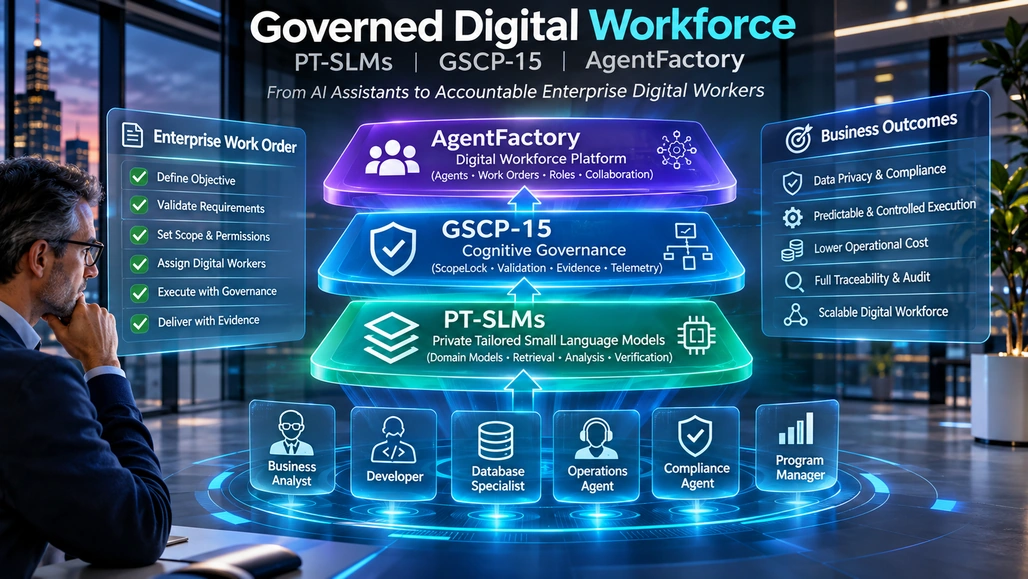
How PT-SLMs, GSCP-15, and AgentFactory Fit Together
Technical Architecture & Systems Engineering Research Group | November 2026
Architecture: John Gödel • Gate2ASI AI (formerly AlpineGate AI Technologies Inc.)
AbstractEnterprise Digital Intelligence is moving beyond the generation of text, code, and analysis toward work that changes operational outcomes. That shift demands more than an intelligent model. Organizations need clear authority, safe handling of sensitive information, recoverable execution, and evidence that supports every consequential result. This article examines a three-part architecture developed by John Gödel: Private Tailored Small Language Models (PT-SLMs) provide specialist intelligence; Gödel’s Scaffolded Cognitive Prompting (GSCP-15) governs execution; and AgentFactory manages the digital workers, responsibilities, and work orders through which tasks are delivered.
The value of the architecture lies in their combination. Intelligence is selected for the domain, action is constrained by explicit controls, and the operational record remains attached to the work rather than disappearing into a chat transcript.
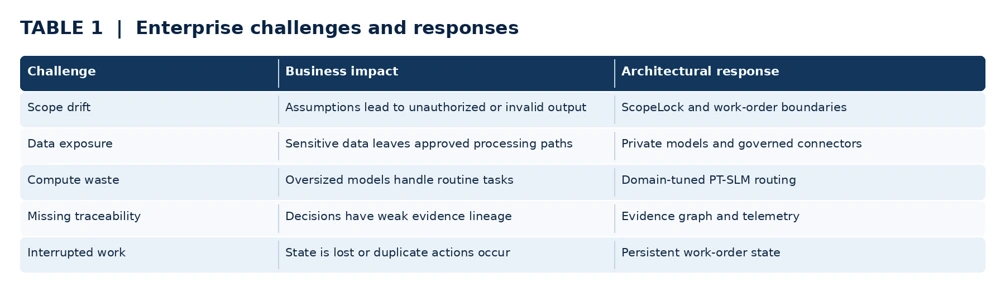
1. Why Enterprise Autonomy Requires a Different ArchitectureAn AI assistant that summarizes a procurement policy has a relatively limited mandate. An agent that checks a purchase request, reads supplier records, applies spending limits, and initiates approval is carrying out a business process. The interface may look the same, yet the consequences are very different.
General-purpose language models can infer unstated context. That can be helpful in conversation, but in regulated operations a plausible assumption may become a costly error. External model processing may also raise residency and vendor-governance questions for confidential information. Finally, using the most capable model for every simple classification or parsing step can waste computational resources.
These are not reasons to reject general-purpose models. They are reasons to stop treating model capability as a substitute for enterprise architecture. A digital worker must be bound to a task, a set of permissions, and a verifiable execution history.
 2. A Deliberate Separation of Responsibilities
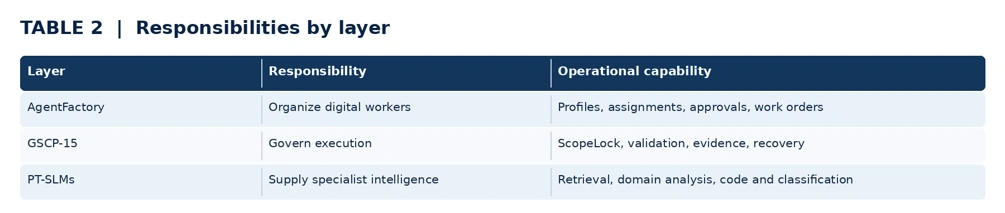
The three technologies are complementary rather than competing products. AgentFactory owns the workforce context: who is responsible and what has been requested. GSCP-15 defines the execution conditions: what may happen, what must be checked, and how evidence is retained. PT-SLMs contribute the domain-specific processing needed to accomplish the assigned work.
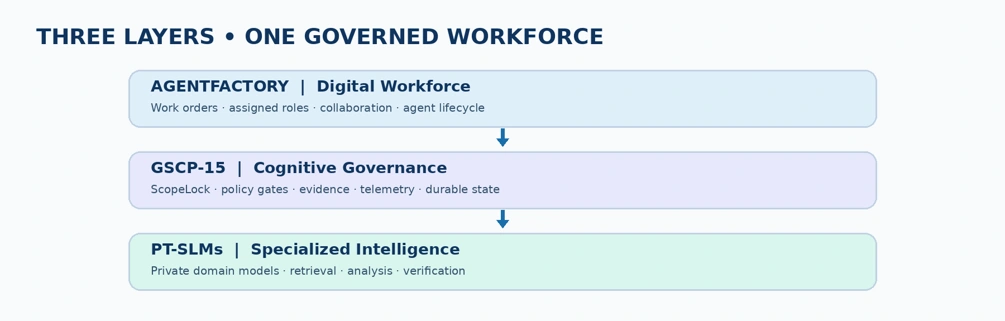
Figure 1. Logical responsibility layers in the governed workforce.
 3. PT-SLMs: Specialized Intelligence Inside Controlled Infrastructure
Private Tailored Small Language Models replace the assumption that every task needs one expansive model with a more selective approach. A banking reconciliation model, a code-assistance model, and a policy analysis model can each be configured and evaluated for a narrower purpose. Fine-tuning may improve task conventions, while retrieval supplies current internal knowledge and rule engines enforce business decisions that should not rely on probabilistic inference.
PT-SLMs can run within a private virtual cloud or on-premises environment. This gives the enterprise more control over processing and supports alignment with identity systems, network segregation, and internal access policies. It does not by itself prove data sovereignty: retrieval, logs, administration, and tool integrations must also remain within the intended boundaries.
A complex work order can cascade through retrieval, analysis, and verification components. The retrieval stage gathers approved records; an analyst model interprets the material; a verifier compares findings against source evidence and policy. Conventional services such as SQL queries and schema validators should be used whenever deterministic logic is the better tool. The result is not necessarily fewer steps, but a better match between each step and its purpose.
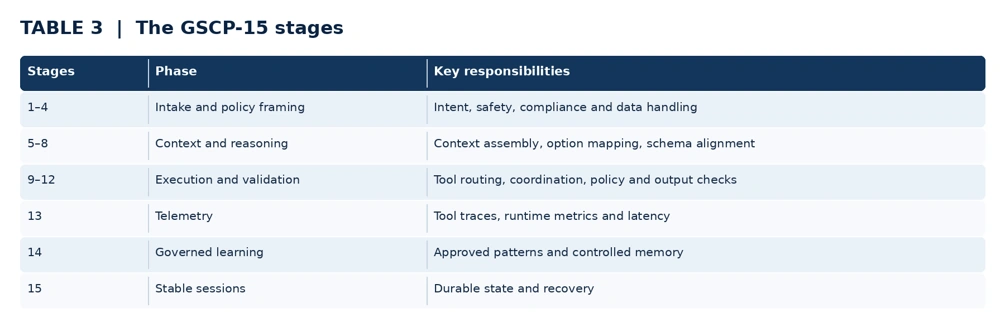
4. GSCP-15: Turning Intelligent Behavior Into Governed ExecutionGSCP-15 addresses the gap between generating a confident response and producing an authorized business result. Its 15-stage framework arranges intake, policy framing, context, reasoning, routing, verification, telemetry, learning, and continuity into an explicit operational structure. Stages can be revisited when exceptions arise, but mandatory checks are not meant to be skipped because an agent reports that everything looks fine.
4.1 ScopeLock and enforceable boundaries
ScopeLock is the contract that tells the platform what a particular work order permits. It can specify accessible data, approved tools, output formats, escalation conditions, and approval gates. For example, a development agent might be allowed to propose an authentication change without receiving permission to modify production credentials or deploy the change. Understanding an operation is not the same as being authorized to perform it.
4.2 Evidence graph and validation
A useful enterprise artifact should connect significant conclusions to sources and observed system events. An evidence graph can link a finding to a document clause, a retrieved database value, a calculation, a tool result, and the validation outcome. It does not make every conclusion automatically correct; it makes the basis of that conclusion inspectable and helps reviewers distinguish verified findings from unresolved ones.
4.3 Telemetry, learning, and durable sessions
The later GSCP-15 stages address the practical life of operational work. Telemetry captures execution traces and resource use. Governed learning retains approved patterns without silently rewriting business policies or model parameters. Durable sessions preserve pending actions, dependencies, approvals, and recovery details for work that spans interruptions or multiple days. Reliability depends on real state management, not merely a long conversation history.
5. AgentFactory: Managing Digital Workers as a TeamAgentFactory treats agents as managed workers with defined roles, skills, tool bindings, and lifecycle states. A Business Analyst, Full-Stack Developer, Database Developer, and Program Manager may collaborate on the same assignment, but they should not inherit one another’s authority. Clear responsibilities improve coordination and make it easier to establish which component performed a consequential action.
The formal Work Order is the shared basis for the assignment. It records the objective, required inputs, constraints, expected deliverables, acceptance criteria, and needed approvals. Before execution, a Business Analyst agent assesses whether the work is adequately specified. It can permit harmless, documented design assumptions while blocking actions that depend on missing credentials, uncertain schemas, or unresolved mandatory requirements.
Natural workplace conversation is useful for collaboration, but it must not be confused with evidence of execution. An agent saying “the deployment is complete” is not a deployment record. AgentFactory’s operational value comes from connecting communication to separately verifiable actions and states.
6. Integrated Work Order: From Request to DeliverableConsider a financial reconciliation review. A user states the goal, AgentFactory creates the work order, and the Business Analyst checks the required period, systems, policies, and acceptance conditions. GSCP-15 establishes a ScopeLock contract. Specialized PT-SLMs then retrieve approved records, interpret differences, and evaluate findings. Policy and evidence gates inspect the result before any authorized delivery or business action. The platform retains the work order, its evidence, and its final disposition.
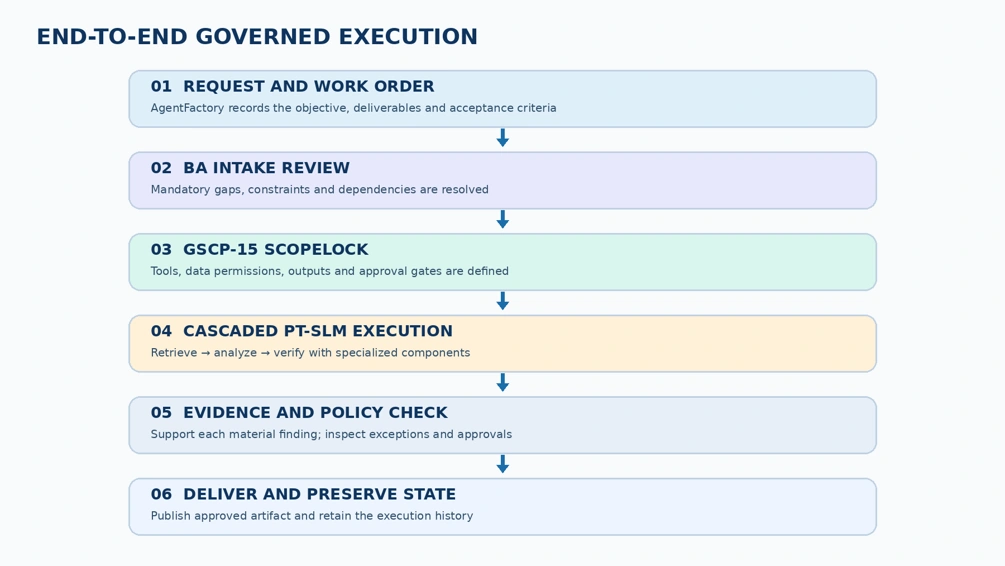
Figure 2. The integrated lifecycle places governance between the request and the final deliverable.
Failed validations follow an exception or clarification path instead of being hidden behind a polished narrative. Where a human must approve a financial action, the work order remains at that approval gate until the required authority is recorded.
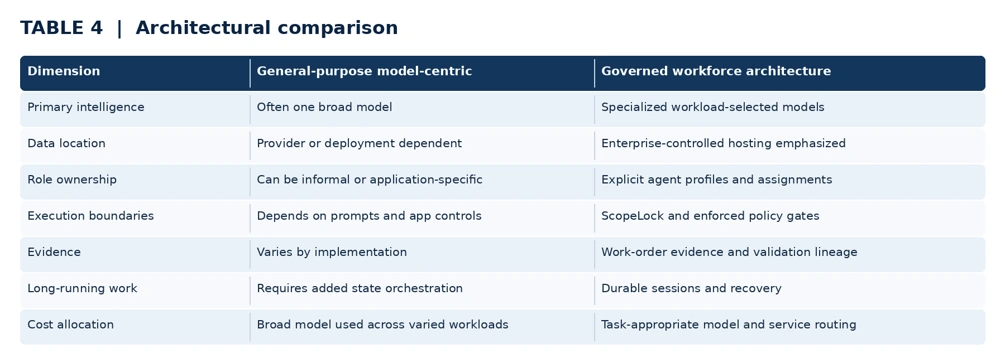
7. How the Approach Compares With Model-Centric ApplicationsMany mature public-model implementations already support security, auditing, and human approval. The distinctive emphasis here is that workforce organization, scope enforcement, and evidence are foundational parts of the architecture rather than optional integrations added after a chatbot is built.
 8. Industry Applications
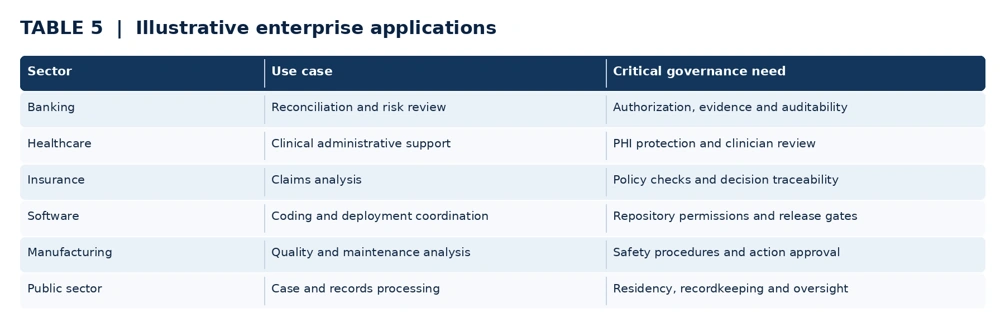
The same control pattern can be adapted across industries without assuming that a single model is equally suited to every domain. What changes are the specialized knowledge, tool integrations, required evidence, and limits on authorized actions. Banking processes emphasize transaction integrity; healthcare emphasizes sensitive records and professional review; development workflows emphasize repository permissions and release controls.
 9. What to Measure Before Scaling
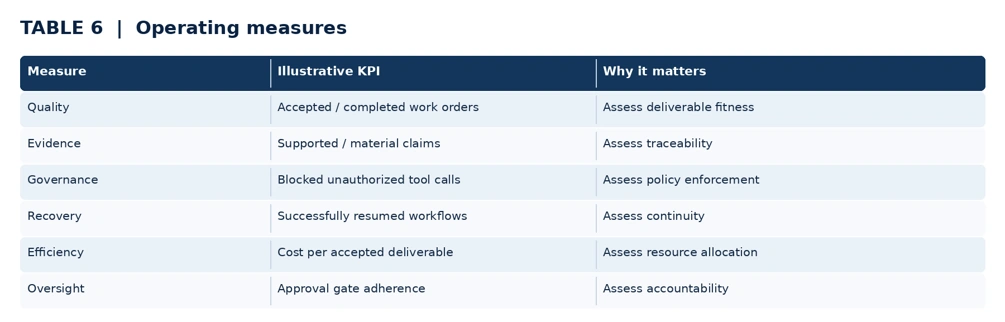
Enterprise adoption should be judged by completed work, not demonstrations alone. Useful measures include accepted deliverables, substantiated findings, blocked unauthorized actions, failed validations, recovery performance, approval compliance, and cost per accepted work order. These metrics expose whether the orchestration layer actually improves operational performance.
 10. From AI Assistants to Digital Organizations
The next meaningful evolution is not simply a larger model or a more elaborate chat interface. It is an operating environment where specialist digital workers collaborate on business outcomes under the same principles that make traditional enterprise systems dependable: explicit interfaces, limited authority, documented decisions, controlled changes, and reviewable evidence.
A digital workforce does not need to imitate every social convention of a human organization. It needs to make responsibility legible. The agent assigned to analyze a policy should be able to explain which policy it used. The agent assigned to change software should produce a traceable implementation and tests. The coordinator should be able to show what was approved, what remains blocked, and who owns the next step.
11. ConclusionPrivate Tailored Small Language Models, GSCP-15, and AgentFactory form a coherent architecture for governed enterprise autonomy. PT-SLMs supply focused domain intelligence. GSCP-15 provides structured scope, validation, evidence, and continuity. AgentFactory translates business requests into managed work performed by identifiable digital workers.
Their combined purpose is not to promise error-free autonomy. It is to make intelligent execution inspectable, constrained, recoverable, and useful inside established enterprise operations. The strongest digital workforce is not the one that claims it can do everything; it is the one whose responsibilities are clear and whose completed work can be accounted for.
Gate2ASI AI | November 2026


RinkieditedPosted Nov 23, 2026, 11:00 AM ESTEdited Nov 23, 2026, 12:07 PM EST
Very helpful
RinkieditedPosted Nov 23, 2026, 11:00 AM ESTEdited Nov 23, 2026, 12:07 PM EST
👍