
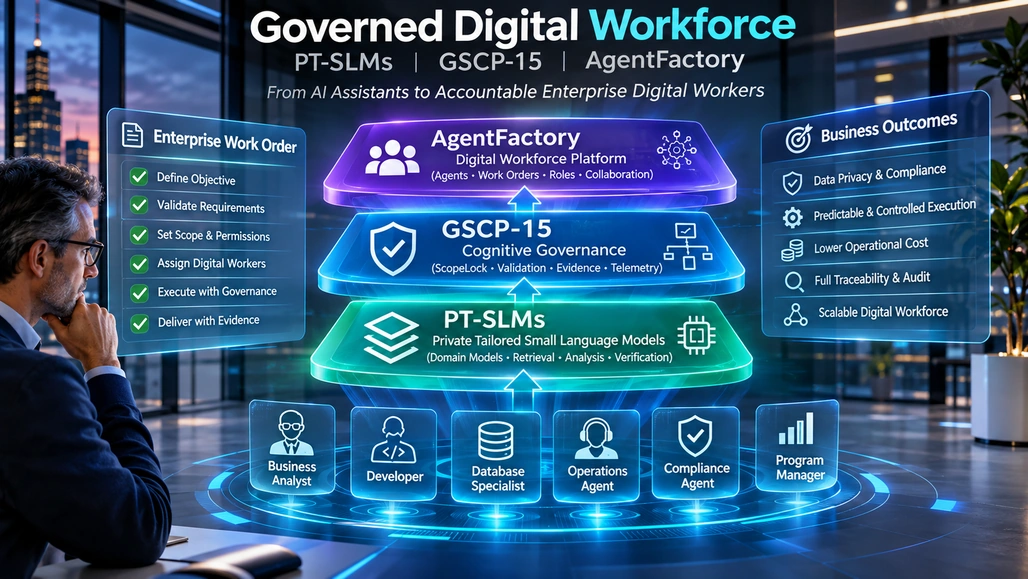
How PT-SLMs, GSCP-15, and Agent Factory Are Redefining Enterprise Digital Intelligence
Published: November 2026
Abstract
Enterprise Digital Intelligence is entering a new chapter. For years, the primary objective was to build systems capable of understanding natural language, generating content, writing software, and answering complex questions. Today, the challenge is considerably more demanding: organizations want intelligent systems that can perform meaningful work, collaborate across business functions, operate enterprise applications, and make decisions without sacrificing security, accountability, or operational control.
This transition raises an important architectural question. How can an organization benefit from autonomous digital workers while retaining the governance standards expected of its human workforce and enterprise software?
A governed digital workforce architecture brings together three complementary technologies: Private Tailored Small Language Models (PT-SLMs), the GSCP-15 governance framework, and AgentFactory.
PT-SLMs provide specialized intelligence within controlled computing environments. GSCP-15 establishes the governance framework responsible for execution boundaries, validation, evidence, and operational continuity. AgentFactory organizes these capabilities into a coordinated digital workforce built around defined roles, responsibilities, and formal work orders.
Rather than treating autonomous intelligence as an unrestricted conversational interface, the architecture places it within a disciplined operational structure. The objective is to move from systems that merely produce convincing answers to systems capable of performing accountable enterprise work.
1. The Enterprise Problem: Intelligence Without GovernanceThe remarkable progress of large language models has changed how organizations think about automation. Tasks that previously required substantial software development can now begin with a natural-language instruction.
A business analyst can request a financial assessment. A software engineer can describe a feature and receive an implementation. An operations manager can ask an intelligent agent to examine a complicated workflow and recommend improvements.
These capabilities are useful, but generating a response is fundamentally different from carrying out an operational responsibility.
Consider an intelligent system asked to review a banking transaction for regulatory compliance. A conversational model might produce a convincing analysis based on the information supplied. Yet an enterprise-grade system must go further. It needs to establish whether the records are complete, whether the applicable regulations are current, whether the requesting party is authorized, and whether the resulting decision can be independently verified.
These requirements expose several architectural weaknesses in loosely governed model-centric systems.
1.1 Scope Drift and Unverified Assumptions
General-purpose language models are designed to be helpful across a broad range of subjects. When faced with incomplete instructions, they may fill gaps using inferred information.
That behavior works well during brainstorming. It becomes dangerous when assumptions influence financial records, regulatory reporting, production systems, or customer data.
A digital worker should recognize the difference between an acceptable working assumption and a missing requirement that prevents authorized execution.
1.2 Enterprise Data Boundaries
Organizations operate under a combination of legal, contractual, and internal data-protection requirements.
Sensitive material may include intellectual property, banking records, customer profiles, healthcare information, proprietary algorithms, and confidential business strategies.
Sending such information through externally hosted model endpoints can create additional governance obligations involving data residency, vendor access, retention, confidentiality, and regulatory oversight.
Although enterprise API providers may offer substantial safeguards, some workloads are better suited to privately controlled infrastructure.
1.3 Cost and Computational Efficiency
Not every enterprise task requires a massive general-purpose model.
A model with hundreds of billions of parameters may be valuable for complex synthesis and open-ended reasoning. However, applying the same computational resources to field extraction, schema classification, routine document processing, or narrowly defined policy checks can be inefficient.
An enterprise architecture should match the complexity of the processing component to the actual business requirement.
1.4 The Missing Operational Structure
Perhaps the most important weakness is the absence of organizational accountability.
Traditional enterprise systems define users, permissions, responsibilities, approval levels, execution history, and operational boundaries.
An autonomous agent participating in enterprise work needs comparable controls.
Without them, an organization may know what an agent produced but struggle to establish why it produced it, what information it used, which actions it performed, and whether those actions were authorized.
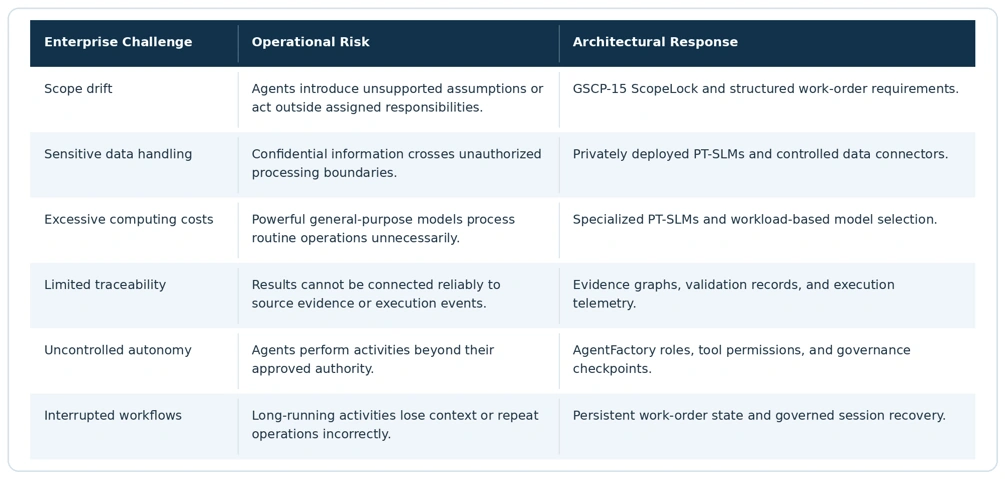
Table 1. Enterprise AI Challenges and Architectural Responses
The solution is not simply a more sophisticated language model. It requires an architecture that connects intelligence to operational responsibility.
2. Three Technologies, One Governed Digital WorkforceThe architecture combines three distinct layers, each responsible for a different part of enterprise execution.
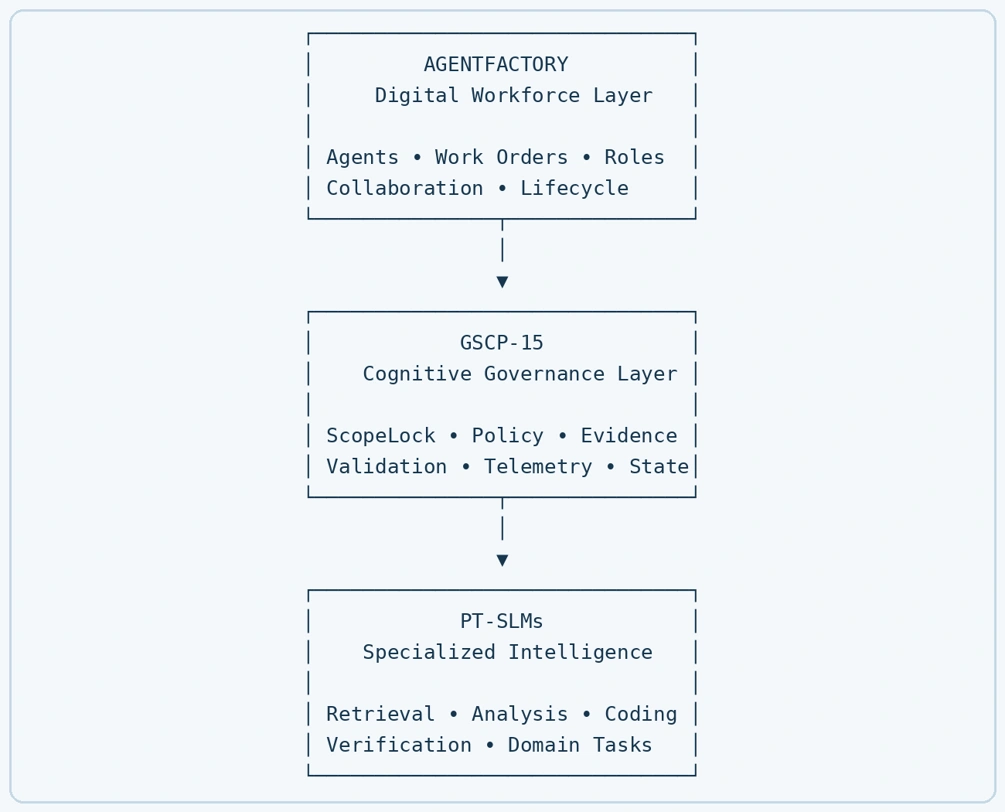
Figure 1. The Three-Layer Architecture
The relationship is straightforward.
AgentFactory manages the work. GSCP-15 governs how the work is performed. PT-SLMs provide the specialized intelligence needed to complete it.
The separation allows organizations to evolve each layer without redesigning the entire platform.
For example, a financial institution may replace one domain model with a more capable version while retaining its existing workforce structure, authorization rules, and work-order history.
Similarly, a new governance rule can be introduced without requiring every specialized model to be retrained.
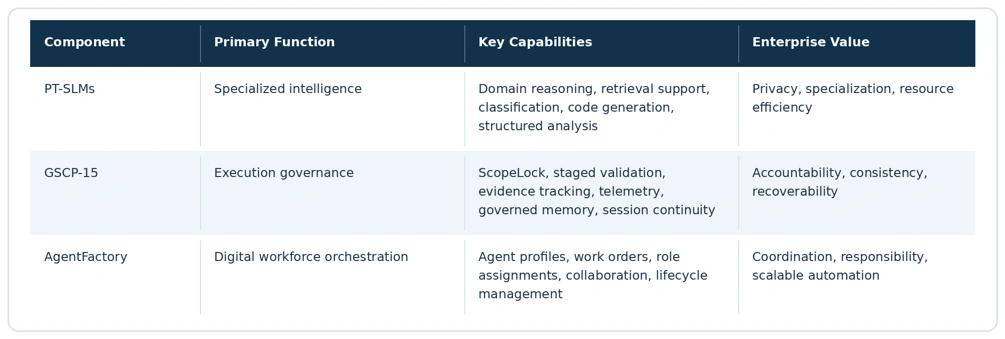
Table 2. Architectural Responsibilities
These are not three competing solutions. They are deliberately complementary components of a broader enterprise architecture.
3. Private Tailored Small Language Models: Intelligence That Belongs to the EnterpriseOne of the central ideas behind PT-SLMs is that enterprise intelligence should be designed around specific business responsibilities.
A global banking organization, for example, may have separate requirements for credit analysis, payment processing, regulatory documentation, customer onboarding, and software engineering.
Each domain relies on different data structures, terminology, rules, and operational constraints.
Instead of forcing every activity through a single large model, PT-SLMs allow organizations to deploy smaller, specialized models configured for particular workloads.
3.1 Domain-Specific Intelligence
A PT-SLM can be adapted to a defined area of expertise using domain-specific fine-tuning, task-oriented configuration, and retrieval from controlled knowledge sources.
A model serving a banking operations team might be equipped to interpret transaction schemas and internal procedure documents.
Another model supporting a development team might understand the organization's application architecture, coding conventions, integration standards, and deployment constraints.
The benefit is not merely vocabulary recognition. Specialization enables more focused testing, clearer performance criteria, and closer alignment with the tasks a model is expected to perform.
3.2 Private Infrastructure and Data Sovereignty
PT-SLMs can operate inside a private virtual cloud, dedicated enterprise infrastructure, or on-premises environment.
Such deployments allow organizations to maintain greater control over where model processing occurs and how enterprise data is accessed.
The architecture can be integrated with existing security controls, including identity management, role-based access control, encrypted storage, network segmentation, and internal auditing.
A fully private execution path also requires governance of supporting services, including logging, retrieval, telemetry, and external tool connections.
The result is a deployment model designed to align specialized intelligence with enterprise data-management policies.
3.3 Specialized Models Working as a Team
A single work order may require several different cognitive capabilities.
For example, a compliance analysis could involve retrieving records, interpreting policy requirements, comparing evidence, and evaluating whether a proposed conclusion is supported.
Instead of assigning these responsibilities to one general-purpose model, the platform can distribute them among specialized components.
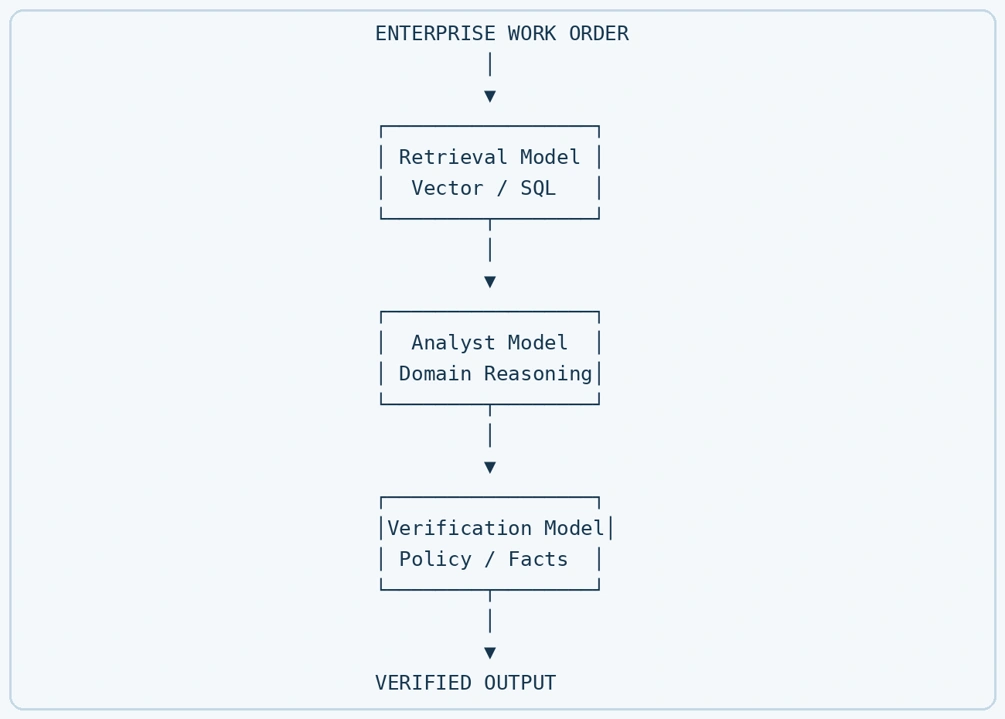
Figure 2. Cascaded PT-SLM Processing
This arrangement provides several practical advantages.
Different models can be evaluated against different objectives. Sensitive workloads can remain inside approved infrastructure. Expensive processing can be reserved for tasks that genuinely require it.
Where appropriate, deterministic services such as SQL queries, schema validators, and rules engines can perform operations that do not benefit from generative reasoning.
The architectural goal is intelligent resource allocation, not the indiscriminate use of language models.
4. GSCP-15: A Governance Framework for Intelligent ExecutionIf PT-SLMs provide the intelligence, GSCP-15 establishes the conditions under which that intelligence may operate.
The GSCP-15 governance framework is organized around a 15-stage framework covering request intake, policy framing, reasoning, execution, validation, telemetry, learning, and persistent session management.
The underlying principle is that an autonomous system should not move directly from interpreting a request to carrying out consequential actions without passing through appropriate governance checks.
4.1 The Fifteen Stages
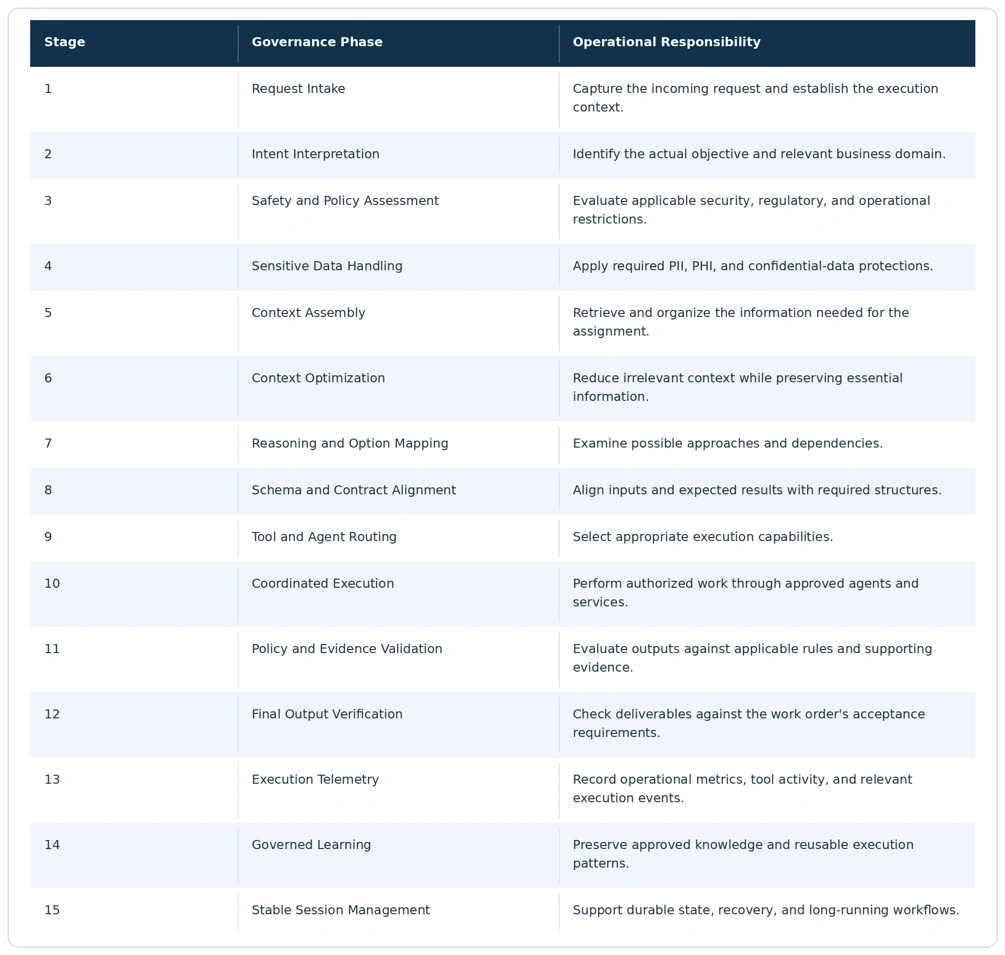
Table 3. GSCP-15 Execution Framework
4.2 The Governance Lifecycle
GSCP-15 can be understood as five connected operational groups.
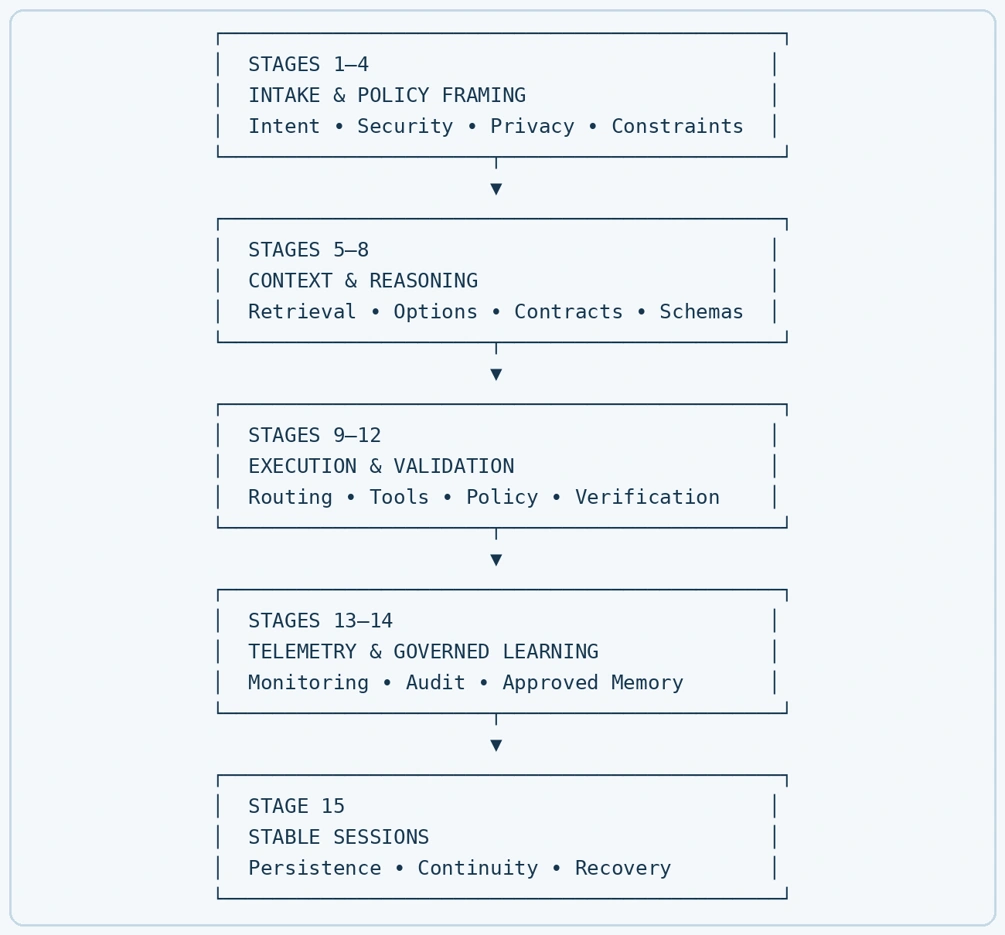
Figure 3. GSCP-15 Governance Pipeline
Although presented as a sequence, a practical implementation may revisit validation checkpoints when new information, exceptions, or revised requirements emerge.
The important requirement is that execution cannot bypass mandatory controls simply because a model produces a persuasive explanation.
4.3 ScopeLock: Establishing the Agent's Authority
ScopeLock is a central governance concept within GSCP-15.
A ScopeLock contract establishes the operational boundaries of an assignment before the system proceeds with authorized execution.
These boundaries can include the business objective, permitted data sources, tool access, expected output schema, escalation conditions, and approval requirements.
Imagine a software development agent assigned to update an authentication interface.
Its work order may authorize code analysis and implementation within a particular project. It may not authorize changing production credentials, deleting database records, or deploying directly to a live environment.
ScopeLock is intended to keep those responsibilities separate.
Understanding how to perform an action does not establish permission to perform it.
That distinction is foundational to governed autonomy.
4.4 Evidence Graphs: Connecting Results to Verifiable Sources
A persuasive response is not necessarily a trustworthy one.
In regulated enterprise environments, important conclusions should be traceable to supporting information.
GSCP-15 incorporates evidence tracking so that a completed output can be associated with the records, tool responses, calculations, validation results, and approvals relevant to its production.
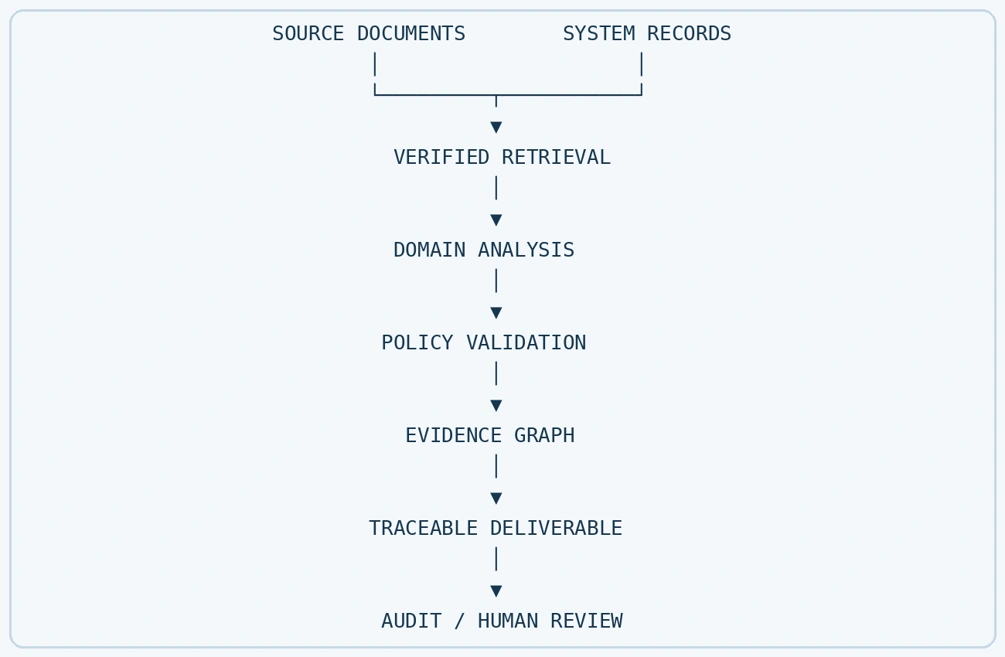
Figure 4. Evidence Lineage
An evidence graph provides more than a log of model messages.
It establishes relationships between the assertions made in a deliverable and the underlying evidence supporting them.
For example, a compliance finding may be associated with a specific policy clause, a retrieved transaction record, and the validation procedure applied to that record.
Where evidence is insufficient, the system should distinguish an unresolved finding from a verified conclusion.
4.5 Governed Learning and Long-Running Sessions
Enterprise agents must also operate over time.
Some assignments involve multiple contributors, human approvals, interrupted execution, and dependencies that extend beyond a single conversation.
GSCP-15's later stages address these operational realities through execution telemetry, controlled retention of approved knowledge, and persistent workflow state.
Governed learning allows verified patterns to inform future execution without automatically modifying model parameters or enterprise policy.
Stable session management preserves the information needed to continue interrupted work, including completed activities, pending decisions, dependencies, and relevant evidence.
Together, these capabilities provide a framework for continuity without abandoning supervision.
5. AgentFactory: Organizing Intelligent Systems as Digital WorkersThe AgentFactory platform introduces a different way to think about enterprise automation.
Instead of presenting every capability through one general-purpose assistant, AgentFactory organizes intelligent agents around specific responsibilities.
A digital worker may be assigned to business analysis, software development, database engineering, compliance, architecture, project coordination, or operational support.
Each agent can have its own profile, skills, approved tools, operating boundaries, and lifecycle state.
This structure reflects an important enterprise reality: organizations function through coordinated responsibilities, not unrestricted authority.
5.1 Agents as Managed Operational Resources
Within AgentFactory, agents are treated as managed resources rather than informal prompt configurations.
An agent's identity and configuration determine the work it is designed to undertake.
A Database Developer agent, for instance, may be authorized to inspect schema definitions and prepare migration scripts. A Frontend Developer agent may work on presentation logic and user-interface components. A Program Manager agent may coordinate dependencies and identify unresolved requirements.
These agents can communicate and collaborate while remaining accountable for their assigned responsibilities.
5.2 Work Orders as the Foundation of Execution
The Work Order serves as the formal connection between a business request and the digital workforce.
A work order identifies what needs to be accomplished and the conditions under which the result will be accepted.
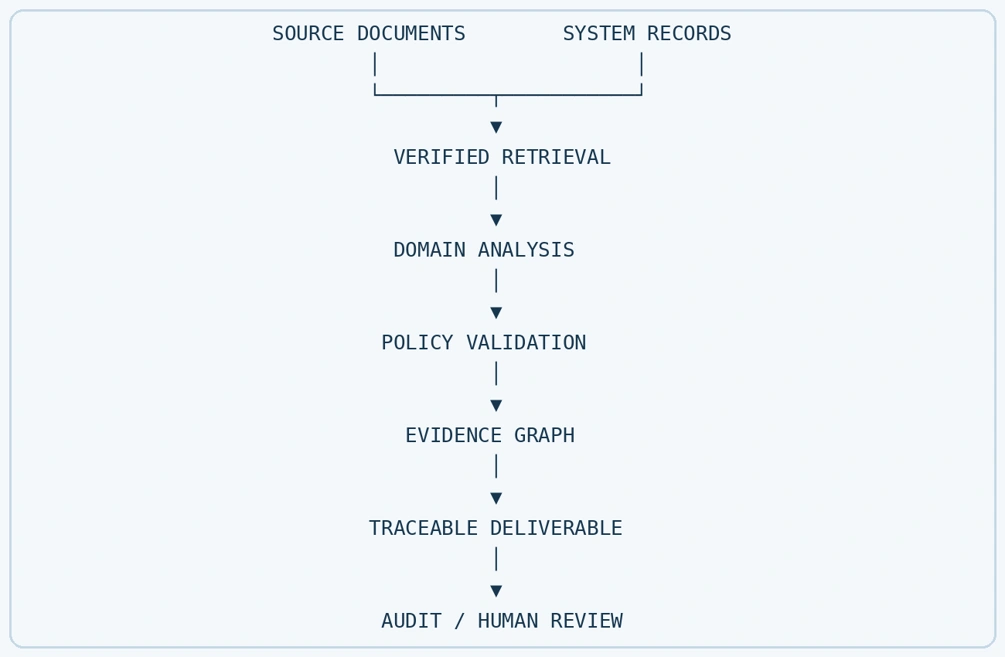
Table 4. Typical Work Order Structure
This structure helps prevent an agent from treating every conversational suggestion as an executable instruction.
It also creates a shared reference point when several digital workers contribute to the same project.
5.3 The Business Analyst as a Quality Gate
AgentFactory introduces a Business Analyst agent to evaluate incoming work orders before execution.
Its responsibility is to identify missing requirements, conflicting instructions, unclear acceptance criteria, and dependencies that may affect successful delivery.
Consider an instruction to create a customer-facing appointment system.
Before implementation, the platform may need to establish whether appointments require authentication, which database stores customer details, whether external integrations are expected, and who has authority to approve changes.
A BA agent helps turn an informal request into an assignment that developers and other specialists can execute consistently.
When mandatory requirements remain unresolved, the workflow can request clarification instead of inventing operational facts.
5.4 Natural Collaboration With Operational Accountability
Human teams exchange questions, suggestions, updates, and informal observations throughout a working day.
Digital teams can benefit from similarly natural communication.
AgentFactory's collaborative model supports interactions among specialized workers while preserving the distinction between communication and execution.
An agent can discuss a possible implementation without claiming it has been deployed. It can request information from another specialist without representing the request as a completed handoff.
This distinction becomes especially important when work spans multiple agents and systems.
A conversational exchange may help coordinate the task, but completed actions should be supported by corresponding execution records.
6. End-to-End Execution: From Business Request to Governed DeliverableThe relationship among PT-SLMs, GSCP-15, and AgentFactory becomes clearer when examining a complete workflow.
Suppose an organization submits a work order requesting an assessment of its internal financial reconciliation procedures.
The assignment requires access to approved records, interpretation of reconciliation rules, identification of exceptions, and preparation of a documented report.
Figure 5. Integrated Digital Workforce Workflow
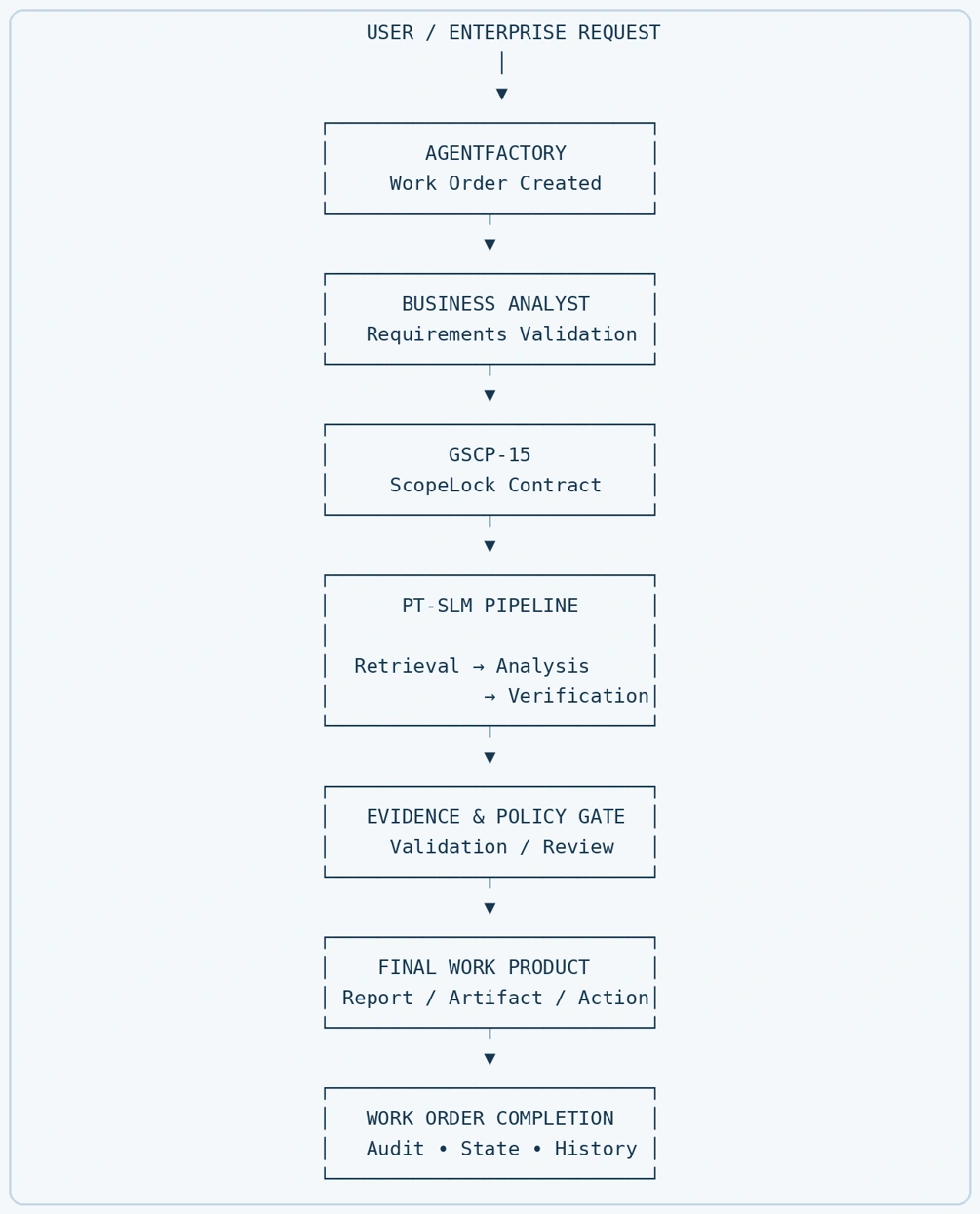
The workflow unfolds through five operational steps.
Step 1 — Intake and clarification. AgentFactory receives the request and generates a work order. The Business Analyst agent examines requirements and resolves mandatory ambiguities before execution.
Step 2 — ScopeLock initialization. GSCP-15 defines the approved operating boundaries, including accessible systems, input and output contracts, validation requirements, and escalation procedures.
Step 3 — Specialized processing. The appropriate PT-SLMs and supporting services retrieve records, perform structured analysis, and evaluate proposed conclusions.
Step 4 — Evidence and validation. The governance layer associates findings with source evidence, applies required checks, and determines whether the output satisfies the work order's acceptance conditions.
Step 5 — Delivery and closure. AgentFactory returns the approved artifact, updates the work-order state, and preserves the associated execution history.
If a critical validation fails, execution follows the defined exception path rather than silently continuing.
This provides a controlled relationship between autonomous intelligence and enterprise authority.
7. Architectural Comparison: Conventional AI Versus Governed Digital WorkforcesThe difference between a conversational AI deployment and a governed digital workforce is not simply the number of models involved.
It is the way responsibilities, permissions, evidence, and operational state are managed.
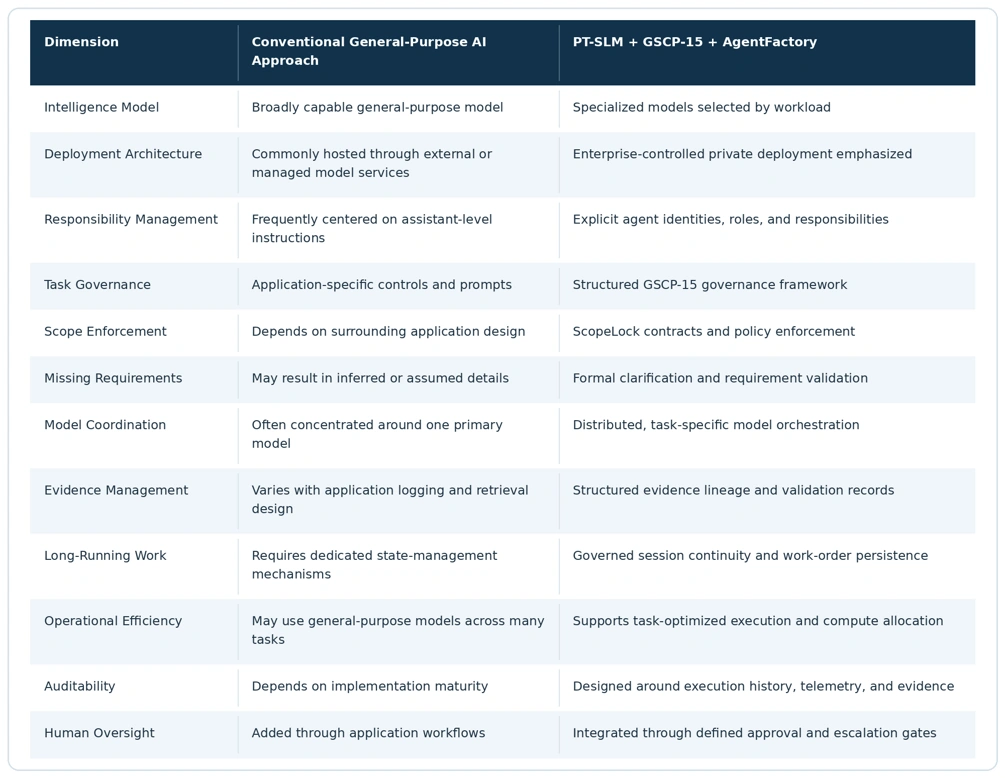
Table 5. Enterprise Architecture Comparison
The comparison describes architectural design choices rather than asserting that all general-purpose implementations share the same limitations.
The central difference is that governance and workforce management are first-class architectural responsibilities rather than features left to individual agents.
8. Applying the Architecture Across IndustriesThe same underlying design can support a wide range of enterprise use cases because its organizational and governance layers are separated from the domain-specific intelligence models.
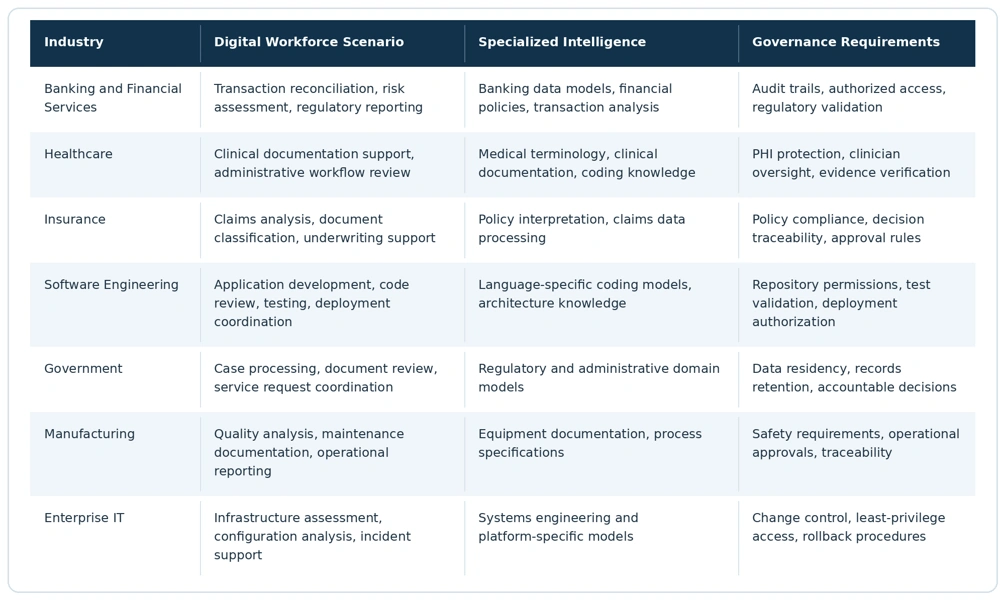
Table 6. Potential Industry Applications
A financial services organization may emphasize privacy, transaction integrity, and regulatory evidence. A software engineering organization may emphasize code quality, integration boundaries, and controlled deployments.
The specialized intelligence changes. The principles of responsibility, scope, validation, and accountability remain applicable.
9. Building an Enterprise Digital Workforce: Practical Design PrinciplesTurning this architecture into an operational platform requires more than deploying models and defining agent profiles.
The surrounding systems must support the governance model consistently.
9.1 Separate Intelligence From Authority
A language model can interpret instructions and propose actions, but authorization should be enforced through independent application controls.
A model's ability to generate a database command should never automatically grant permission to execute it.
9.2 Assign Responsibilities Explicitly
Every agent should have an understandable organizational purpose, a defined set of capabilities, and access only to the resources necessary for its assignment.
Role descriptions must be reflected in actual tool permissions.
9.3 Preserve Reliable Execution Records
Important operations should produce records that distinguish requested activities, attempted actions, completed operations, validation results, and approvals.
A successful model response should not be treated as proof that an external action occurred.
9.4 Design for Exceptions and Recovery
Enterprise workflows encounter failed integrations, unavailable data, incomplete inputs, and interrupted sessions.
A governed digital workforce needs defined recovery procedures, durable state, and appropriate mechanisms for avoiding unintended duplicate operations.
9.5 Match Governance to Operational Risk
Not every task requires identical restrictions.
Producing an internal document draft and initiating a financial transaction have different consequences.
Governance should reflect the sensitivity, reversibility, and potential impact of each action.
9.6 Measure Outcomes, Not Just Model Accuracy
Model evaluation remains important, but operational success depends on broader measures.
Relevant metrics include completion accuracy, policy violations, unsupported claims, processing latency, exception rates, recovery performance, cost per completed work order, and quality of audit evidence.
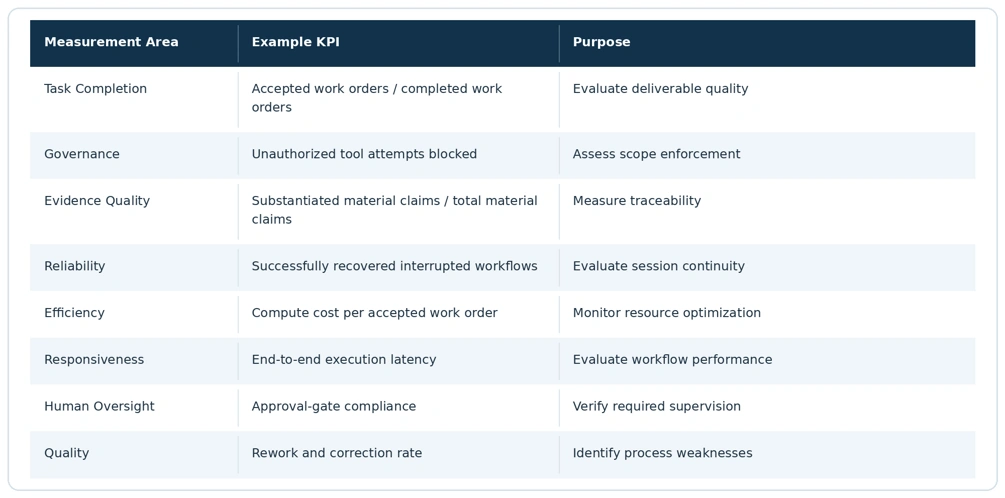
Table 7. Suggested Operational Performance Measures
These metrics offer a more meaningful assessment of enterprise readiness than model benchmark scores alone.
10. The Next Evolution: From AI Tools to Digital OrganizationsMost organizations have become familiar with AI as an individual productivity tool.
An employee asks a question. An assistant produces an answer. The employee reviews the result and decides what happens next.
Governed digital workforces represent a broader operating model.
Instead of one assistant responding to isolated prompts, organizations can assemble groups of specialized digital workers that collaborate on defined business outcomes.
A Program Manager agent may coordinate a project. A Business Analyst agent may clarify requirements. A Developer agent may implement software changes. A Database specialist may evaluate the data architecture. A validation agent may inspect the deliverables against specified acceptance criteria.
The value of this approach lies in the structure connecting those activities.
Each participant has a defined purpose. Each work order establishes an expected outcome. Governance controls determine the permitted actions. Evidence and execution records allow the organization to understand what actually happened.
The goal is not to reproduce a human office inside a computer.
It is to apply the organizational principles that make complex work manageable—responsibility, coordination, review, specialization, and accountability—to intelligent software systems.
That distinction becomes increasingly significant as autonomous capabilities expand.
An enterprise does not merely need agents that can complete tasks. It needs agents whose work can be governed as part of the organization's existing operational environment.
11. Conclusion: Building Autonomy on AccountabilityEnterprise Digital Intelligence is moving beyond an era defined primarily by impressive model outputs.
As intelligent systems become more involved in operational work, their value will depend increasingly on how well they fit within enterprise security, governance, compliance, and management structures.
PT-SLMs address the need for specialized intelligence and controlled deployment.
GSCP-15 establishes a structured approach to execution boundaries, reasoning, validation, evidence management, telemetry, and continuity.
AgentFactory provides the organizational environment in which digital workers receive assignments, collaborate, perform authorized tasks, and deliver accountable results.
Together, these technologies establish an architectural foundation for governed digital workforces.
The larger opportunity is not simply automating individual tasks. It is creating intelligent operational capabilities that organizations can manage, inspect, refine, and incorporate into existing business processes.
In that environment, intelligence and accountability are not competing priorities. They are complementary requirements.
The direction of enterprise autonomy is becoming clearer: businesses will need systems that do more than understand instructions and generate convincing responses. They will need digital workers that operate within defined responsibilities, use approved resources, recognize operational limits, and provide verifiable evidence of their work.
A truly intelligent digital workforce is not defined by how much autonomy it possesses, but by how effectively that autonomy is governed.
November 2026 This is a scientific artcile and there is no intent for any promotion

Join the conversation! Your thoughts help the community grow.