
Introduction
The Web3 revolution is changing how people think about ownership, value, and community. Instead of depending on centralized corporations to manage platforms and extract profits, Web3 introduces a model where users are owners. In this shift, community-owned economies are emerging as one of the most exciting innovations.
Among the tokens exploring this model, Sharp Token (SHARP) stands out. With its Learn2Earn programs, reward-driven ecosystem, and fair token distribution, Sharp is being recognized as a potential blueprint for fair Web3 growth.
Why Community-Owned Economies Matter
For decades, traditional platforms have followed a top-down approach: companies control data, dictate monetization, and keep most of the profits. Users contribute value but rarely benefit beyond access to the service.
Web3 challenges this by introducing community-owned economies, where:
Users earn rewards for participation.
Communities share governance power.
Value circulates within the ecosystem rather than being extracted.
Fairness becomes part of tokenomics.
This shift ensures that users are not just participants, but also stakeholders in the platforms they support.
Sharp Token as a Case Study
Sharp Token is built around these very principles. It is not just another speculative coin; it is a utility-first, reward-driven token designed to create fairness and inclusivity.
Here’s what makes Sharp unique:
Reward Mechanisms (Sharp Rewards): Users can earn SHARP tokens for learning, contributing, or engaging with platforms.
Community-First Distribution: Sharp emphasizes wide distribution and affordability (still trading under $1), ensuring accessibility.
Tradeability + Utility: SHARP can be used in DeFi, spent across apps, and traded on exchanges, combining function with liquidity.
AI + Web3 Alignment: Sharp integrates AI-driven personalization and fairness tools, strengthening its community-focused design.
This makes Sharp Token a working model of a community-owned economy in Web3.
Benefits of Community-Owned Token Models
Using Sharp as an example, here are the key benefits of community-owned economies in Web3:
Fair Participation - Everyone has access to tokens, rewards, and governance — not just early insiders.
Shared Growth - As platforms expand, value flows back to the users powering it.
Sustainability - Tokens with utility, like SHARP, avoid pump-and-dump cycles by creating real demand.
Trust & Transparency - Community-driven governance ensures decisions are open and fair.
Comparison Table: Traditional vs Community-Owned
| Feature | Traditional Platforms | Community-Owned (Sharp Model) |
|---|---|---|
| Ownership | Centralized (companies) | Decentralized (users + community) |
| Profit Distribution | Corporations keep most profits | Value shared via tokens & rewards |
| User Incentives | Limited (ads, discounts) | Learn2Earn, Sharp Rewards, staking |
| Accessibility | Pay-to-play models common | Affordable, under $1 entry point |
| Governance | Corporate executives decide | Token-based community governance |
Community Value Flow
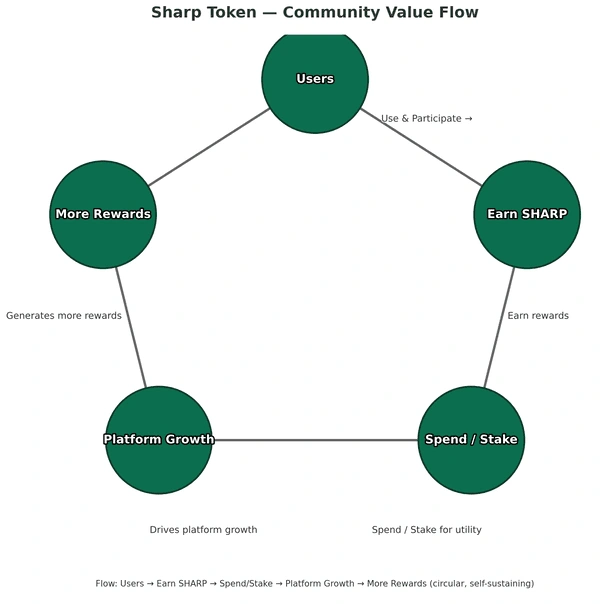
This demonstrates how Sharp Token keeps value circulating within the community, instead of being extracted.
Why Sharp Token Could Be a Model for Fair Web3 Growth
Sharp’s design addresses three critical challenges in crypto:
Speculation vs. Utility - It balances being tradeable with offering real ecosystem uses.
Accessibility - At under $1, Sharp lowers the barrier for participation.
Fair Growth - Its community-driven reward programs ensure fairness at scale.
By combining AI innovation, DeFi integration, and rewards-driven utility, Sharp offers a framework that other projects can learn from.
Final Thoughts
The future of Web3 depends on fairness. Community-owned economies provide a solution by ensuring that users own the value they create. Sharp Token is showing how this can work in practice: a liquid, affordable, utility-first token that rewards users and grows with the community.
As more people demand fairness and inclusivity in crypto, Sharp Token could become a model for how community-owned economies reshape Web3.

Join the conversation! Your thoughts help the community grow.