
Introduction
Modern applications like Instagram, Netflix, Amazon, and banking platforms serve millions of users every second.
Behind this scale lies one critical challenge:
How do databases handle massive data without slowing down?
The answer is Database Sharding — a core concept every backend and system design engineer must understand.
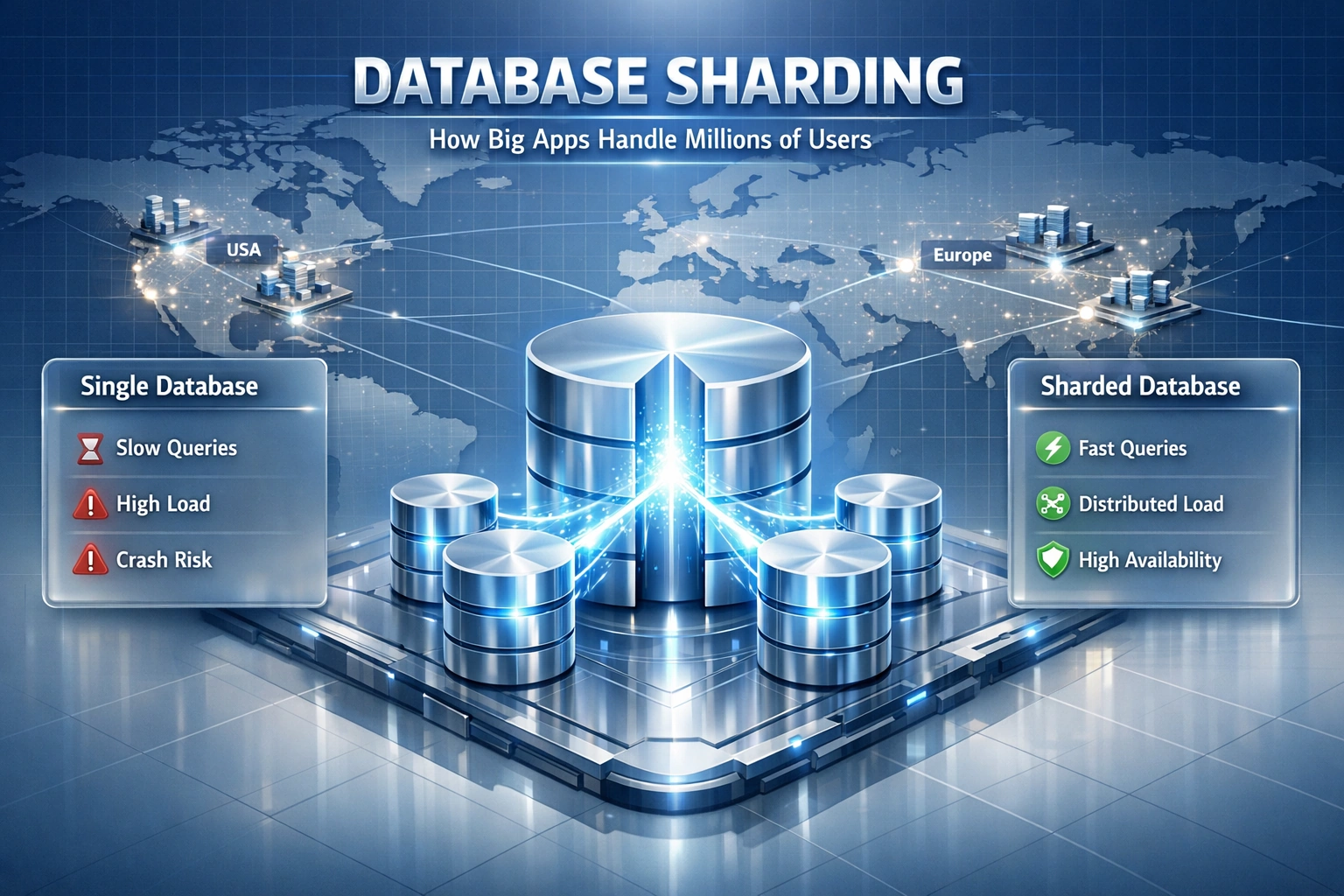
The Problem with a Single Database
WhenA an application is small, one database is enough.
But as users grow:
Queries become slower
Response time increases
Server load rises
Risk of database crash increases
A single database eventually becomes a performance bottleneck.
Traditional Fix: Vertical Scaling
The first solution teams try is:
Bigger server
More RAM
Faster CPU
This is called Vertical Scaling.
But it has limits:
Hardware becomes expensive
Physical capacity is finite
Still a single point of failure
This is not sustainable for large-scale systems.
What Is Database Sharding?
Database Sharding means:
Dividing one large database into smaller independent databases.
Each smaller database is called a Shard.
Every shard:
Stores a portion of data
Handles its own queries
Works independently
Example:
Shard 1 → Users A–M
Shard 2 → Users N–Z
Shard 3 → Media data
This distributes load evenly across multiple database servers.
How Big Apps Use Sharding
Large global apps often shard data by region:
India users → India shard
US users → US shard
Europe users → Europe shard
Benefits:
Faster local access
Lower latency
Better global performance
This is how social media, streaming, and fintech platforms scale worldwide.
Benefits of Database Sharding
Sharding provides:
Faster query execution
Horizontal scalability
No single database overload
Improved system reliability
High availability
This makes it essential for modern cloud-native applications.
Why Sharding Matters for Developers
In backend and system design interviews, a common question is:
“How will you scale the database?”
The expected answer:
“Use Database Sharding.”
Understanding sharding shows you can design real-world scalable architectures.
India and Global Demand
In India:
SaaS startups
Fintech platforms
EdTech apps
are rapidly building high-scale architectures.
Globally:
Cloud providers
AI platforms
E-commerce giants
depend on sharded databases to handle massive workloads.
Backend engineers who understand sharding gain:
Strong interview advantage
Global job opportunities
High-paying roles in scalable system design
Final Thoughts
Single databases cannot handle internet-scale applications.
Database Sharding enables speed, stability, and scalability.
For developers in India and across the world, mastering this concept is a key step toward modern backend and cloud engineering careers.

Join the conversation! Your thoughts help the community grow.