
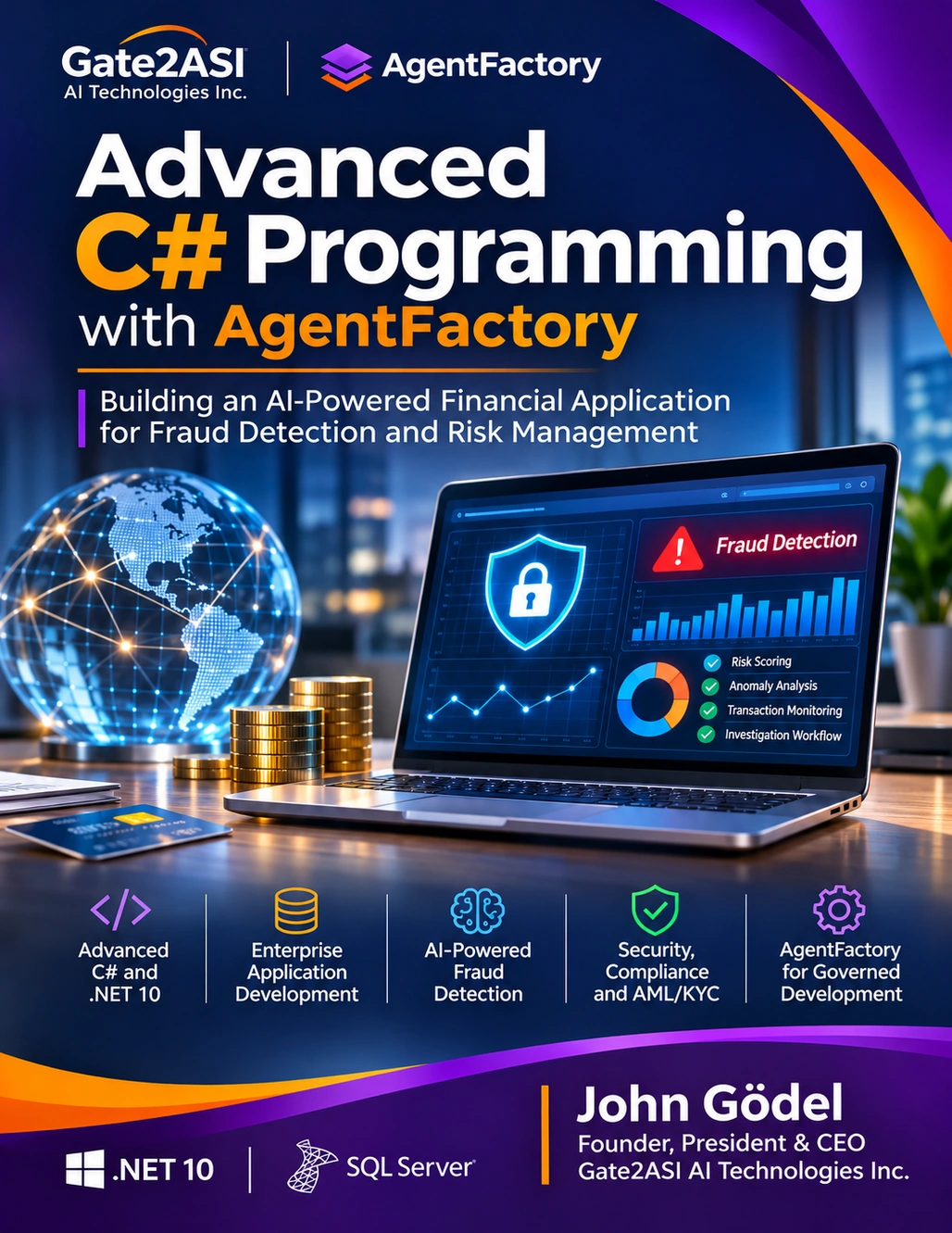
By John Gödel
Founder, President & CEO, Gate2ASI AI Technologies Inc.
The Evolution of Financial Software Engineering
The financial technology industry is entering a new era in which traditional transaction processing is no longer sufficient. Modern financial applications must do more than transfer funds, maintain accounts, and generate reports. They must recognize suspicious behavior, assess financial risks, respond to threats in real time, and provide intelligent decision support while maintaining security, transparency, and regulatory accountability.
This transformation creates opportunities for software engineers, particularly those working with C#, .NET, distributed systems, and artificial intelligence.
At Gate2ASI AI Technologies Inc., our AgentFactory approach reflects a broader shift in enterprise software engineering: moving from isolated programming activities toward coordinated, intelligent, and governed development processes.
The combination of advanced C# programming, AI-assisted software engineering, and financial fraud analytics provides a powerful foundation for designing the next generation of enterprise financial applications.
However, achieving this requires more than connecting an AI model to a banking database.
It requires fundamentally sound software architecture.
1. Why Advanced C# Matters in Financial Technology
Financial applications are among the most demanding enterprise systems. They must process financial transactions accurately, maintain consistent data across concurrent operations, protect sensitive information, and remain operational under significant workloads.
C# and the .NET ecosystem offer capabilities that are particularly valuable in these environments.
Modern C# supports sophisticated programming techniques, including asynchronous operations, concurrent processing, immutable data structures, generics, advanced pattern matching, and efficient memory management.
These capabilities become especially important in fraud detection systems, where thousands of transactions may need to be evaluated simultaneously.
Consider a payment processing platform receiving transaction requests from multiple channels, including mobile banking, payment gateways, online merchants, and financial institutions.
Each transaction may require several operations:
Validating transaction information and customer identity.
Retrieving historical financial activity.
Evaluating transaction velocity and behavioral patterns.
Identifying suspicious relationships between accounts.
Calculating a financial risk score.
Determining whether the transaction should proceed, be challenged, or require investigation.
These operations must be coordinated without creating unacceptable latency or compromising data consistency.
Advanced C# techniques help engineers address these challenges through asynchronous execution, controlled concurrency, efficient data access, and modular application architecture.
But performance alone is not enough. In financial systems, correctness is equally important.
A transaction processed quickly but recorded incorrectly is a failure, regardless of the application's technical sophistication.
2. Building an Intelligent Fraud Detection Engine
Traditional fraud detection systems rely heavily on static rules.
For example, a financial institution might flag a transaction exceeding a specified amount or identify multiple transactions occurring within a short period.
Although rule-based detection remains useful, sophisticated financial fraud frequently involves behavioral patterns that cannot be captured through simple thresholds.
An intelligent fraud detection engine should evaluate multiple dimensions of financial activity.
Transaction behavior: Does the transaction align with the customer's historical spending patterns?
Transaction velocity: Has an unusual number of transactions occurred within a short period?
Geographic anomalies: Does the activity originate from an unexpected location, considering the context and reliability of location data?
Account relationships: Are multiple accounts participating in suspicious transaction networks?
Device and access signals: Do changes in device characteristics, login behavior, or authentication patterns indicate increased risk?
Historical fraud indicators: Does the transaction share characteristics with previously confirmed fraudulent activity?
A mature system combines these signals into a risk-assessment process.
For example, consider an illustrative situation involving a customer who typically makes small domestic purchases.
Within minutes, the customer's account initiates several unusually large transfers to newly established recipients.
A conventional system might flag only the transaction amounts.
An intelligent fraud detection engine can examine the combined behavior, including transfer frequency, recipient history, account activity, and deviations from established patterns.
It may determine that the overall risk warrants additional authentication or human investigation.
The objective is not to automatically label the customer as fraudulent.
The objective is to identify potentially suspicious activity using relevant evidence while minimizing unnecessary disruption to legitimate customers.
This distinction is fundamental to responsible financial risk management.
3. Designing the Financial Intelligence Architecture
A reliable financial fraud detection platform should separate transaction processing from analytical decision-making.
A practical architecture may contain six major components.
Transaction Ingestion
The ingestion layer receives financial events from payment systems, banking applications, APIs, and transaction-processing services.
Every incoming transaction must be validated, assigned a stable identifier, and processed through a controlled workflow.
Idempotency is particularly important. If a transaction request is retried because of network failure, the system must prevent unintended duplicate financial operations.
Financial Data Management
Microsoft SQL Server, accessed through Entity Framework Core or carefully designed data-access services, can manage operational information such as customers, accounts, transactions, fraud cases, and audit records.
Financial amounts should use appropriate fixed-precision decimal representations rather than floating-point types that may introduce rounding errors.
Database transaction boundaries, uniqueness constraints, concurrency controls, and access restrictions are essential to preserving integrity.
Fraud Rules Engine
The rules engine evaluates deterministic conditions such as transaction limits, account restrictions, known fraud indicators, and unusual activity thresholds.
Rules should be versioned so investigators and auditors can determine which policy was applied to a particular transaction.
AI Risk Analysis
The AI analysis layer evaluates more complex patterns using statistical models, machine learning, or other approved analytical approaches.
It may provide anomaly scores, behavioral classifications, or risk indicators.
However, an AI-generated recommendation should not automatically become an irreversible financial decision.
Investigation and Decision Management
A separate decision-management layer evaluates the available evidence, applies organizational policies, and determines whether a transaction should proceed, require additional verification, or enter an investigation workflow.
High-impact decisions should have clearly defined human oversight and escalation mechanisms.
Monitoring and Auditability
The system records the relevant decision history, including the transaction identifier, rule versions, model versions, contributing risk factors, decision outcome, and authorized overrides.
The architecture should provide enough information for investigators to reconstruct why a decision was made.
Together, these components create a foundation for a financial intelligence platform that is modular, explainable, and operationally manageable.
4. Real-Time Financial Processing with Asynchronous C#
Real-time fraud detection presents a significant engineering challenge.
Financial systems must evaluate transaction activity rapidly while preventing resource exhaustion during unexpected traffic spikes.
C# provides powerful asynchronous programming constructs that support scalable input/output operations.
The async and await keywords allow applications to perform database queries, service calls, and other asynchronous activities without unnecessarily blocking threads.
However, asynchronous programming does not automatically guarantee scalability.
Engineers must also consider connection-pool limits, resource contention, cancellation handling, service timeouts, and memory consumption.
For high-volume processing, bounded channels and background workers can help manage workloads without allowing unbounded queues to consume system resources.
Parallel processing also requires careful consideration.
Some fraud indicators can be evaluated concurrently. Others depend on transaction ordering or consistent account-level state.
For instance, transaction-velocity analysis may produce incorrect results if multiple transactions update shared counters without appropriate coordination.
These are not merely implementation details. They directly affect the reliability of fraud decisions.
A well-engineered system therefore balances performance with deterministic behavior, consistency, and recoverability.
5. Explainable AI and Financial Accountability
One of the most important challenges in AI-powered financial systems is explainability.
A financial institution cannot responsibly rely on a risk score without understanding the evidence behind it.
Suppose an AI model assigns a transaction a risk score of 92 out of 100.
That number alone offers limited operational value.
Investigators need to know why the score was elevated.
Was the transaction inconsistent with historical behavior? Did it involve a suspicious recipient relationship? Was there a sudden increase in transaction frequency?
An explainable system should provide relevant contributing factors, distinguish observed evidence from inferred risk, and identify the policies governing the final decision.
It must also recognize that AI models can produce inaccurate assessments.
False positives can inconvenience customers, delay legitimate payments, and increase investigation costs.
False negatives may allow fraudulent activity to proceed.
Therefore, fraud detection performance must be evaluated using more than overall prediction accuracy.
Important measurements include precision, recall, false-positive rates, detection latency, model drift, financial loss prevented, and investigation workload.
The appropriate balance depends on the institution's business objectives, legal obligations, and risk appetite.
AI should strengthen financial decision-making, not obscure responsibility for it.
6. AgentFactory and the Future of AI-Assisted Engineering
The development of an intelligent financial platform involves multiple specialized disciplines.
Database architecture, API development, security engineering, business analysis, frontend implementation, testing, and operational readiness must all contribute to the final solution.
Traditionally, these activities are distributed across software development teams, with coordination handled through project-management systems, meetings, and manual handoffs.
AgentFactory introduces an AI-assisted approach to coordinating specialized engineering responsibilities.
Under this model, AI agents can support different phases of the software development lifecycle while operating within defined responsibilities and governance controls.
For example, a business analysis agent can assist in transforming financial requirements into structured specifications.
A database engineering agent can contribute data-model designs, schema definitions, and persistence strategies.
A backend development agent can help implement C# services and application interfaces.
A quality assurance agent can evaluate implementations against defined acceptance criteria and identify defects requiring correction.
A coordination agent can help maintain alignment between requirements, responsibilities, and development activities.
The critical principle is that these agents must operate within controlled workflows.
Generated code still requires validation. Architectural decisions still require review. Security controls still require testing. Business acceptance and production authorization must remain explicit.
The goal is not to eliminate engineering accountability.
It is to improve development efficiency while preserving quality, traceability, and human authority.
7. The Intersection of AI Development and AI-Powered Applications
An important distinction exists between using AI to develop software and building software that uses AI.
These are two separate engineering concerns.
AI-assisted development concerns how software is designed, implemented, tested, and maintained.
AI-powered application functionality concerns how a deployed system performs analysis, generates predictions, or supports operational decisions.
A financial fraud detection platform may involve both.
AgentFactory may assist engineers in developing the application's architecture and implementation.
Separately, the financial application may employ analytical models to identify suspicious transactions.
These two systems should have independent validation processes, security boundaries, and governance controls.
A development agent's ability to generate C# code does not establish that the resulting fraud model is accurate.
Likewise, a high-performing fraud detection model does not guarantee that its surrounding application is secure, scalable, or compliant.
Both areas demand disciplined engineering.
This distinction becomes increasingly important as organizations adopt AI across multiple layers of their technology environments.
8. Security and Compliance by Design
Financial software must protect sensitive information at every stage of processing.
Security cannot be treated as an optional feature added after the application has been developed.
It must be incorporated into system architecture from the beginning.
Important controls include strong authentication, role-based and policy-based authorization, encryption, secure credential management, least-privilege database access, and protection against injection attacks.
Financial applications must also preserve reliable audit records and support appropriate data-retention policies.
Where applicable, organizations must consider requirements arising from payment security standards, anti-money laundering obligations, customer identity verification, privacy laws, and financial regulatory frameworks.
The exact requirements depend on jurisdiction, business model, and the type of financial activity being performed.
AI introduces additional considerations.
Training data may contain sensitive financial information. Model outputs may expose confidential patterns. Poorly governed integrations may create unauthorized access paths.
Therefore, AI-assisted financial software requires both conventional application security and controls specific to AI systems.
These include model versioning, data governance, output validation, access restrictions, change management, and monitoring for unexpected model behavior.
The goal is to build systems that organizations can understand, control, and trust.
9. Testing the Entire Financial Decision Lifecycle
Testing a fraud detection system requires much more than confirming that an API returns a successful response.
The complete decision lifecycle must be evaluated.
Engineers should test transaction validation, data consistency, authorization, deterministic fraud rules, analytical model behavior, investigation workflows, and audit-record completeness.
They should also simulate difficult operational conditions.
What happens if a database connection fails during transaction processing?
What happens if the analytical service becomes unavailable?
What happens if a payment event is delivered twice?
What happens if two concurrent transactions attempt to modify the same account state?
What happens when an updated fraud rule produces unexpected results?
A robust architecture should provide appropriate retry behavior, failure isolation, observability, and controlled recovery.
Testing should include negative scenarios and failure injection, not only successful processing paths.
In financial applications, the ability to fail safely can be as important as the ability to operate efficiently.
10. A Practical Vision for Intelligent Financial Applications
Consider the architecture of an intelligent financial application developed using advanced C# and an AgentFactory-assisted engineering workflow.
A customer initiates a financial transaction.
The application authenticates the request and validates the transaction details.
A transaction-processing service establishes an appropriate database transaction boundary and records the relevant operational state.
The fraud detection engine evaluates deterministic rules and retrieves contextual information.
An analytical component examines behavioral patterns and generates additional risk indicators.
The decision-management layer combines validated evidence with financial policies.
A low-risk transaction may continue through the authorized payment workflow.
A higher-risk transaction may require additional verification or investigator review.
The system captures relevant decision evidence and maintains an auditable record.
Meanwhile, monitoring services track processing latency, system health, fraud indicators, and operational exceptions.
This architecture demonstrates how multiple technologies can work together to support a coherent business outcome.
The value does not come from any single AI model, framework, or programming technique.
It comes from the engineering discipline used to integrate them.
11. The Software Engineer's Role Is Expanding
AI is changing the nature of software engineering, but it does not eliminate the need for skilled engineers.
In fact, intelligent enterprise systems demand deeper architectural understanding.
Developers must increasingly think about distributed processing, data governance, model behavior, security boundaries, system observability, and business consequences.
The most valuable software professionals will be those who can translate complex business requirements into reliable technical solutions.
They will understand when automation is appropriate and when human judgment is essential.
They will know how to evaluate AI-generated work rather than assuming that generated output is correct.
And they will recognize that the true quality of an enterprise application is measured not only by its features but also by its reliability, maintainability, security, and operational accountability.
Advanced C# remains highly relevant in this environment because it provides the technical foundation for implementing these systems with precision and control.
AgentFactory represents a complementary direction: applying AI-assisted coordination to the engineering processes used to create them.
Conclusion: Engineering Intelligence with Responsibility
The future of financial software development will be defined by the convergence of advanced programming, intelligent analytics, and governed automation.
C# and .NET provide a mature foundation for building robust enterprise applications.
AI-based analytical methods offer new opportunities to identify suspicious financial behavior and improve risk assessment.
AgentFactory's approach to coordinated software engineering demonstrates how specialized AI assistance can become part of a disciplined development lifecycle.
However, none of these technologies removes the need for sound architecture, comprehensive testing, security, and human oversight.
The objective should never be simply to produce more software faster.
It should be to produce better software that solves meaningful business problems while remaining understandable, reliable, and accountable.
I believe the next generation of enterprise financial platforms will be distinguished by their ability to combine intelligent analysis with dependable engineering.
The future of financial technology is not merely automated. It is intelligently engineered, continuously evaluated, securely governed, and ultimately accountable to the people and institutions it serves.
That is the direction we are pursuing with AgentFactory at Gate2ASI AI Technologies Inc.
About the Author
John Gödel is the Founder, President & CEO of Gate2ASI AI Technologies Inc., focused on enterprise architecture, AI-assisted software engineering, intelligent agent coordination, and the development of governed enterprise technology solutions through AgentFactory.
© 2026 John Gödel | Gate2ASI AI Technologies Inc.

Join the conversation! Your thoughts help the community grow.