
In modern data-driven enterprises, efficient data integration is critical for analytics, reporting, and decision-making. Two widely adopted paradigms—ETL (Extract, Transform, Load) and ELT (Extract, Load, Transform)—serve this purpose but differ in execution, architecture, and use cases.
ETL (Extract, Transform, Load)
Process: Data is extracted from source systems, transformed into the required format, and then loaded into the target system (usually a data warehouse).
Execution: Transformation occurs before loading.
Best Fit: Traditional data warehouses with limited processing power.
ELT (Extract, Load, Transform)
Process: Data is extracted, loaded into the target system first, and then transformed using the computational power of the target system (often cloud-based).
Execution: Transformation occurs after loading.
Best Fit: Modern cloud data warehouses and data lakes with scalable compute resources.
The decision framework diagram for ETL vs ELT
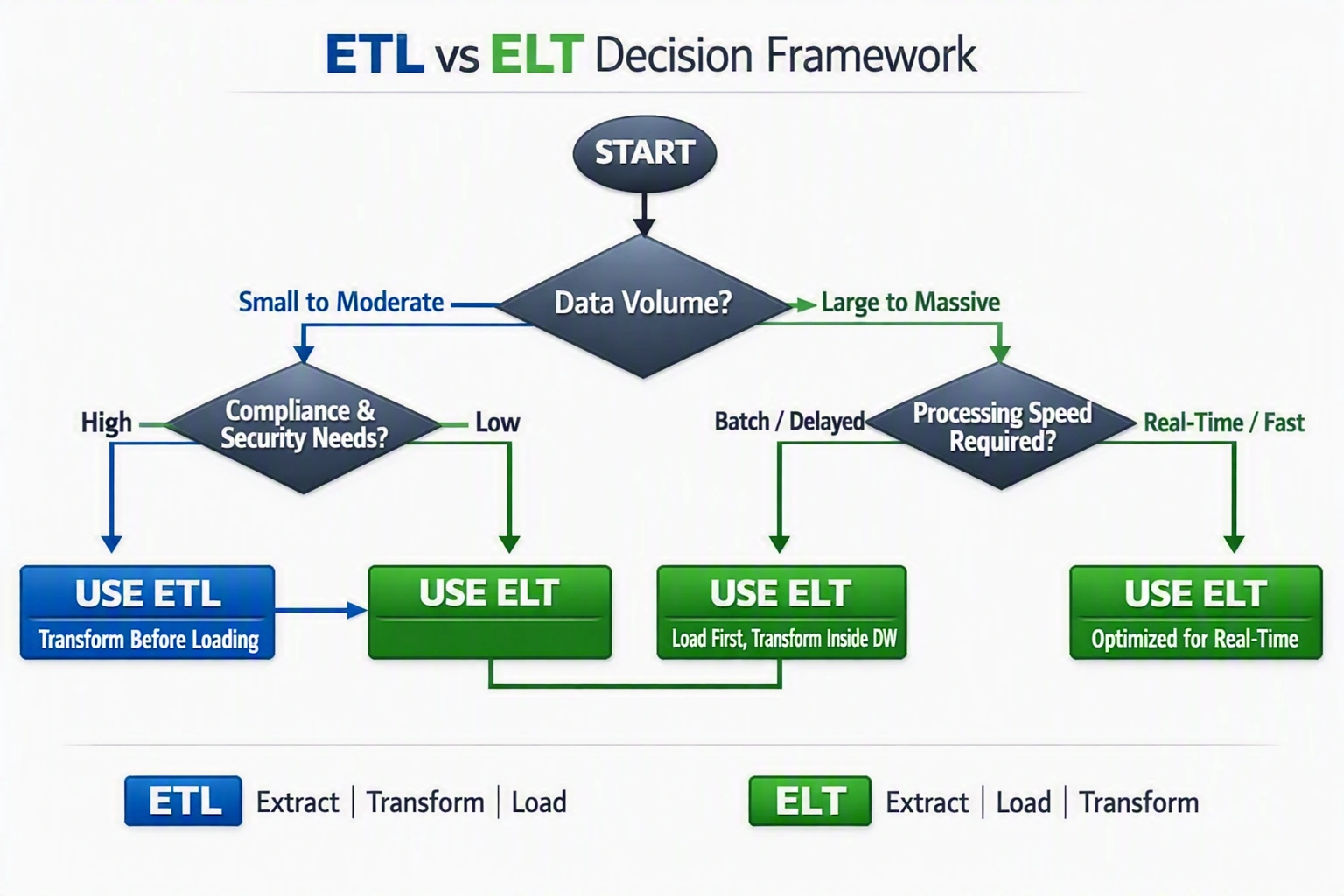
This flowchart helps technical leaders quickly determine whether ETL or ELT is the right approach based on factors like data volume, compliance/security needs, and processing speed requirements.
ETL Path (Blue) → Best for small to moderate data volumes with high compliance/security requirements.
ELT Path (Green) → Best for large-scale datasets and environments needing real-time or fast processing.
Key Differences
| Aspect | ETL | ELT |
|---|---|---|
| Transformation Location | Outside target system | Inside target system |
| Performance | Limited by ETL server capacity | Leverages cloud/data warehouse scalability |
| Data Volume Handling | Suited for moderate volumes | Optimized for massive datasets |
| Latency | Batch-oriented, slower for real-time | Supports near real-time processing |
| Complexity | Requires dedicated ETL tools | Simplified architecture with fewer moving parts |
| Use Case Fit | Legacy systems, compliance-heavy environments | Cloud-native, big data, advanced analytics |
Use Cases
ETL
Financial Reporting: Structured, compliance-driven data pipelines.
Healthcare Systems: Sensitive data transformations before storage.
ERP Integration: Consolidating structured data from multiple enterprise systems.
ELT
Big Data Analytics: Leveraging cloud-native compute for large-scale transformations.
Machine Learning Pipelines: Directly transforming raw data in data lakes.
Streaming Data: Real-time ingestion and transformation for dashboards.
Tools Commonly Used
ETL Tools
Informatica PowerCenter
Talend
Microsoft SQL Server Integration Services (SSIS)
Apache NiFi
ELT Tools
dbt (Data Build Tool)
Apache Spark
Snowflake (native ELT capabilities)
Google BigQuery
Conclusion
Both ETL and ELT remain relevant, but their applicability depends on the data architecture and business requirements.
ETL is ideal for structured, compliance-heavy environments where transformations must occur before loading.
ELT excels in cloud-native ecosystems, enabling scalable, flexible, and real-time analytics.
Enterprises often adopt a hybrid approach, using ETL for legacy systems and ELT for modern cloud platforms, ensuring agility while maintaining governance.

Join the conversation! Your thoughts help the community grow.