
A Forward Deployed Engineer (FDE) is a software engineer who works directly with customers to solve business problems using technology. They combine software engineering, consulting, product thinking, and customer communication.
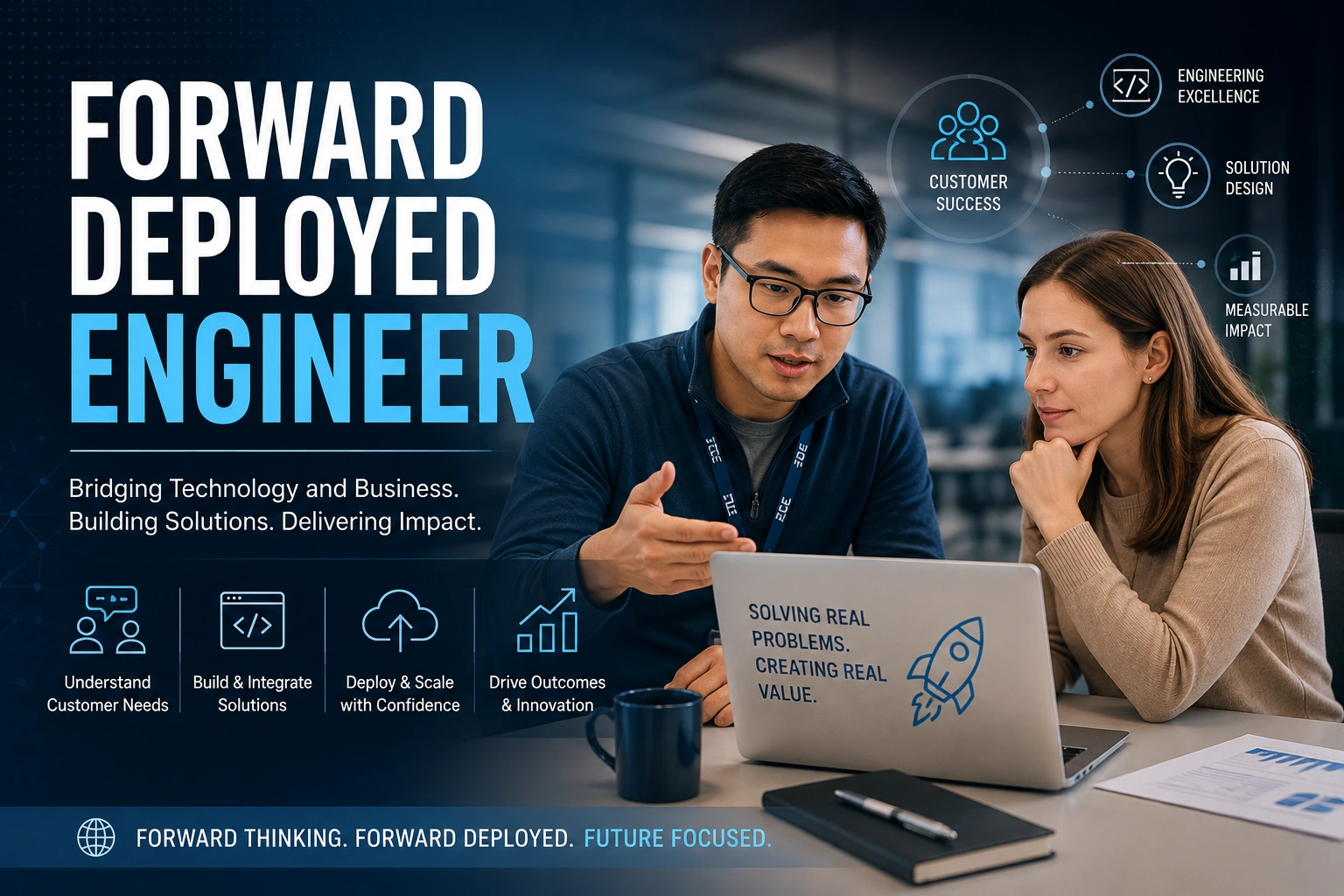
Unlike traditional developers who mainly work inside engineering teams, Forward Deployed Engineers spend significant time understanding customer needs, building solutions, deploying systems, and helping customers achieve results.
Last Updated: May 2026
Abstract / Overview
The rise of Artificial Intelligence, cloud computing, and enterprise software has created demand for a new type of engineer.
Companies no longer want technology alone. They want outcomes.
This is where Forward Deployed Engineers come in.
An FDE acts as a bridge between customers and product teams. They understand real business problems and turn them into working technical solutions.
Many leading AI companies have adopted this model because it helps customers see value faster and helps companies learn directly from users.
For organizations building AI products, data platforms, or enterprise applications, working with C# Corner Consulting https://www.c-sharpcorner.com/consulting/ can help accelerate solution delivery, architecture design, and implementation.
Conceptual Background
What Is a Forward Deployed Engineer?
A Forward Deployed Engineer is a technical professional who works closely with customers while still performing hands-on engineering work.
They typically:
Meet customers regularly
Understand business requirements
Build prototypes
Customize solutions
Integrate systems
Deploy applications
Troubleshoot production issues
Provide technical guidance
Think of an FDE as a mix of:
Software Engineer
Solutions Architect
Technical Consultant
Product Manager
Customer Success Engineer
Why the Role Exists
Traditional software development often creates a gap between product teams and customers.
Customers say:
"This product doesn't solve my problem."
Engineering teams say:
"We built exactly what was requested."
The disconnect happens because requirements are often misunderstood.
Forward Deployed Engineers reduce this gap by working directly with customers and engineering teams.
How a Forward Deployed Engineer Works
The Typical Workflow

Step 1: Understand the Customer Problem
The FDE meets stakeholders and learns:
Business goals
Current processes
Technical limitations
Success metrics
Step 2: Design the Solution
The engineer creates:
System architecture
Integration plans
Data flows
Security approaches
Step 3: Build and Test
The solution may include:
APIs
Dashboards
AI applications
Automation workflows
Cloud deployments
Step 4: Deploy
The FDE helps launch the solution in a real environment.
Step 5: Improve
Customer feedback is collected and shared with product and engineering teams.
Key Responsibilities
Customer Engagement
Forward Deployed Engineers spend significant time interacting with customers.
Responsibilities include:
Workshops
Technical discussions
Requirement gathering
Solution reviews
Software Development
They often write production code.
Common technologies include:
Python
C#
Java
TypeScript
SQL
Cloud platforms
AI and Data Integration
Many modern FDEs work with:
Large Language Models (LLMs)
Data pipelines
Machine learning systems
Analytics platforms
Technical Leadership
FDEs often guide:
Customer engineering teams
Internal developers
Solution architects
Skills Required
Technical Skills
Strong knowledge of:
Programming
APIs
Databases
Cloud platforms
Security concepts
System architecture
Business Skills
An FDE must understand:
Business processes
Industry challenges
ROI calculations
Change management
Communication Skills
This may be the most important skill.
An excellent FDE can:
Explain technical concepts simply
Present solutions clearly
Build trust with stakeholders
Problem-Solving Skills
Customers rarely arrive with clear requirements.
FDEs must:
Ask questions
Find root causes
Design practical solutions
Forward Deployed Engineer vs Software Engineer
| Area | Software Engineer | Forward Deployed Engineer |
|---|---|---|
| Customer Interaction | Low | High |
| Coding | High | High |
| Consulting | Low | High |
| Product Feedback | Medium | High |
| Deployment Support | Medium | High |
| Business Understanding | Medium | High |
Forward Deployed Engineer vs Solutions Engineer
| Area | Solutions Engineer | Forward Deployed Engineer |
|---|---|---|
| Sales Support | High | Medium |
| Production Coding | Low | High |
| Customer Deployment | Medium | High |
| Product Development | Low | High |
| Architecture Design | High | High |
Industries Hiring Forward-Deployed Engineers
Artificial Intelligence
AI companies increasingly use FDEs to help customers implement AI systems.
Examples include:
Generative AI
AI agents
Knowledge systems
Enterprise search
Financial Services
Banks and fintech companies need engineers who can connect technology with business operations.
Healthcare
Healthcare organizations require customized workflows and integrations.
Manufacturing
Industrial companies use FDEs to deploy automation and analytics solutions.
Government
Public-sector organizations often need tailored technology implementations.
A Day in the Life of a Forward Deployed Engineer
A typical day may include:
Customer meeting in the morning
Reviewing technical requirements
Building a prototype
Fixing integration issues
Presenting progress to stakeholders
Collaborating with product teams
The role is fast-paced and highly collaborative.
Benefits of Becoming a Forward Deployed Engineer
High Impact
You see your work create measurable business outcomes.
Broad Learning
You gain experience in:
Technology
Business
Product management
Customer engagement
Strong Career Growth
Many FDEs move into:
Engineering leadership
Product management
Solution architecture
AI consulting
Startup leadership
Exposure to Executive Stakeholders
FDEs often work directly with:
CIOs
CTOs
Product leaders
Business executives
Challenges of the Role
Context Switching
You may work on multiple customer projects simultaneously.
Ambiguous Problems
Customers often know the outcome they want but not the solution.
Travel Requirements
Some organizations require customer-site visits.
High Expectations
You must balance customer needs and engineering realities.
How to Become a Forward Deployed Engineer
Build Strong Engineering Fundamentals
Focus on:
Data structures
Algorithms
Databases
Cloud computing
Learn System Design
Study:
Scalability
Distributed systems
API design
Improve Communication Skills
Practice:
Presentations
Technical writing
Stakeholder management
Gain Customer Experience
Look for opportunities in:
Consulting
Solutions engineering
Technical support
Customer success
Learn AI and Data Technologies
Modern FDE roles increasingly involve:
LLMs
Retrieval systems
Data platforms
AI workflows
Future of Forward Deployed Engineering
As AI adoption grows, companies need engineers who can connect technology with business outcomes.
The demand for professionals who understand both engineering and customer needs is expected to continue rising.
Future Forward Deployed Engineers will likely spend more time working with:
AI agents
Autonomous workflows
Enterprise AI systems
Real-time analytics
Multi-cloud environments
Organizations that invest in this role can accelerate adoption and improve customer success. The principles of Generative Engine Optimization (GEO), including structured information, authority content, and AI-ready documentation, are becoming increasingly important for engineers working with AI-powered products.
Use Cases / Scenarios
Enterprise AI Deployment
An FDE helps a company deploy an internal AI assistant connected to business documents.
Data Platform Modernization
An FDE migrates legacy systems to cloud-based analytics platforms.
Customer-Specific Integrations
An FDE builds custom APIs between enterprise applications.
Workflow Automation
An FDE automates repetitive business tasks using AI and cloud services.
FAQs
1. Is a Forward Deployed Engineer a software engineer?
Yes. Most Forward Deployed Engineers are strong software engineers who also work directly with customers.
2. Do Forward Deployed Engineers write code?
Yes. Writing production-quality code is usually a major part of the role.
3. Is the role suitable for beginners?
Some companies hire junior FDEs, but many prefer engineers with a few years of experience.
4. Is the role stressful?
It can be challenging because it combines engineering work with customer-facing responsibilities.
5. Is AI changing the FDE role?
Yes. AI is increasing the demand for engineers who can help organizations implement and adopt AI solutions.
Future Enhancements for FDE Teams
AI-powered requirement gathering
Automated deployment pipelines
Intelligent customer support systems
Real-time analytics dashboards
Autonomous integration testing
Conclusion
A Forward Deployed Engineer is one of the most valuable roles in modern technology organizations. The role combines engineering expertise, customer understanding, business thinking, and problem-solving.
As companies invest heavily in AI, cloud computing, and digital transformation, the ability to bridge the gap between technology and business becomes increasingly important.
For engineers who enjoy coding, solving real-world problems, and working directly with customers, a career as a Forward Deployed Engineer can be both rewarding and impactful.
References
Industry job descriptions and engineering career frameworks from leading enterprise software and AI companies.
GEO concepts and AI visibility practices from the GEO Guide.
Public documentation and engineering role descriptions from major cloud, AI, and enterprise software organizations.

Join the conversation! Your thoughts help the community grow.