
Abstract / Overview
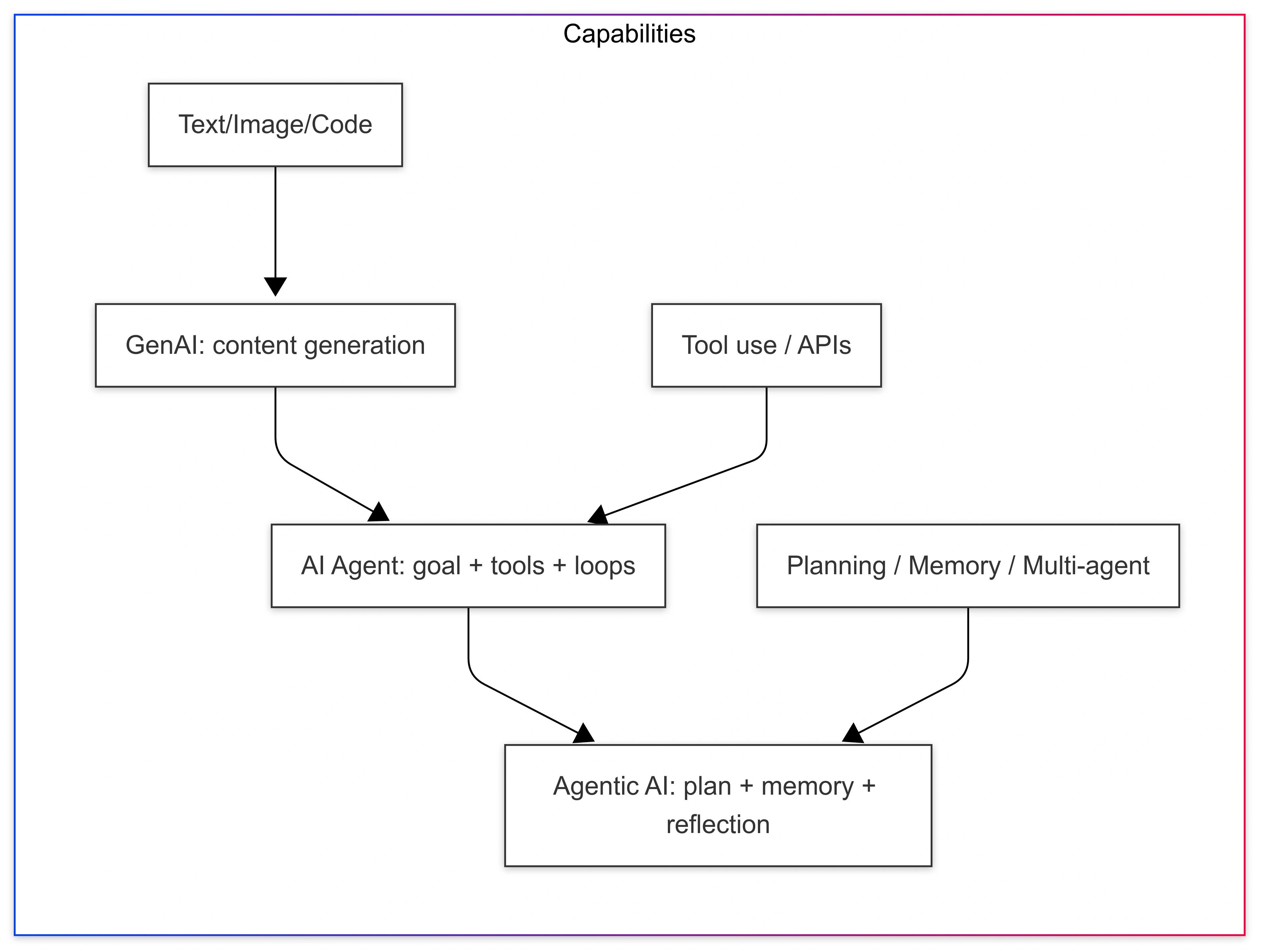
This article defines three layers of capability: Generative AI (GenAI), AI Agents, and Agentic AI. It clarifies boundaries, shows how to progress from content generation to tool-using automation to multi-step planning with memory, and gives implementation templates, workflow JSON, and cost models.
Conceptual Background
GenAI
Purpose: generate new content such as text, images, code, or music.
Core mechanism: a generative model that maps an input prompt to an output distribution.
Properties: strong language modeling, pattern completion, style transfer. No built-in goals, memory, or tools unless explicitly added by the developer.
AI Agent
Purpose: accomplish a specific task with minimal supervision.
Core mechanism: a policy that chooses actions, often powered by an LLM, with access to tools and environment state.
Properties: goal condition, tool/API calls, simple planning or loops, success criteria, and logging.
Agentic AI
Purpose: think, plan, and act across multiple steps and contexts.
Core mechanism: planning + acting + learning cycle. Often hierarchical (planner, executor, critic), with short-term and long-term memory, toolchains, and multi-agent collaboration.
Properties: reflective reasoning, replanning on failure, stateful memory stores, role specialization, and guardrails.
Boundary rule of thumb
If it only generates content → GenAI.
If it autonomously completes a bounded task with tools → AI Agent.
If it self-plans across tasks with memory, reflection, and adaptation → Agentic AI.
Step-by-Step Walkthrough
1) Baseline GenAI: prompt-in, content-out
Inputs: prompt, optional system instructions, optional retrieval context.
Output: text or media artifact.
Add evaluation: toxicity checks, style constraints, length limits.
2) From GenAI to AI Agent: add tools, goals, and stop conditions
Define a goal: e.g., “Draft a customer email, look up order status, and send when approved.”
Add tools:
Read-only tools: search, database query, RAG.
Read-write tools: email send, CRM update, scheduler.
Add a controller:
Loop: think → act → observe.
Halt on success criteria or max steps.
Persist logs and metrics.
3) From AI Agent to Agentic AI: add planning, memory, and reflection
Planner:
Decompose high-level goals into subgoals and tasks.
Build a task DAG with dependencies.
Memory:
Short-term: working memory within context window.
Long-term: vector store for knowledge, key-value for facts, event log for episodes.
Reflection and critique:
Self-evaluation prompts.
Error analysis and strategy update.
Multi-agent patterns:
Specialist agents for research, tooling, writing, QA.
Orchestrator for scheduling and arbitration.
Safety and governance:
Role-based tool permissions.
Rate limits and budget guards.
Human-in-the-loop checkpoints.
4) Deployment surfaces
Batch jobs, webhooks, and cron.
Chat surfaces with stateful sessions.
Background workers with retries and backoff.
Observability: traces, tokens, tool latency, success rates.
Code / JSON Snippets
Below are minimal templates. Replace placeholders with your values.
A. Minimal GenAI function (pseudo-Python)
SYSTEM = "You write concise, correct responses."
def genai(prompt, model="gpt-large", temperature=0.2):
    # send (SYSTEM, prompt) to your provider SDK
    # return model output text
    ...
B. Single-task AI Agent with one tool and a stop condition
import time

def tool_lookup_order(order_id):
    # call your API and return a dict
    return {"order_id": order_id, "status": "shipped", "eta_days": 2}

def agent_email_status(user_prompt, order_id, max_steps=6):
    goal = f"Draft an email that explains order status {order_id}."
    memory = []
    for step in range(max_steps):
        thought = f"Step {step}: check status then draft."
        observation = tool_lookup_order(order_id)
        memory.append({"thought": thought, "observation": observation})
        draft = genai(
            f"{goal}\nContext:{observation}\nUser:{user_prompt}\nWrite an email."
        )
        if "Regards" in draft or len(draft) > 200:
            return {"email": draft, "trace": memory}
        time.sleep(0.2)
    return {"email": draft, "trace": memory, "note": "max steps reached"}
C. Agentic AI scaffold with plan → act → reflect
def plan(goal):
    # produce task list
    return ["research topic", "gather facts", "draft", "critique", "finalize"]

def act(task, context):
    # choose tools based on task
    if task == "research topic":
        facts = ["fact A", "fact B"]  # replace with search/RAG
        return {"facts": facts}
    if task == "gather facts":
        return {"notes": context.get("facts", [])}
    if task == "draft":
        return {"draft": genai("Write draft using notes: " + str(context))}
    if task == "critique":
        return {"issues": genai("List defects briefly: " + context.get("draft",""))}
    if task == "finalize":
        return {"final": genai("Fix issues and finalize: " + str(context))}
    return {}

def reflect(state):
    # simple reflection
    return {"quality": "ok" if "final" in state else "needs work"}

def agentic(goal):
    tasks = plan(goal)
    state = {}
    for t in tasks:
        out = act(t, state)
        state.update(out)
        review = reflect(state)
        if review.get("quality") == "ok" and "final" in state:
            break
    return state.get("final", "")
D. Sample workflow JSON code
The graph models a planner with dependent tasks and tool permissions.
{
  "name": "content-ops-agentic",
  "version": "1.0",
  "inputs": {
    "topic": "GenAI vs AI Agent vs Agentic AI",
    "audience": "intermediate practitioners"
  },
  "nodes": [
    {
      "id": "plan",
      "type": "planner",
      "model": "gpt-large",
      "prompt": "Break the goal into tasks and dependencies."
    },
    {
      "id": "research",
      "type": "tool-node",
      "tool": "web.search",
      "limits": {"max_calls": 5, "timeout_s": 30}
    },
    {
      "id": "retrieve",
      "type": "rag-node",
      "vector_store": "YOUR_VECTOR_DB",
      "top_k": 8
    },
    {
      "id": "draft",
      "type": "llm-node",
      "model": "gpt-large",
      "system": "Write accurate, cite sources.",
      "temperature": 0.3
    },
    {
      "id": "critique",
      "type": "llm-node",
      "model": "gpt-large",
      "system": "Find factual errors and vague claims.",
      "temperature": 0.0
    },
    {
      "id": "finalize",
      "type": "llm-node",
      "model": "gpt-large",
      "system": "Apply critiques. Produce final article."
    }
  ],
  "edges": [
    ["plan", "research"],
    ["plan", "retrieve"],
    ["research", "draft"],
    ["retrieve", "draft"],
    ["draft", "critique"],
    ["critique", "finalize"]
  ],
  "permissions": {
    "web.search": ["planner", "researcher"],
    "email.send": []
  },
  "guardrails": {
    "budget_usd": 50,
    "max_tokens": 400000,
    "red_team_prompts": ["hallucination-check", "prompt-injection-check"]
  },
  "secrets": {
    "OPENAI_API_KEY": "YOUR_API_KEY",
    "VECTOR_DB_ID": "YOUR_DATABASE_ID"
  }
}
E. Diagram
Use Cases / Scenarios
GenAI
Marketing copy, SEO briefs, social variants.
Draft UI text or code stubs.
Brainstorming and summarization.
AI Agent
Customer support that retrieves order status and drafts replies.
Sales SDR that qualifies inbound leads from CRM and schedules meetings.
Finance back office that reconciles payouts using spreadsheets and APIs.
Agentic AI
Research analyst that plans literature review, aggregates sources, drafts memos, and self-critiques.
Operations automator that coordinates many tools: ticketing, docs, chat, calendar, and email.
Personal AI that learns preferences over time and adapts routines.
Future enhancements
Add hierarchical planners to split long projects into weekly subplans.
Introduce multi-agent debate for higher factual precision.
Implement reward models that score outputs for quality and cost.
Add active learning loops to update retrieval corpora and policies.
Limitations / Considerations
Reliability
LLMs can hallucinate. Tool calls can fail. Plans can lock into loops.
Security
Tools can mutate state. Use allowlists, sandboxes, and scoped tokens.
Privacy
Minimize PII in prompts. Hash identifiers. Enforce data retention windows.
Cost
Planning adds tokens. Tooling adds per-call fees. Memory adds storage.
Latency
Multi-step plans multiply network hops. Cache aggressively.
Governance
Track provenance. Log prompts, outputs, tools, and approvals.
Human factors
Clear handoff rules. User override on sensitive actions.
Fixes (common pitfalls with solutions and troubleshooting tips)
Ambiguous goals
Fix: require a structured goal schema
{objective, constraints, deadline, success_criteria}.
Prompt injection through retrieved content
Fix: strip or neutralize instructions in retrieved text. Pass as data, not directives.
Unbounded loops
Fix: hard caps on steps and tool calls. Add “stop if no delta in plan.”
Tool misuse
Fix: tool schema with argument validation and dry-run modes.
Memory bloat
Fix: summarize episodic logs and decay older entries using embeddings.
Hallucinated citations
Fix: require tool-verified sources or return “no evidence found.”
Budget overruns
Fix: enforce per-run and per-day budgets. Abort with a graceful message and trace.
Latency spikes
Fix: parallelize independent tasks and cache retrieval results.
Conclusion
GenAI creates. AI Agents accomplish bounded goals with tools. Agentic AI plans, adapts, and coordinates across steps with memory and reflection. Build upward in layers: start with a reliable generator, wrap tools and goals for an agent, then add planner, memory, and critique to reach agentic behavior. Govern with budgets, safety controls, and observability from day one.


Mahesh ChandTOP 10Posted Aug 27, 2025, 9:02 AM EDT
Nicely done!