
Abstract / Overview
Multi-Agent Reinforcement Learning (MARL) studies how multiple autonomous agents learn simultaneously through interaction with a shared environment and with each other. Each agent adapts its policy based on rewards, observations, and the evolving behavior of other agents. MARL extends classical reinforcement learning into settings that involve cooperation, competition, or mixed incentives. It is foundational to robotics swarms, traffic control, distributed systems, games, and modern AI coordination problems.
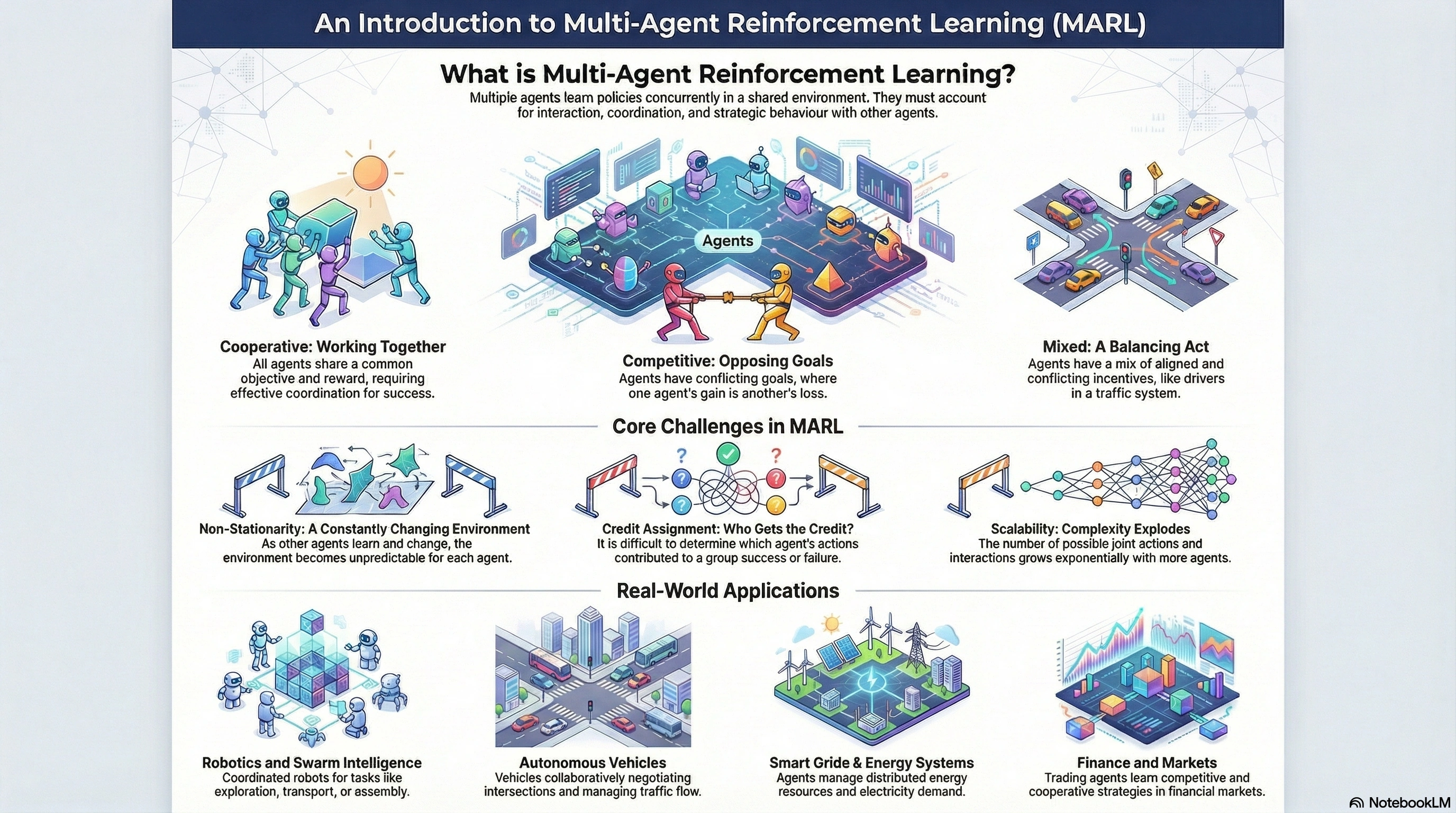
Direct answer: Multi-agent reinforcement learning is a reinforcement learning paradigm where multiple agents learn policies concurrently in a shared environment, accounting for inter-agent interaction, coordination, and strategic behavior.
Conceptual Background
From Single-Agent RL to Multi-Agent Systems
In single-agent reinforcement learning, an agent interacts with a stationary environment modeled as a Markov Decision Process (MDP). In MARL, the environment becomes non-stationary from each agent’s perspective because other agents are also learning and changing their policies.
This shift introduces new challenges:
Coupled decision-making
Partial observability
Strategic reasoning
Emergent coordination or conflict
MARL draws heavily from game theory, distributed systems, and control theory, in addition to reinforcement learning.
Formal Setting
A typical MARL problem is modeled as a Markov Game (also called a stochastic game):
A set of agents
A shared state space
Individual action spaces per agent
A transition function dependent on joint actions
Individual or shared reward functions
Each agent seeks to optimize its own expected return, which may align or conflict with others.
Core MARL Paradigms
Cooperative MARL
All agents share a common objective and reward signal. Success depends on coordination.
Examples:
Robot swarms moving objects together
Distributed sensor networks
Team-based strategy games
Competitive MARL
Agents have opposing goals. Learning resembles strategic games.
Examples:
Adversarial games
Security and attack-defense simulations
Market trading agents
Mixed / General-Sum MARL
Agents have partially aligned and partially conflicting incentives.
Examples:
Traffic systems with self-interested drivers
Resource allocation in networks
Economic simulations
Centralized vs Decentralized Learning
Centralized Training, Decentralized Execution (CTDE)
A dominant paradigm in modern MARL.
Training uses global state and joint information
Execution relies only on local observations
Balances scalability and coordination
CTDE enables stable learning while preserving autonomy at inference time.
Fully Decentralized Learning
Each agent learns independently using only local information.
Advantages:
Scalable
Robust to communication failures
Limitations:
Non-stationarity
Credit assignment difficulty
Major MARL Algorithms and Approaches
Independent Learners
Each agent treats others as part of the environment and applies standard RL.
Independent Q-Learning
Independent Policy Gradients
Simple but unstable in many settings due to non-stationarity.
Value Decomposition Methods
Designed for cooperative MARL under CTDE.
Key ideas:
Learn individual value functions
Combine them into a joint value function
Notable algorithms:
Value Decomposition Networks (VDN)
QMIX
These approaches enforce structural constraints to enable coordination.
Policy Gradient Methods
Agents directly optimize parameterized policies.
Examples:
Multi-Agent Deep Deterministic Policy Gradient (MADDPG)
Centralized critics with decentralized actors
These methods handle continuous action spaces effectively.
Game-Theoretic Learning
Incorporates equilibrium concepts.
Nash equilibrium learning
Fictitious play
Minimax learning
Often used in competitive or adversarial environments.
Step-by-Step MARL Training Workflow

Training typically follows these stages:
Initialize policies for all agents
Collect joint experience from environment interactions
Compute rewards (shared or individual)
Update policies using centralized or decentralized signals
Repeat until convergence or equilibrium
Key Challenges in MARL
Non-Stationarity
Because agents update policies simultaneously, the environment dynamics change over time.
Mitigation strategies:
Centralized critics
Experience replay stabilization
Slower policy updates
Credit Assignment
Determining which agent contributed to success or failure.
Solutions:
Difference rewards
Counterfactual baselines
Attention-based critics
Scalability
Joint action spaces grow exponentially with the number of agents.
Approaches:
Parameter sharing
Factorized value functions
Communication learning
Communication and Coordination
Agents may need to share information.
Research directions:
Learned communication protocols
Emergent languages
Bandwidth-constrained messaging
Use Cases and Applications
1. Robotics and Swarm Intelligence
Multiple robots coordinate to explore, transport, or assemble.
2. Autonomous Vehicles
Vehicles negotiate intersections, lane changes, and traffic flow collaboratively.
3. Games and Simulations
Complex environments such as StarCraft II and cooperative board games have driven MARL benchmarks.
4. Smart Grids and Energy Systems
Agents manage distributed energy resources and demand response.
5. Finance and Markets
Trading agents learn strategies under competition and partial cooperation.
Limitations and Considerations
Training instability remains a core issue
Theoretical convergence guarantees are limited
High computational cost for large agent populations
Real-world deployment requires robustness to partial observability and failures
Assumption: most current MARL successes rely on simulated environments with controlled dynamics.
Fixes and Practical Tips
Use centralized critics to stabilize learning
Limit agent count early; scale gradually
Apply parameter sharing when agents are homogeneous
Regularly evaluate against fixed policy baselines
Visualize joint behaviors, not just rewards
FAQs
1. How is MARL different from distributed RL?
Distributed RL focuses on parallelizing learning for efficiency, while MARL focuses on interaction between learning agents.
2. Is MARL only for cooperation?
No. MARL covers cooperative, competitive, and mixed-incentive scenarios.
3. Does MARL require communication between agents?
Not always. Communication can be learned, predefined, or absent depending on the task.
4. Is MARL used in real products today?
Yes, in robotics, traffic control, recommendation systems, and simulation-driven decision-making tools.
References
Sutton, R. S., & Barto, A. G. Reinforcement Learning: An Introduction
Shoham, Y., Powers, R., & Grenager, T. Multi-Agent Reinforcement Learning: A Critical Survey
OpenAI and DeepMind research on multi-agent systems
Conclusion
Multi-agent reinforcement learning extends reinforcement learning into interactive, strategic, and distributed environments. By addressing coordination, competition, and non-stationarity, MARL enables intelligent systems to function collectively rather than in isolation. As AI systems increasingly operate in shared and decentralized settings, MARL provides the theoretical and practical foundation for scalable, adaptive, and cooperative intelligence.

Join the conversation! Your thoughts help the community grow.