
Introduction
In the rapidly evolving Fintech landscape of 2026, the traditional paradigms of credit scoring are being fundamentally challenged. For decades, financial institutions relied on rigid, feature-based Machine Learning (ML) pipelines to assess creditworthiness. However, these models often fail to capture the nuanced, real-world financial behaviors of thin-file applicants or Small and Medium Enterprises (SMEs).
To overcome these limitations, our engineering team transitioned to a RAG-powered (Retrieval-Augmented Generation) credit scoring workflow orchestrated by an Enterprise Multi-Agent LangGraph system. By combining structured financial metrics with unstructured contextual data and utilizing persistent state and memory we built a system that doesn't just output a score, but provides an explainable, context-rich underwriting decision. This article details how this workflow differs from traditional pipelines and provides a complete, end-to-end Proof of Concept (POC).
Traditional Feature-Based ML vs. RAG-Powered Credit Scoring
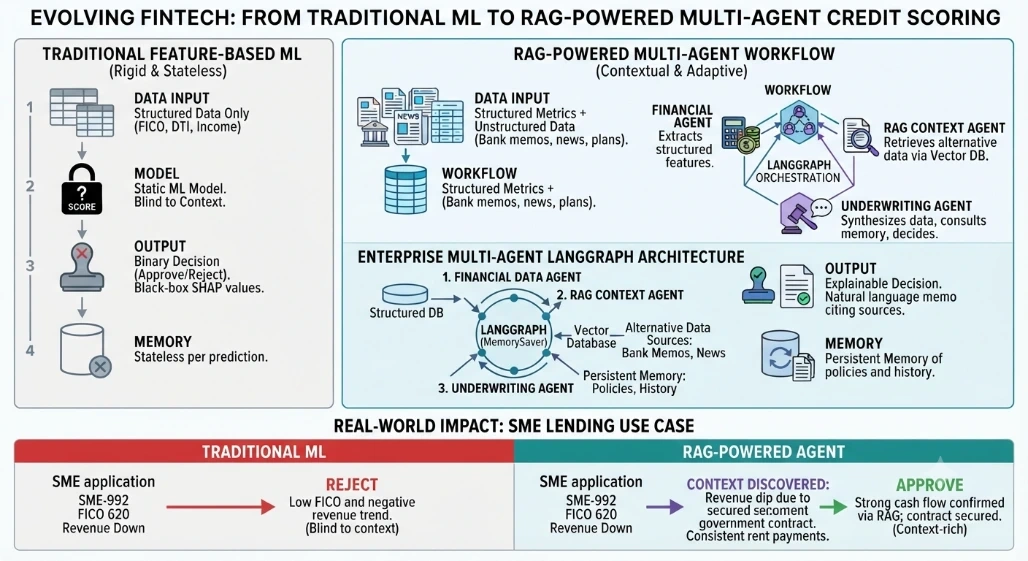
The shift from traditional ML to RAG-powered agents represents a move from rigid mathematics to contextual reasoning.
Feature | Traditional Feature-Based ML Pipeline | RAG-Powered Multi-Agent Workflow |
|---|---|---|
Data Input | Strictly tabular/structured (FICO, DTI, Income). | Structured metrics + Unstructured data (bank memos, news, business plans). |
Context Awareness | Zero. Treats a $10k drop in revenue the same regardless of why. | High. Retrieves context (e.g., "Revenue dropped due to a planned equipment upgrade"). |
Explainability | Black-box feature importance (SHAP values). | Natural language explanations citing retrieved documents and policies. |
Adaptability | Requires retraining the model for new data types. | Dynamically retrieves new context via Vector DB without model retraining. |
Memory | Stateless per prediction. | Persistent memory of underwriting policies and applicant interaction history. |
Real-Time Use Case: SME Lending with Alternative Data
The Scenario: An SME applies for a $100,000 working capital loan.
Traditional ML: The model sees a low personal FICO score (620) and a recent dip in business revenue. It automatically rejects the application.
RAG-Powered Workflow: The system retrieves the business's unstructured bank transaction narratives and recent industry news. The RAG agent discovers the revenue dip was due to a delayed, but already secured, government contract, and the bank memos show consistent, on-time rent payments not captured in traditional credit bureaus. The system approves the loan with an explainable memo.
Enterprise Multi-Agent LangGraph Architecture
Our architecture uses LangGraph to route the application through specialized agents:
Financial Data Agent: Extracts traditional structured features.
RAG Context Agent: Queries a Vector Database for unstructured alternative data and news.
Underwriting Agent: Synthesizes both data streams, consults persistent memory for bank lending policies, and generates the final decision.
Step-by-Step POC Implementation
Step 1: Defining the State and Memory (LangGraph)
We define the state schema and initialize LangGraph's MemorySaver to persist underwriting policies and session history.
# backend/graph_state.py
from typing import TypedDict, List, Annotated
from langgraph.graph import StateGraph, END
from langgraph.checkpoint.memory import MemorySaver

class CreditState(TypedDict):
    applicant_id: str
    structured_features: dict
    retrieved_context: List[str]
    final_decision: str
    reasoning_trace: Annotated[List[str], "Memory of agent reasoning"]

# Initialize Memory for State and Policy Persistence
memory = MemorySaver()
Step 2: Building the Multi-Agent Workflow
We define the nodes (agents) and edges. The RAG agent simulates retrieving unstructured context from a vector store.
# backend/agents.py
from .graph_state import CreditState, memory

# Mock Vector Database for RAG (Alternative Data)
MOCK_VECTOR_DB = {
    "SME-992": [
        "Bank Memo: Consistent $4,500 monthly rent payment for 24 months.",
        "News: SME-992 awarded $250k municipal contract starting next quarter."
    ],
    "SME-104": [
        "Bank Memo: Frequent overdraft fees in the last 3 months."
    ]
}

def financial_data_agent(state: CreditState):
    """Extracts traditional structured credit features."""
    app_id = state["applicant_id"]
    # Mocked structured data extraction
    features = {"fico_score": 620, "dti_ratio": 0.45, "revenue_delta": -15.0}
    state["reasoning_trace"].append(f"Financial Agent: Extracted features for {app_id}. FICO is low, revenue is down.")
    return {"structured_features": features}

def rag_context_agent(state: CreditState):
    """Retrieves unstructured alternative data via RAG."""
    app_id = state["applicant_id"]
    context = MOCK_VECTOR_DB.get(app_id, ["No alternative data available."])
    state["reasoning_trace"].append(f"RAG Agent: Retrieved {len(context)} unstructured context documents.")
    return {"retrieved_context": context}

def underwriting_agent(state: CreditState):
    """Synthesizes data, checks memory/policies, and makes a decision."""
    features = state["structured_features"]
    context = state["retrieved_context"]

    # Simulate LLM reasoning based on retrieved context
    decision = "REJECT"
    reason = "Low FICO and negative revenue trend."

    # Context overrides traditional ML rigid rules
    if any("municipal contract" in doc for doc in context) and any("rent payment" in doc for doc in context):
        decision = "APPROVE"
        reason = "Despite low FICO, RAG retrieved evidence of strong cash flow: secured municipal contract and flawless rent history."

    final_report = f"Decision: {decision}\nReasoning: {reason}"
    state["reasoning_trace"].append("Underwriting Agent: Final decision rendered based on synthesized context.")

    return {"final_decision": final_report}

# Build the Graph
workflow = StateGraph(CreditState)
workflow.add_node("financial", financial_data_agent)
workflow.add_node("rag", rag_context_agent)
workflow.add_node("underwriting", underwriting_agent)

workflow.set_entry_point("financial")
workflow.add_edge("financial", "rag")
workflow.add_edge("rag", "underwriting")
workflow.add_edge("underwriting", END)

# Compile with Memory
app = workflow.compile(checkpointer=memory)
Step 3: The FastAPI Backend
We expose the LangGraph workflow via a REST API, utilizing thread_id to maintain memory of the underwriting session.
# backend/main.py
from fastapi import FastAPI, HTTPException
from pydantic import BaseModel
from .agents import app

app_api = FastAPI(title="Fintech Credit Scoring POC")

class CreditRequest(BaseModel):
    applicant_id: str
    session_id: str = "underwriting_session_01"

@app_api.post("/score-applicant")
async def score_applicant(req: CreditRequest):
    config = {"configurable": {"thread_id": req.session_id}}

    initial_state = {
        "applicant_id": req.applicant_id,
        "structured_features": {},
        "retrieved_context": [],
        "final_decision": "",
        "reasoning_trace": []
    }

    try:
        final_state = app.invoke(initial_state, config)
        return {
            "decision": final_state["final_decision"],
            "agent_trace": final_state["reasoning_trace"]
        }
    except Exception as e:
        raise HTTPException(status_code=500, detail=str(e))
Step 4: The Streamlit Frontend
A clean UI for loan officers to interact with the multi-agent system and view the RAG context.
# frontend/app.py
import streamlit as st
import requests

st.set_page_config(page_title="AI Underwriting Assistant", layout="wide")
st.title("🏦 Enterprise AI Underwriting: RAG-Powered Credit Scoring")

st.sidebar.header("Application Details")
applicant_id = st.sidebar.text_input("Applicant ID", "SME-992")
session_id = st.sidebar.text_input("Session ID (Memory)", "session_01")

if st.sidebar.button("Run Credit Assessment"):
    with st.spinner("Agents are analyzing structured and unstructured data..."):
        response = requests.post(
            "http://localhost:8000/score-applicant",
            json={"applicant_id": applicant_id, "session_id": session_id}
        )

        if response.status_code == 200:
            data = response.json()

            col1, col2 = st.columns([1, 1])
            with col1:
                st.subheader("Final Underwriting Decision")
                if "APPROVE" in data["decision"]:
                    st.success(data["decision"])
                else:
                    st.error(data["decision"])

            with col2:
                st.subheader("Agent Reasoning & RAG Trace")
                for trace in data["agent_trace"]:
                    st.info(f"🧠 {trace}")
        else:
            st.error("Error connecting to the underwriting engine.")
Conclusion
The transition from traditional feature-based ML pipelines to RAG-powered multi-agent workflows marks a critical evolution in Fintech credit scoring. While traditional models are fast and mathematically rigorous, they are inherently blind to context. By integrating LangGraph, we created a system where the Financial Agent handles the math, the RAG Agent provides the real-world context, and the Underwriting Agent synthesizes both. Crucially, the inclusion of persistent memory allows the system to remember underwriting policies and session histories, transforming a static scoring tool into a dynamic, explainable, and highly inclusive AI underwriting assistant. This architecture not only reduces false negatives for thin-file applicants but also provides auditors with clear, document-backed reasoning for every credit decision.

Join the conversation! Your thoughts help the community grow.