
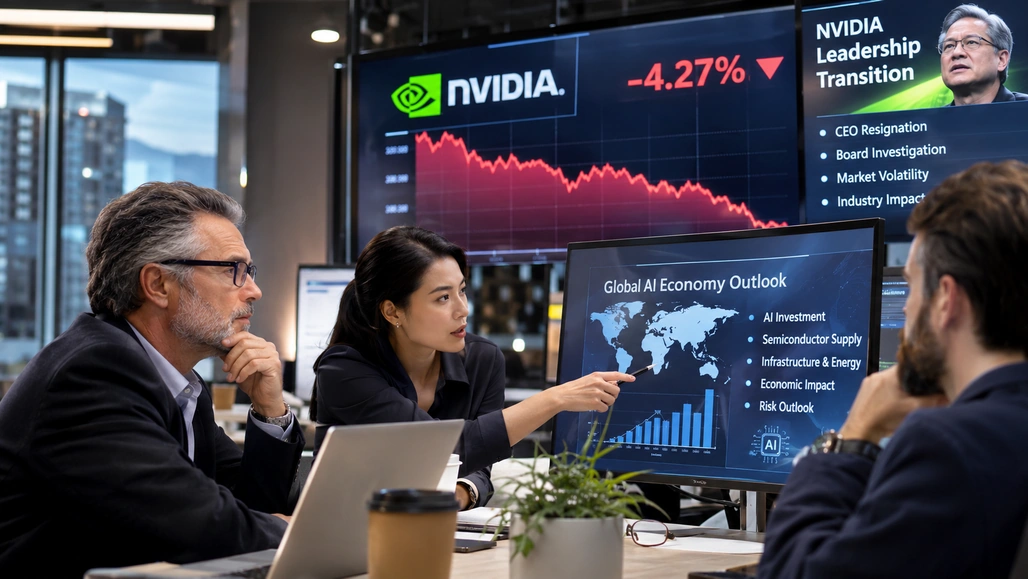
NVIDIA's Leadership Crisis, the Fragility of Global AI Infrastructure, and the Economic Consequences for America and the World
By John Gödel
Founder & CEO, Gate2ASI AI Technologies Inc.
Chief Enterprise AI Architect
November 13, 2026
Abstract
Artificial intelligence is entering a decisive stage of technological and economic development. Advances in reasoning models, multimodal intelligence, autonomous agents, and accelerated computing are creating unprecedented opportunities for productivity, scientific discovery, industrial transformation, and economic growth. Simultaneously, the global AI ecosystem is becoming increasingly dependent on a concentrated network of semiconductor manufacturers, cloud infrastructure providers, financial institutions, and dominant technology corporations.
The recent NVIDIA leadership crisis exposes the structural vulnerabilities within this rapidly expanding ecosystem.
In this article, I examine the relationship between AI technological development, NVIDIA's corporate governance controversy, capital-market concentration, semiconductor supply-chain security, and the macroeconomic implications for the United States and the international economy.
My central argument is that artificial intelligence remains one of the most consequential technologies in modern economic history, but its long-term success depends on reducing systemic concentration, strengthening independent governance, and ensuring that financial investment is supported by measurable productivity and sustainable economic value.
1. Artificial Intelligence Has Entered a New Economic Era
For many years, artificial intelligence was primarily regarded as an emerging technology with enormous theoretical potential.
That period has ended.
AI has become a significant component of global investment strategy, national industrial policy, enterprise architecture, scientific research, and digital infrastructure development.
The transition from conventional machine-learning systems to generative AI and autonomous agentic systems is especially important.
Traditional enterprise software generally executes predefined instructions. Modern AI systems increasingly interpret objectives, generate plans, use tools, analyze information, and perform multistep tasks.
This represents a fundamental shift in the relationship between humans, technology, and economic production.
Stanford University's 2026 AI Index reports that organizational AI adoption reached 88% of surveyed organizations in 2025. However, deployment of AI agents remained in the single digits across nearly all business functions.
This distinction is critical.
There is a substantial difference between using AI experimentally and integrating autonomous systems into controlled, measurable business processes.
Source: Stanford University, 2026 AI Index
From my perspective as an Enterprise Architect, the next phase of AI should not be measured exclusively by model size, benchmark performance, or the number of installed GPUs.
It should be evaluated through economic outcomes:
Measurable productivity improvements
Reduction of operational costs
Reliability and continuity of enterprise operations
Security and governance effectiveness
Sustainable returns on infrastructure investment
Long-term scientific and industrial innovation
The true value of artificial intelligence emerges when computational intelligence becomes reliable economic productivity.
2. The NVIDIA Crisis: A Corporate Event With Systemic Implications
NVIDIA occupies an extraordinary position in the international AI economy.
Its GPUs, networking technologies, CUDA ecosystem, and accelerated computing platforms provide critical infrastructure for training and deploying advanced AI models.
In August 2026, NVIDIA reported fiscal second-quarter revenue of $96.2 billion, representing 106% year-over-year growth. Data center revenue reached $89 billion, demonstrating the scale of global demand for AI infrastructure.
Source: NVIDIA Fiscal 2027 Second-Quarter Results
However, technological dominance creates a corresponding responsibility for governance, transparency, and systemic stability.
What is established, and what remains under investigation?
On November 8, 2026, NVIDIA announced that independent directors would investigate reporting concerning a possible foreign intelligence effort involving its founder and CEO, Jensen Huang.
On November 11, NVIDIA's board accepted Huang's resignation, effective immediately, and appointed Chief Financial Officer Colette Kress as interim CEO.
The crisis followed reports concerning Huang's personal relationships, alleged intelligence connections involving a Chinese businesswoman, and questions surrounding restricted semiconductor shipments to China.
Reuters reported allegations that business relationships facilitated at least $7.5 billion in NVIDIA chip shipments to Chinese firms.
These allegations require careful treatment.
On November 12, the U.S. Justice Department explicitly stated that it had not concluded whether Alice Huang, the businesswoman at the center of the allegations, was acting as a Chinese intelligence agent.
NVIDIA's board had previously stated that it had no reason to believe national security or company secrets had been compromised.
Consequently, allegations of espionage, unlawful export activity, or corporate misconduct must not be presented as established findings.
Sources: NVIDIA Board Statement | SEC Form 8-K | Reuters, November 12
My concern extends beyond the personal circumstances surrounding this controversy.
When a corporation becomes an essential component of a country's technological and economic infrastructure, corporate governance becomes a matter of systemic resilience.
An AI ecosystem cannot be considered fully mature if confidence in its stability depends excessively on one executive, one semiconductor supplier, or one interconnected financing network.
3. The Financial Shock: Understanding the Economic Consequences
NVIDIA's market reaction demonstrates how rapidly a company-specific governance crisis can propagate through financial markets.
Reuters reported that NVIDIA lost approximately $430 billion in market capitalization across two trading sessions by November 10, 2026.
Further volatility followed Huang's departure.
On November 13, Reuters reported that U.S. technology shares remained under pressure, with the Nasdaq Composite declining around 1.4% and the Philadelphia Semiconductor Index approximately 4% during the reporting period.
These movements occurred alongside broader inflation concerns, meaning not all market declines can be attributed exclusively to NVIDIA.
Source: Reuters, Global Markets, November 13, 2026
It is important to recognize that a decline in market capitalization is not equivalent to an identical reduction in national GDP or realized economic losses.
However, sustained declines in technology valuations can affect the real economy through several mechanisms.
Capital-market transmission
A significant decline in AI-related valuations can influence investment portfolios, pension funds, retirement savings, institutional capital allocations, and risk appetite.
Investment and financing transmission
As the cost of capital increases, technology companies may delay data center construction, reduce infrastructure commitments, or renegotiate financing arrangements.
Supply-chain transmission
Changes in semiconductor orders can propagate to foundries, memory manufacturers, equipment suppliers, power infrastructure providers, and construction companies.
Confidence transmission
If uncertainty persists, enterprises may delay major AI investments until leadership stability, technology roadmaps, and long-term infrastructure costs become clearer.
These mechanisms are well recognized in financial economics, although their magnitude in the current NVIDIA crisis remains uncertain.
The essential point is that financial market stress becomes economically consequential when it changes real investment, employment, financing conditions, and productive capacity.
4. Circular Financing and the Sustainability of the AI Investment Boom
One of the most important issues emerging from the NVIDIA controversy is the structure of financing within the AI industry.
Some semiconductor companies invest in AI infrastructure providers or model developers that subsequently purchase their computing technologies.
These arrangements are not inherently improper. Strategic investments can help create new markets, accelerate infrastructure deployment, and reduce financing constraints.
However, they also introduce financial interdependence.
For example, a semiconductor company may invest in an AI cloud provider. That provider purchases hardware from the semiconductor company and sells computing capacity to AI developers.
Revenue, financing, and expectations of future growth become interconnected.
The critical economic question is whether the system ultimately produces sufficient independent customer revenue and operating cash flow.
If expansion is disproportionately supported by investment circulating among companies within the same ecosystem, reported growth can become more sensitive to financing conditions.
Reuters reported that NVIDIA's incoming interim CEO had questioned certain aggressive financing commitments, including major AI infrastructure investments.
Source: Reuters, November 13, 2026
I believe the industry should examine AI investment through three distinct measures:
First, infrastructure growth: How much capital is being invested in computing capacity?
Second, commercial utilization: How effectively is that capacity being used by paying customers?
Third, independently generated economic value: How much productivity, revenue, scientific progress, or cost reduction results from the technology?
These indicators must not be treated as interchangeable.
The International Monetary Fund's October 2026 Global Financial Stability Report identified an AI-driven market correction as an important financial stability risk, particularly given rising leverage and the growing scale of AI-related assets.
This does not establish that the AI industry is a financial bubble.
It establishes why the financial structure of the industry deserves closer analytical scrutiny.
5. The Economic Implications for the United States
The United States has benefited substantially from leadership in AI research, computing infrastructure, software platforms, and venture investment.
Stanford's 2026 AI Index estimates that U.S. private AI investment reached approximately $285.9 billion in 2025, compared with $12.4 billion in China, although the comparison does not fully capture state-directed Chinese investment.
American leadership in AI is therefore both a technological achievement and a major economic asset.
However, three structural vulnerabilities require attention.
5.1 Concentration of economic growth
The Congressional Research Service reported on November 12, 2026, that AI-related investment has contributed materially to recent U.S. economic activity.
It also warned that AI infrastructure investment may contribute to inflationary pressures, higher interest rates, and increased imports.
Since significant portions of AI hardware are manufactured outside the United States, gross investment in AI infrastructure does not translate directly into an equivalent increase in domestic GDP.
Source: Congressional Research Service, November 12, 2026
In my assessment, the danger is not that America is investing too heavily in advanced technology by definition.
The danger arises when economic expectations become excessively concentrated in infrastructure spending without sufficient diversification of productive returns.
5.2 Semiconductor dependency and national security
America's AI leadership depends on a global semiconductor manufacturing network involving Taiwan, South Korea, Japan, the Netherlands, and other advanced manufacturing economies.
This creates extraordinary efficiency and specialization.
It also creates exposure to geopolitical disruption, export restrictions, production bottlenecks, and supplier concentration.
A national AI strategy must consider not only ownership of intellectual property but also the physical availability of semiconductor manufacturing capacity, advanced packaging, high-bandwidth memory, and reliable energy.
5.3 Employment and productivity
AI can improve efficiency, accelerate engineering, strengthen scientific research, and create new industries.
It can also change the distribution of employment and demand for specific skills.
The economic objective should therefore be measured in terms of sustained productivity and societal value rather than computational expansion alone.
In my view, America must invest simultaneously in AI infrastructure, industrial resilience, workforce adaptation, and governance.
Technological leadership without institutional resilience is an incomplete national strategy.
6. Global Economic Consequences
The NVIDIA crisis also highlights the international nature of AI economic dependencies.
Region | Principal exposure | Potential economic consequences |
|---|---|---|
United States | AI investment, capital markets, cloud platforms | Changes in investment, financing conditions, and productivity expectations |
Taiwan | Advanced semiconductor fabrication | Sensitivity to orders, manufacturing utilization, and geopolitical conditions |
South Korea | High-bandwidth memory and semiconductor supply | Demand volatility and changes in capital expenditure |
China | Advanced computing access and export restrictions | Incentives for domestic alternatives and changes in access to foreign computing |
European Union | Industrial AI, equipment suppliers, energy infrastructure | Technology diversification, compliance costs, and investment opportunities |
Emerging economies | Imported compute, cloud access, and financing | Exposure to computing prices, currency conditions, and infrastructure dependency |
These are potential transmission channels, not predictions of country-level losses.
The global AI economy functions as an interconnected production network.
Disruption in one major technology company can influence suppliers and customers across several continents, but the impact depends on substitution possibilities, contractual arrangements, and the duration of the disruption.
A major concern is the geographical concentration of advanced semiconductor manufacturing.
Stanford's 2026 AI Index identifies Taiwan's TSMC as the manufacturer of almost every leading AI chip.
This concentration increases the importance of supply-chain resilience.
At the same time, diversification of suppliers, architectures, and manufacturing locations can create opportunities for innovation and competition.
The global economy does not necessarily lose when one dominant supplier faces greater competition.
On the contrary, greater technological choice may ultimately strengthen industrial resilience, provided transitions are managed effectively.
7. AI's Physical Infrastructure: Energy Is Becoming a Strategic Constraint
Artificial intelligence is often discussed as though it exists entirely in software.
It does not.
Advanced AI requires enormous physical infrastructure, including semiconductor manufacturing, data centers, power generation, cooling systems, networking equipment, and specialized electrical distribution.
The International Energy Agency reported in 2026 that capital expenditure by the largest technology companies exceeded $400 billion in 2025 and was expected to rise by approximately 75% in 2026.
The agency also found that global data center electricity demand grew 17% in 2025, while consumption by AI-focused data centers increased by approximately 50%.
Source: International Energy Agency, Key Questions on Energy and AI
These figures underline an important reality.
AI competitiveness is increasingly linked to electricity availability, grid capacity, energy costs, and physical infrastructure development.
Model efficiency is improving, but increasingly sophisticated reasoning, multimodal processing, and autonomous agent workloads can offset some of these improvements through higher overall demand.
The economic consequences extend well beyond technology companies.
Utilities, construction firms, equipment suppliers, municipalities, and ordinary electricity consumers may experience the effects of large-scale infrastructure expansion.
Therefore, the sustainability of AI must be evaluated across the entire infrastructure lifecycle.
8. What Enterprises Should Learn From the Crisis
As someone building enterprise AI systems, I see a fundamental distinction between using artificial intelligence and engineering a dependable AI operating environment.
An organization can adopt a powerful AI model without developing the architectural controls required to use it safely and sustainably.
A mature enterprise AI strategy should provide:
Provider independence. Organizations should avoid unnecessary dependence on a single model, infrastructure supplier, or technology vendor.
Governed autonomous execution. AI agents must operate under explicit permissions, business rules, human approval requirements, and auditable execution boundaries.
Operational resilience. Failover strategies should address infrastructure, model availability, network connectivity, and the failure of dependent services.
Economic accountability. AI deployments should demonstrate benefits through verified operational and financial indicators.
Transparency and auditability. Decisions made by autonomous systems should be traceable, reviewable, and subject to appropriate controls.
These principles are especially important as the industry shifts from AI-assisted work toward autonomous execution.
Recent technical progress demonstrates both opportunity and limitations.
The Stanford AI Index reported substantial improvements in computer-use agent benchmarks, with performance on OSWorld reaching approximately 66% in 2025. Yet this still reflected significant failure rates on structured tasks.
Benchmark improvements alone cannot establish production reliability.
In my assessment, the future belongs not simply to the organizations with the largest computing clusters, but to those capable of turning advanced intelligence into secure, governed, interoperable, and economically productive systems.
9. The Need for Independent AI Assurance and Governance
The NVIDIA controversy also raises a broader institutional question.
As artificial intelligence becomes embedded in financial services, transportation, healthcare, industrial infrastructure, energy management, and national defense, how should society evaluate the systemic risks associated with its deployment?
I believe the AI industry would benefit from a more mature assurance framework, informed by the safety-engineering principles already established in other critical industries.
This could include an independent AI safety and assurance authority or a coordinated framework of qualified oversight institutions.
Its purpose should not be to prevent technological progress.
Instead, it should establish credible mechanisms for:
Independent evaluation of high-impact AI systems
Mandatory incident reporting for defined critical failures
Risk-based certification of safety-critical deployments
Auditability of autonomous decision-making
Verification of security and operational resilience
Coordination of standards across national boundaries
Corporate governance and AI-system governance are distinct responsibilities, but both become increasingly important when a technology provider occupies a systemic position.
A mature technology industry should not rely exclusively on voluntary assurances.
It should be capable of demonstrating compliance, accountability, resilience, and measurable safety performance.
10. Three Scenarios for the Next Phase of the AI Economy
Rather than treating the current crisis as proof of an inevitable collapse or a temporary market disturbance, I believe a scenario-based analysis is more scientifically defensible.
Scenario | Principal conditions | Economic implications |
|---|---|---|
Stabilization | NVIDIA restores leadership confidence, AI demand remains robust, and financing markets remain functional | Infrastructure investment continues, with greater emphasis on governance and capital discipline |
Selective correction | Valuations adjust, financing becomes more restrictive, and companies prioritize profitable deployment | Some projects are delayed, weaker business models face pressure, and investment shifts toward measurable returns |
Systemic stress | Multiple financing, regulatory, and supply-chain shocks reinforce one another | Broader investment contraction, credit stress, and disruptions across global AI infrastructure supply chains |
These scenarios are analytical possibilities rather than statistically estimated forecasts.
The outcome will depend on corporate governance developments, AI demand, credit conditions, export restrictions, competitive responses, and real-world productivity improvements.
The critical variables to monitor include infrastructure utilization, independently funded customer demand, financing leverage, semiconductor order trends, enterprise adoption, and the relationship between AI expenditure and economic value added.
This approach offers a more meaningful assessment than relying on stock-price movements alone.
11. My Perspective: The AI Revolution Must Become Economically and Institutionally Mature
I remain convinced that artificial intelligence will fundamentally reshape software engineering, business operations, scientific research, and industrial production.
However, I also believe that enthusiasm for technological advancement must not replace engineering discipline or economic analysis.
The NVIDIA crisis does not invalidate the scientific foundations of artificial intelligence.
It does reveal the risk of building an increasingly interconnected global technological economy around a limited number of corporations, executives, suppliers, and financing relationships.
In enterprise architecture, we recognize that a system can function exceptionally well under normal conditions while remaining dangerously vulnerable to a single point of failure.
The same principle applies to the AI economy.
A globally significant technology ecosystem must be designed for resilience, not merely optimized for rapid growth.
For the United States, the objective should be to convert AI leadership into sustainable technological sovereignty, economic productivity, industrial competitiveness, and institutional trust.
For the international community, the objective should be a diversified and interoperable AI ecosystem that supports innovation without creating excessive systemic dependency.
For businesses, the objective should be the disciplined transformation of artificial intelligence from an experimental capability into a dependable operational resource.
And for investors, the essential question must shift from how rapidly AI infrastructure is expanding to whether that expansion produces durable, independently measurable economic value.
Conclusion: Beyond the Hype, Toward a Resilient AI Economy
Artificial intelligence is too important to be evaluated exclusively through corporate valuations, executive personalities, or short-term financial speculation.
Its future will be shaped by a more fundamental relationship between scientific capability, physical infrastructure, financial sustainability, institutional governance, and human economic productivity.
The NVIDIA crisis is a significant event because it exposes how closely these dimensions have become interconnected.
The appropriate response is neither technological pessimism nor unquestioning optimism.
It is a commitment to measurable outcomes, credible governance, competition, and resilient system design.
My central conclusion is that the greatest risk to the AI revolution is not necessarily a shortage of intelligence or computing power. It is the possibility that the institutions, financial structures, and governance mechanisms supporting artificial intelligence will fail to mature at the same pace as the technology itself.
We have already demonstrated that humanity can build increasingly powerful artificial intelligence.
The next challenge is to demonstrate that we can build an AI economy that is equally intelligent, accountable, stable, and sustainable.
John Gödel
Founder & CEO, Gate2ASI AI Technologies Inc.
Chief Enterprise Architect
Research and analysis dated November 13, 2026. This article distinguishes confirmed events, ongoing allegations, published economic evidence, and the author's analytical scenarios. It is an original professional commentary, not a peer-reviewed empirical study or investment recommendation.

Join the conversation! Your thoughts help the community grow.