🤔 What is Logistic Regression?
Despite its name, Logistic Regression is not used for regression problems. Instead, it is a classification algorithm used in supervised learning. It predicts the probability of an event occurring and is commonly used for binary classification (Yes/No, True/False, Spam/Not Spam).
Example
Predicting whether an email is spam (1) or not spam (0).
Predicting whether a customer will buy a product (Yes/No).
🧮 The Core Idea Behind Logistic Regression
The main idea is to use input features (independent variables) and estimate the probability of an output belonging to a certain class.
Instead of fitting a straight line like in linear regression , logistic regression uses the sigmoid function to map values between 0 and 1 .
📐 The Logistic (Sigmoid) Function
The sigmoid function is defined as:
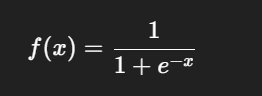
The output of this function is always between 0 and 1.
If the probability > 0.5 → classify as class 1.
If the probability ≤ 0.5 → classify as class 0.
📌 Example. If logistic regression predicts 0.8, that means there is an 80% chance the observation belongs to class 1.
🔍 How Logistic Regression Works Step by Step
Input Features: Collect input data (e.g., age, income, education).
Linear Combination: Compute a weighted sum:

Apply Sigmoid Function:
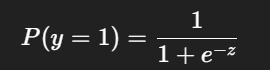
Classification: Assign the observation to class 1 if probability > threshold (usually 0.5).
🧑💻 Logistic Regression in Python (Example)
    import pandas as pd
from sklearn.model_selection import train_test_split
from sklearn.linear_model import LogisticRegression
from sklearn.metrics import accuracy_score

# Sample dataset
data = pd.read_csv("data.csv")

X = data[['age', 'income']]   # Features
y = data['buy_product']       # Target (0 = No, 1 = Yes)

# Split dataset
X_train, X_test, y_train, y_test = train_test_split(X, y, test_size=0.2, random_state=42)

# Train model
model = LogisticRegression()
model.fit(X_train, y_train)

# Predictions
y_pred = model.predict(X_test)

print("Accuracy:", accuracy_score(y_test, y_pred))
This code trains a logistic regression model to predict whether a customer will buy a product based on age and income.
🌍 Real-World Applications
📧 Spam detection (Email filters)
💳 Fraud detection in banking
🏥 Medical diagnosis (predicting if a patient has a disease)
🎓 Student admission prediction (admit/reject based on marks, GPA, test scores)
👩💼 HR analytics (predicting employee attrition)
✅ Advantages of Logistic Regression
Simple and easy to implement
Works well for linearly separable data
Outputs probabilities, not just classifications
Requires less computational power compared to complex models
⚠️ Limitations of Logistic Regression
Assumes a linear relationship between input features and log-odds
Not effective for non-linear data without transformations
Sensitive to outliers
Struggles with high-dimensional datasets
🏁 Conclusion
Logistic Regression may be one of the simplest ML algorithms, but it is extremely powerful for classification tasks. By understanding its sigmoid function and probability-based predictions, you can apply it in real-world problems like spam filtering, fraud detection, and healthcare diagnosis.
🚀 It’s a must-learn algorithm for beginners stepping into AI and ML!

Join the conversation! Your thoughts help the community grow.