
Let's start with a common term used with a class association called 'Coupling'.
Class Coupling
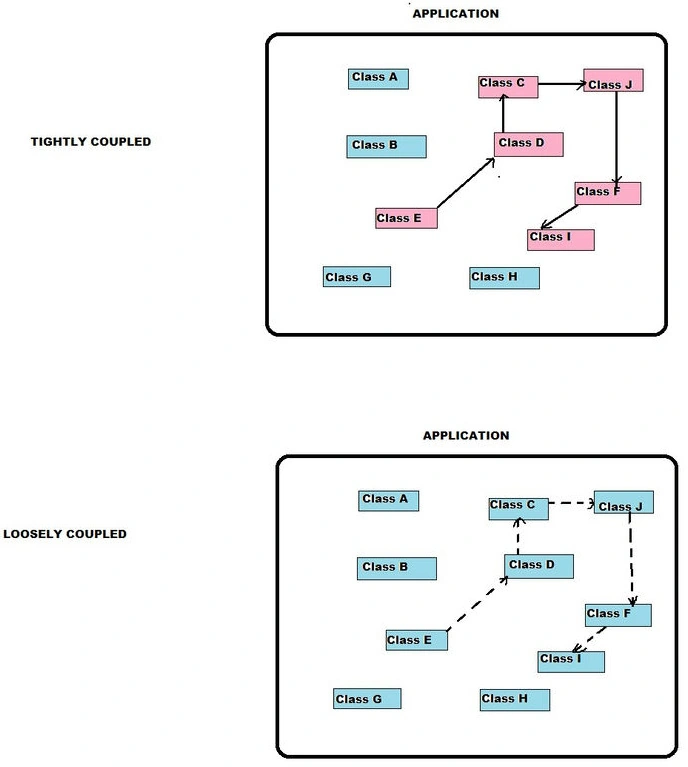
- It quantifies the level of interconnectedness among classes and subsystems.
- Tight coupling between classes makes them more difficult to modify, as changes in one class can cascade across many others.
- Loosely coupled software allows for easier modifications compared to tightly coupled software
- Classes exhibit two main types of relationships: Inheritance and Composition.
Inheritance
- It's when one class can use code from another.
- For example, saying a Car is a type of Vehicle.
- This helps reuse code and make objects behave differently based on their types.
Usage
public class Car : Vehicle
{
}
Example
Below is a Presentation class object. Text, Table, and Image classes are child classes/ derived from the base Presentation class

class Presentation
{
    public string Title { get; }
}

class Text : Presentation
{
}

class Image : Presentation
{
}

class Table : Presentation
{
}
Composition
- It's when one class has another class inside it.
- For instance, a Car might have an Engine.
- The good things about Composition are that it helps reuse code, makes things flexible, and keeps them loosely connected.
Example
class Logger
{
    // Method to log a message
    public void Log(string message) => Console.WriteLine($"Logging: {message}");
}

class Installer
{
    private readonly Logger _logger;

    // Constructor to initialize Installer with a Logger instance
    public Installer(Logger logger) => _logger = logger;

    // Method to perform installation
    public void Install()
    {
        _logger.Log("Installing...");
        // Installation logic here
        _logger.Log("Installation complete.");
    }
}

class DbMigrator
{
    private readonly Logger _logger;

    // Constructor to initialize DbMigrator with a Logger instance
    public DbMigrator(Logger logger) => _logger = logger;

    // Method to perform database migration
    public void Migrate()
    {
        _logger.Log("Migrating database...");
        // Database migration logic here
        _logger.Log("Migration complete.");
    }
}
Composition or Inheritance. Which one to choose?
Let's consider an example to understand more.
Suppose we have a Shape class representing various shapes such as circles, squares, and triangles. We then create subclasses Circle, Square, and Triangle that inherit from the Shape class.
class Shape
{
    public virtual void Draw()
    {
        Console.WriteLine("Drawing a generic shape.");
    }
}

class Circle : Shape
{
    public override void Draw()
    {
        Console.WriteLine("Drawing a circle.");
    }
}

class Square : Shape
{
    public override void Draw()
    {
        Console.WriteLine("Drawing a square.");
    }
}

class Triangle : Shape
{
    public override void Draw()
    {
        Console.WriteLine("Drawing a triangle.");
    }
}
Now, let's say we want to introduce a new shape called Rectangle. We decided to create a new subclass Rectangle that inherits from the Shape class.
class Rectangle : Shape
{
    public override void Draw()
    {
        Console.WriteLine("Drawing a rectangle.");
    }
}
However, what if later we realize that a rectangle has different properties compared to other shapes? For example, rectangles have a width and height, while other shapes do not.
class Rectangle : Shape
{
    public int Width { get; set; }
    public int Height { get; set; }

    public override void Draw()
    {
        Console.WriteLine("Drawing a rectangle.");
    }
}
In this situation, opting for inheritance from the Shape class might not be ideal due to the inconsistency in properties among different shapes.
A more effective strategy would involve employing composition over inheritance. By creating a Rectangle class that encompasses a Shape object rather than inheriting from it, we can better capture the relationship between the entities. This approach ensures a more accurate representation and mitigates the risk of encountering inheritance-related issues.
To solve the problem using composition instead of inheritance, we can create a Rectangle class that contains a Shape object as a member. This way, we can leverage the functionality of the Shape class without inheriting it directly. Here's how we can implement it.
using System;

class Shape
{
    public virtual void Draw()
    {
        Console.WriteLine("Drawing a generic shape.");
    }
}

class Rectangle
{
    private readonly Shape _shape;

    public Rectangle(Shape shape)
    {
        _shape = shape;
    }

    public void Draw()
    {
        Console.WriteLine("Drawing a rectangle.");
        _shape.Draw(); // Delegate drawing the generic shape to the Shape object
    }
}

class Circle : Shape
{
    public override void Draw()
    {
        Console.WriteLine("Drawing a circle.");
    }
}

class Square : Shape
{
    public override void Draw()
    {
        Console.WriteLine("Drawing a square.");
    }
}

class Triangle : Shape
{
    public override void Draw()
    {
        Console.WriteLine("Drawing a triangle.");
    }
}

class Program
{
    static void Main()
    {
        var circle = new Circle();
        var square = new Square();
        var triangle = new Triangle();

        var rectangleWithCircle = new Rectangle(circle);
        var rectangleWithSquare = new Rectangle(square);
        var rectangleWithTriangle = new Rectangle(triangle);

        rectangleWithCircle.Draw(); // Drawing a rectangle, Drawing a circle
        rectangleWithSquare.Draw(); // Drawing a rectangle, Drawing a square
        rectangleWithTriangle.Draw(); // Drawing a rectangle, Drawing a triangle
    }
}
I hope this article will help you in understanding various associations between classes while designing. Wishing you successful coding!


Mariusz PostolPosted May 12, 2024, 2:19 PM EDT
My understanding is that the "Class Coupling" diagrams are UML class diagrams. Would you like to be so kind as to explain the differences between associations and dependencies implementation using C#? Are there any other limitations in the context of the mentioned kinds of class relationships?