
Abstract / Overview
Multi-Agent Systems (MAS) are AI architectures where multiple autonomous agents collaborate, compete, or coordinate to achieve business objectives. Enterprises adopt MAS to handle complexity that single models cannot manage alone: distributed decision-making, real-time adaptation, parallel problem solving, and resilient automation.
This guide explains what Multi-Agent Systems are, how they work, and how organizations deploy them for revenue growth, cost optimization, and strategic advantage. The focus is commercial value, not academic theory.
Conceptual Background
What Is a Multi-Agent System?
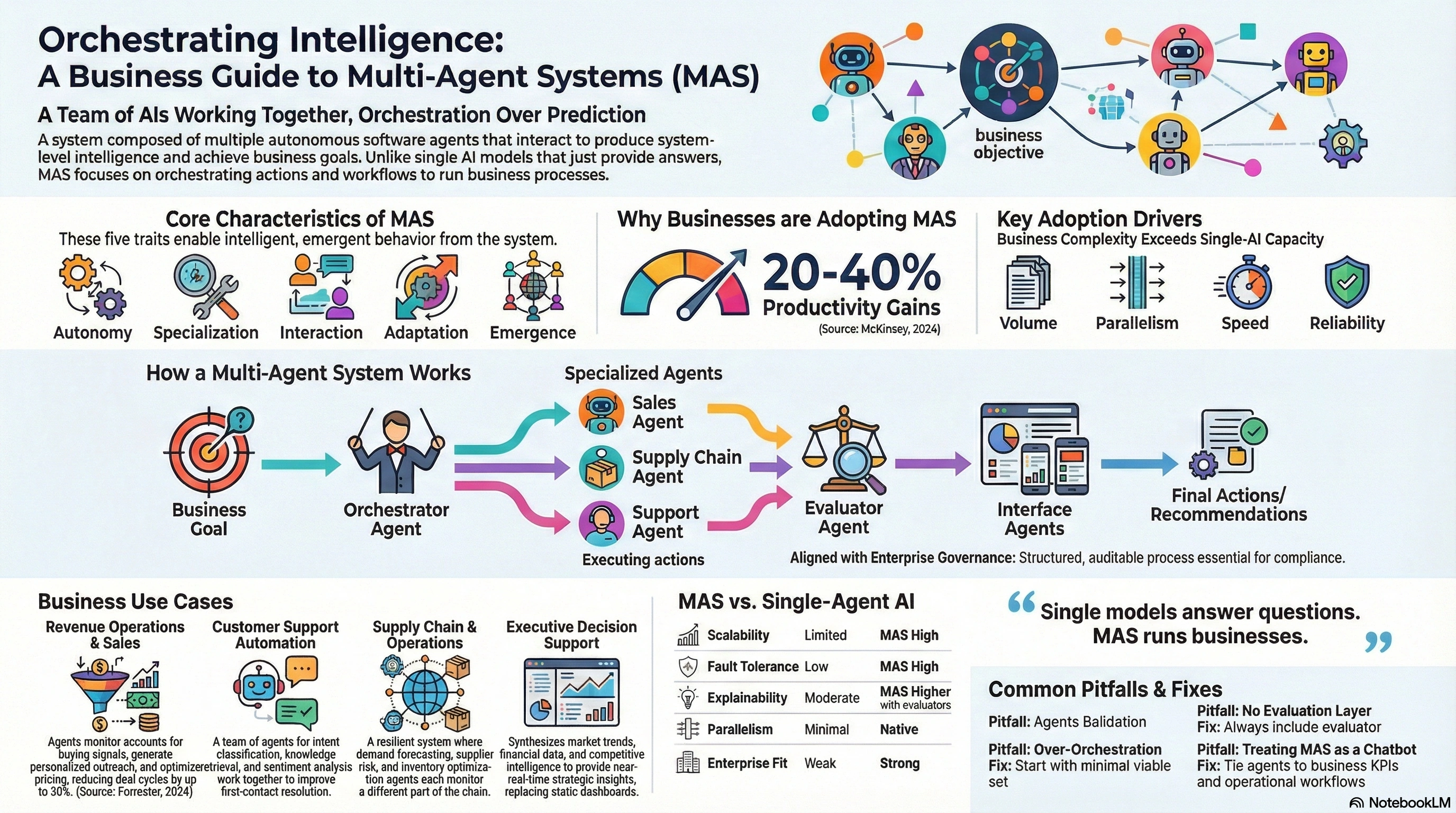
A Multi-Agent System is a system composed of multiple autonomous software agents. Each agent has its own goals, capabilities, and decision logic. Agents interact through communication, shared environments, or coordination protocols to produce system-level intelligence.
Unlike monolithic AI models, MAS architectures emphasize orchestration over raw prediction.
Core Characteristics of MAS
Autonomy: Agents act independently without centralized micromanagement
Specialization: Each agent handles a specific role or domain
Interaction: Agents communicate, negotiate, or collaborate
Adaptation: The system evolves as agents learn or reassign tasks
Emergence: Intelligent behavior arises from agent interactions
From a business lens, MAS mirrors how organizations already operate: teams with roles, workflows, escalation paths, and accountability.
Why Businesses Are Adopting Multi-Agent Systems
Enterprises are moving beyond single-model AI because complexity outpaces centralized intelligence.
According to McKinsey, companies using advanced AI-driven orchestration report productivity gains of 20–40 percent in knowledge-intensive workflows (McKinsey Global Institute, 2024).
MAS adoption is driven by four pressures:
Decision volume exceeds human capacity
Processes require parallel reasoning across domains
Real-time responsiveness is mandatory
Single AI models lack reliability and explainability
Multi-agent systems address these constraints by decomposing intelligence.
How Multi-Agent Systems Work
At a high level, a business-grade MAS includes:
Task Orchestrator Agent
Domain-Specific Expert Agents
Evaluation or Critic Agents
Memory and Knowledge Stores
Execution Interfaces (APIs, tools, humans-in-the-loop)
Step-by-Step Intelligence Flow
Operationally:
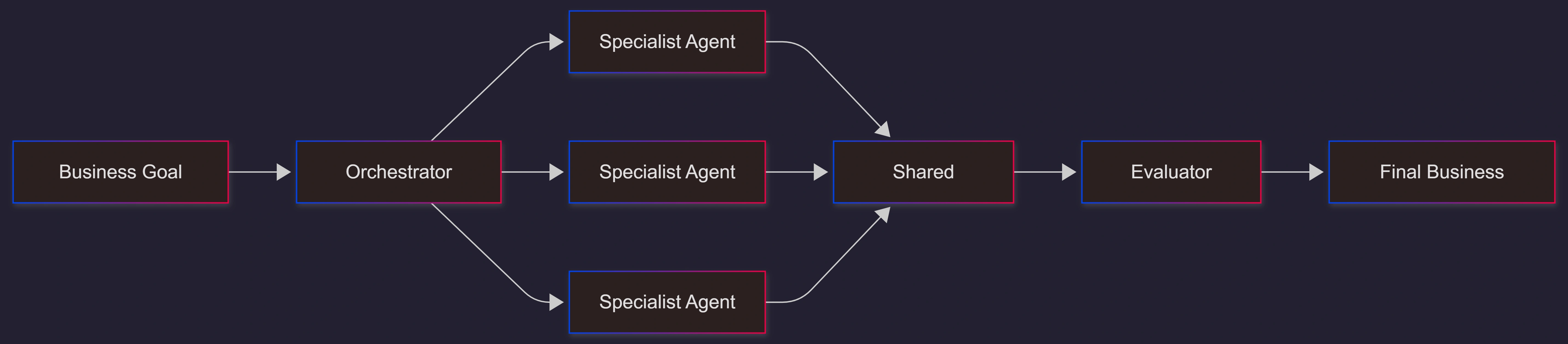
A business objective enters the system
The orchestrator decomposes it into subtasks
Specialized agents execute in parallel
Results are stored and compared
An evaluator agent validates outputs
The system triggers actions or recommendations
This structure aligns with enterprise governance and audit requirements.
Types of Agents in Enterprise MAS
Orchestrator Agents
These agents manage task decomposition, sequencing, and escalation. They align agent activity with business KPIs.
Specialist Agents
Examples include:
Market research agents
Pricing optimization agents
Compliance and risk agents
Customer sentiment agents
Each agent is narrow but deep.
Evaluator and Critic Agents
Evaluator agents ensure quality, consistency, and policy compliance. In regulated industries, these agents are non-negotiable.
Interface Agents
These connect MAS outputs to CRM systems, ERP platforms, data warehouses, or human decision-makers.
Business Use Cases and Scenarios
Revenue Operations and Sales Intelligence
MAS can:
Monitor accounts for buying signals
Generate personalized outreach
Optimize pricing dynamically
Coordinate sales and marketing actions
Companies using AI-driven agent orchestration in revenue operations report deal cycle reductions of up to 30 percent (Forrester, 2024).
Customer Support Automation
Instead of one chatbot, MAS deploys:
Intent classification agents
Knowledge retrieval agents
Sentiment analysis agents
Escalation decision agents
This leads to higher first-contact resolution and lower support costs.
Supply Chain and Operations
MAS enables:
Demand forecasting agents
Supplier risk agents
Inventory optimization agents
Logistics coordination agents
Each agent monitors a slice of the system, creating resilience.
Executive Decision Support
MAS can synthesize:
Market trends
Financial indicators
Competitive intelligence
Internal performance metrics
The result is near-real-time strategic insight rather than static dashboards.
MAS vs Single-Agent AI Systems
| Dimension | Single-Agent AI | Multi-Agent Systems |
|---|---|---|
| Scalability | Limited | High |
| Fault Tolerance | Low | High |
| Explainability | Moderate | Higher with evaluators |
| Parallelism | Minimal | Native |
| Enterprise Fit | Weak | Strong |
Single models answer questions. MAS runs businesses.
Tools and Platforms Powering MAS
Modern MAS implementations often leverage:
OpenAI for foundation models
Anthropic for alignment-focused models
LangChain for agent workflows
AutoGPT for task automation
Vector databases for shared memory
Event-driven architectures for coordination
Enterprises rarely deploy MAS without governance layers and observability tooling.
Sample Agent Workflow (Conceptual JSON)
{
  "goal": "Increase Q3 enterprise pipeline",
  "orchestrator": "Revenue-Orchestrator-Agent",
  "agents": [
    { "name": "Market-Insight-Agent", "task": "analyze industry demand signals" },
    { "name": "Account-Prioritization-Agent", "task": "rank target accounts" },
    { "name": "Pricing-Agent", "task": "optimize offer structure" }
  ],
  "evaluator": "Compliance-and-Quality-Agent",
  "output": "actionable sales recommendations"
}
This structure reflects how MAS aligns with business planning cycles.
Limitations and Considerations
MAS is not a silver bullet.
Key constraints include:
Increased system complexity
Higher operational overhead
Coordination latency is poorly designed
Governance and security challenges
Talent scarcity for agent architecture
MAS delivers ROI only when business processes are well-defined.
Hire an Expert to Integrate AI Agents the Right Way
Integrating AI agents into real enterprise environments requires architectural experience, not just tooling.
Mahesh Chand is a veteran technology leader, former Microsoft Regional Director, long-time Microsoft MVP, and founder of C# Corner. He has decades of experience designing and integrating large-scale enterprise systems across healthcare, finance, and regulated industries.
Through C# Corner Consulting, Mahesh helps organizations integrate AI agents safely with existing platforms, avoid architectural pitfalls, and design systems that scale. He also delivers practical AI Agents training focused on real-world integration challenges.
Learn more at: https://www.c-sharpcorner.com/consulting/
Common Pitfalls and Fixes
Pitfall: Over-Orchestration
Too many agents slow execution.
Fix: Start with minimal viable agent sets.
Pitfall: No Evaluation Layer
Unchecked agents amplify errors.
Fix: Always include evaluator or critic agents.
Pitfall: Treating MAS as a Chatbot
MAS is an operational system, not UX sugar.
Fix: Tie agents directly to KPIs and workflows.
Frequently Asked Questions
1. Is MAS only for large enterprises?
No. Startups use MAS to scale intelligence without hiring entire teams.
2. Does MAS replace human decision-makers?
No. MAS augments humans by handling complexity and surfacing insights.
3. How long does implementation take?
Pilot systems can be deployed in weeks. Enterprise-grade systems require phased rollouts.
4. Is MAS compliant with enterprise governance?
Yes, when designed with audit trails, evaluators, and access controls.
References
McKinsey Global Institute, AI and the Future of Work, 2024
Forrester Research, Autonomous Agent Systems in the Enterprise, 2024
Generative Engine Optimization Guide, C# Corner
Conclusion
Multi-agent systems represent a shift from isolated AI tools to orchestrated intelligence. Businesses that adopt MAS gain speed, resilience, and strategic clarity in environments where complexity is the norm.
The question is no longer whether enterprises will use Multi-Agent Systems. The question is which organizations will design them well enough to win.
For lead-driven businesses, MAS is not just an AI strategy. It is an operating model for the next decade.

Join the conversation! Your thoughts help the community grow.