
What is SQL?
SQL stands for Structured Query Language, as it is the special purpose domain-specific language for querying data in Relational Database Management System (RDBMS).
Microsoft SQL Server, MySQL, Oracle, etc. use SQL for querying with slight syntax differences.
Read More- What is SQL
Types of SQL Statements
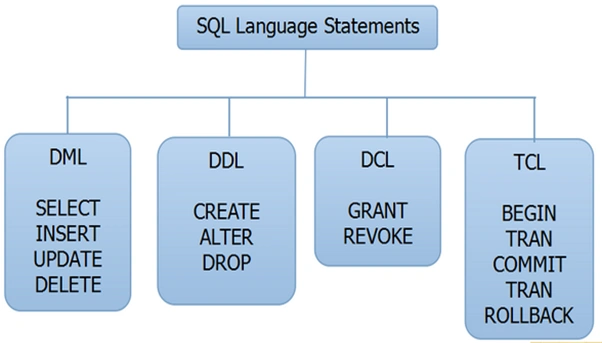
SQL statements are categorized into four different types of statements, which are
- DML (DATA MANIPULATION LANGUAGE)
- DDL (DATA DEFINITION LANGUAGE)
- DCL (DATA CONTROL LANGUAGE)
- TCL (TRANSACTION CONTROL LANGUAGE)
Let's see one by one.
DML
In Data Manipulation Language(DML), we have four different SQL statements, Select, Insert, Update, and Delete.
SELECT Statement
Example
- select * from student- Gets all records of student table.
- Select * from student where rank>5- Gets records with the condition where students' rank is greater than 5.
Read more- SELECT Statement in SQL Server
INSERT
UPDATE
Example
- update student set StudentName=’Manoj’ where StudentName=’Kumar’
DELETE
Example
- Delete from Student where StudentName=’Manoj’
DDL
In Data Definition Language (DDL), we have three different SQL statements.
CREATE
Example
- Create Table Student (Rank Int,StudentName varchar(50),Mark Float)
ALTER
Example
- Alter Table Student Add (StudentAddress varchar (100))
Read more, Alter Table statement in SQL Server
DROP
Example
- Drop Student
Read more- Drop If Exists in SQL Server 2016
TRUNCATE
Example
- Truncate Table Table_Name
DCL
In Data Control Language(DCL), it defines the control over the data in the database. We have two different commands, which are
GRANT
ON object_name
TO {user_name |PUBLIC |role_name}
[WITH GRANT OPTION];
Read more- Grant Read Write Permission in SQL Server
REVOKE
ON object_name
FROM {user_name |PUBLIC |role_name}
Read more- Grant and Revoke In SQL
TCL
In Transaction Control Language (TCL), the commands are used to manage the transactions in the database. These are used to manage the changes made by DML statements. It also allows the statements to be grouped together into logical transactions.
COMMIT
Syntax
Commit;
ROLLBACK
SAVEPOINT
These are the different types of statements in the SQL language. I hope, this will be helpful for the readers. Thanks for reading.


Joshua ByersPosted Jun 28, 2021, 6:09 AM EDT
"update student set StudentName=’Manoj’ where StudentName=’Kumar’ ""The query given above will update the studentName from Manoj to Kumar where student Name Kumar.". This is wrong, the query updates the studentName from KUMAR to MANOJ where the student name is Kumar.
Sandip SinghaPosted Nov 22, 2018, 8:15 AM EST
Your explanation was all correct..but you have missed to explain some more SQL commands like use command is one of the four basic commands of ddl..you have explained only the three...again in dcl ,deny is also an important SQL command among the three..leaving these two commands your explanation was scrumptious and helpful too..
Vikrant MorePosted Oct 11, 2018, 9:41 AM EDT
Truncate is missing in DDL
Kiran KhannaPosted Aug 18, 2018, 6:07 AM EDT
WE SHOULD KNOW ALL SQL TO GET A JOB
Sandeep SharmaPosted May 14, 2018, 7:01 PM EDT
sir, can you further explain DCL TCL through an example.
SubashPosted Mar 13, 2017, 4:34 PM EDT
Very nice keep write more
NehaPosted Jan 5, 2017, 12:37 AM EST
Nice one.............................................
Manoj Kumar DuraisamyPosted Jan 4, 2017, 7:09 PM EST
Thank you so much Fabio Silva Lima......!!!!!!!!!!!!!
Fabio Silva LimaPosted Jan 4, 2017, 1:31 AM EST
Excelent! your explanation was perfect. Congratulations
Manoj Kumar DuraisamyPosted Jan 2, 2017, 9:10 PM EST
Thanks for your appreciation Jaco Zwarts
Jaco ZwartsPosted Jan 2, 2017, 9:00 PM EST
Thank you for sharing Manoj Kumar, Great summary wish I had this summary last year
Manoj Kumar DuraisamyPosted Jan 2, 2017, 7:17 PM EST
If anyone interested to explain in the detail can do