
Google began rolling out its Genie 4 world model in Project Genie on November 18, 2026, giving eligible Google AI Ultra subscribers browser access to create, explore, and edit AI-generated interactive worlds. The release adds live text-based world changes, native adaptive audio, a Project Genie agent, and a community gallery where people can publish and remix worlds.
Key takeaways
Genie 4 lets users change an active generated world with text prompts, including weather, characters, and events.
Google says Genie 4 generates native audio in real time, from ambient sounds to character dialogue.
Genie 3 remains available for longer sessions, now up to 3 minutes per generation, and supports 360-degree panorama image grounding.
Access is rolling out to eligible Google AI Ultra subscribers, while Google AI Pro members can join a waitlist.
Google says Genie 4 is still early research, with known limits around long-term consistency, text rendering, and complex interactions.
What Google released in Project Genie
Google announced the Project Genie update on November 18. Project Genie is a browser-based experimental product for making interactive digital environments from prompts and images. With this update, Genie 4 is available to eligible users for the first time.
A world model is different from a chatbot. Instead of returning text, it generates a simulated visual space that you can move through and affect. A user might start with a prompt for a rainy city street, then type another instruction while exploring, such as adding a vehicle, changing the weather, or redirecting an event.
Google says Genie 4 can respond to those mid-session prompts while generating visuals and sound. The company describes the audio as native, meaning it is generated along with the scene rather than added later as a separate soundtrack.
The release also introduces the Project Genie agent. Google says the agent can help people build a world through a natural-language conversation, create starting visuals, and produce a background score that fits the requested mood. During exploration, Gemini models can observe the session, offer context-aware suggestion chips, and trigger events in the generated world.
How Genie 4 and Genie 3 differ
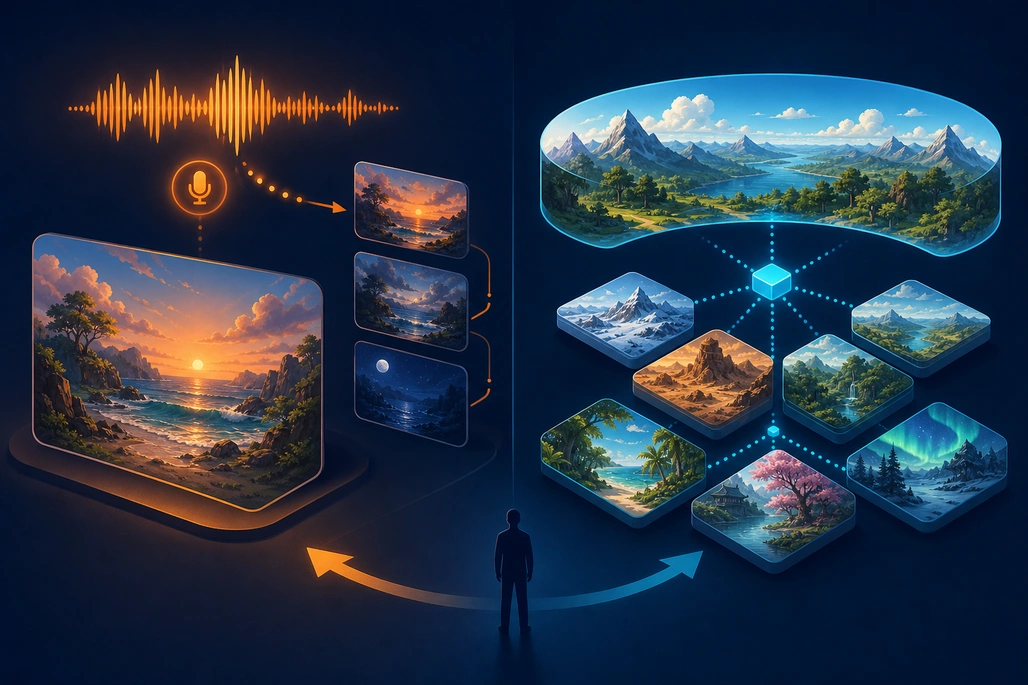
Project Genie keeps Genie 3 available alongside the new Genie 4 model.
Project Genie now offers both Genie 4 and Genie 3 in its model picker. Google positions Genie 4 as the option for higher-fidelity visuals, physics, and native audio. Genie 3 remains the option for people who need longer generated sessions or want to begin from a panorama image.
Capability | Genie 4 | Genie 3 |
|---|---|---|
Live text changes while exploring | Yes | Yes, through real-time in-world events |
Native adaptive audio | Yes | Google highlights Genie 4 for this feature |
Session duration | Google says continuous interaction is around 1 minute | Up to 3 minutes per generation |
360-degree panorama grounding | Not listed in this release | Yes |
Linking worlds into longer journeys | Not listed in this release | Yes |
The Genie 3 change is significant for beginners who want to make a sequence rather than one short scene. Google says users can link multiple worlds together, and can seed a new world with a 360-degree panorama image. The company also says users can alter Genie 3 environments with natural-language prompts while navigating them.
Who can use Genie 4 today
Genie 4 is rolling out to eligible Google AI Ultra subscribers through Project Genie. Google AI Pro members do not have full access through this announcement, but can join the waitlist from the Project Genie page.
Google did not announce separate Genie 4 pricing, usage limits, or a public API price for this release. Google said in May 2026 that its Google AI Ultra plan would be priced at $200 per month, but availability and eligibility can vary by country and account. Developers should check the Project Genie page in their own Google account before expecting access.
Google DeepMind introduced Genie 4 as a research preview on October 27, 2026. At that time, the company said it planned access for Google AI Ultra subscribers and early-access partners using the Gemini API and Google AI Studio. The November 18 announcement covers Project Genie access, but it does not announce a generally available Genie 4 API or a public model identifier for application developers.
What beginners can build with Project Genie
The new community gallery is the easiest place to see the product without starting from a blank prompt. Google says it includes curated and community-built worlds that users can explore, remix, and publish back to the gallery.
Examples named by Google include “Living Memory,” which turns personal photos into explorable spaces, “Dino Field Guide,” which uses 360-degree panoramas for prehistoric environments, and “Rock Paper Scissors,” where Gemini acts as a real-time referee. Google also highlighted “Villa Giallo,” a room-by-room mystery made with creative technologist Will, also known as BLVCKL!GHT, and “The Life of Ants,” made with filmmaker Anand Gandhi.
For a first test, a beginner can describe a single place and action in plain language. Then the user can make one change at a time while exploring. For example, start with a quiet forest trail, then ask for snowfall, a bridge ahead, or a character entering the scene. Keeping changes simple makes it easier to see how the model responds.
What Genie 4 cannot reliably do yet
Google calls Genie 4 an early and evolving technology. It says visual details and object permanence can drift during longer sessions, after several complex edits, or after moving through a scene. In simple terms, an object that appears correct at the start may change, move, or lose detail later.
Google also lists complex physical interactions, real-time audio accuracy, spatial accuracy, clear text rendering, and long-term scene consistency as active research areas. The DeepMind model page says Genie 4 currently supports around 1 minute of continuous interaction, while accurate modeling of multiple independent agents in a shared environment remains a challenge.
All video and audio created in Project Genie include SynthID watermarking, according to Google. The company also says model inputs and outputs pass through safety screening. That matters if users publish work to the community gallery or share generated clips outside Project Genie.
Based on reporting by Google, Google DeepMind, Tom's Guide and AI Watch.




Sarthak VarshneyTOP 100editedPosted Nov 23, 2026, 11:00 AM ESTEdited Nov 23, 2026, 12:07 PM EST
Very helpful