
OpenAI and Cisco announced Shirudo on November 23, 2026, an open-source Linux security runtime that can apply temporary protections to a running service while a permanent software patch is being tested and deployed. The project uses eBPF programs, called shields, to block a vulnerable path without requiring an operating system or application restart. In a controlled test, the companies said a Codex-generated shield stopped a Java4Shell exploit attempt against a live Elasticsearch service while the service kept running.
Key takeaways
- Shirudo is an open-source, pre-release security platform for Linux systems.
- It uses eBPF to observe or block targeted operating system behavior without rebooting a host.
- Operators must approve a shield before it is enforced, according to OpenAI and Cisco.
- Production use requires a compatible Linux kernel, Shirudo kernel patches, and TPM 2.0 hardware.
- Shirudo is licensed under BSD 2-Clause, while its BPF programs use BSD and GPL licenses.
What OpenAI and Cisco announced
OpenAI and Cisco introduced Shirudo as a way to cover the time between learning about a vulnerability and completing a full patch rollout. That window can be long in production environments. Teams may need to test a vendor update, schedule maintenance, check compatibility, and restart services before they can safely apply it.
Shirudo is meant to provide a temporary control during that window. A shield is a small protection that focuses on the behavior an attacker needs to reach vulnerable code. Rather than turning off a broad Linux operation that an application may need, the operator can test whether the shield blocks the attack path while normal requests still work.
This approach is often called a compensating control. The Register reported that compensating controls are already used in security programs when organizations cannot immediately patch a flaw. Shirudo's difference is its open-source runtime and its goal of using AI-assisted code generation and testing to help create narrow controls for Linux systems.
How Shirudo works on a Linux host
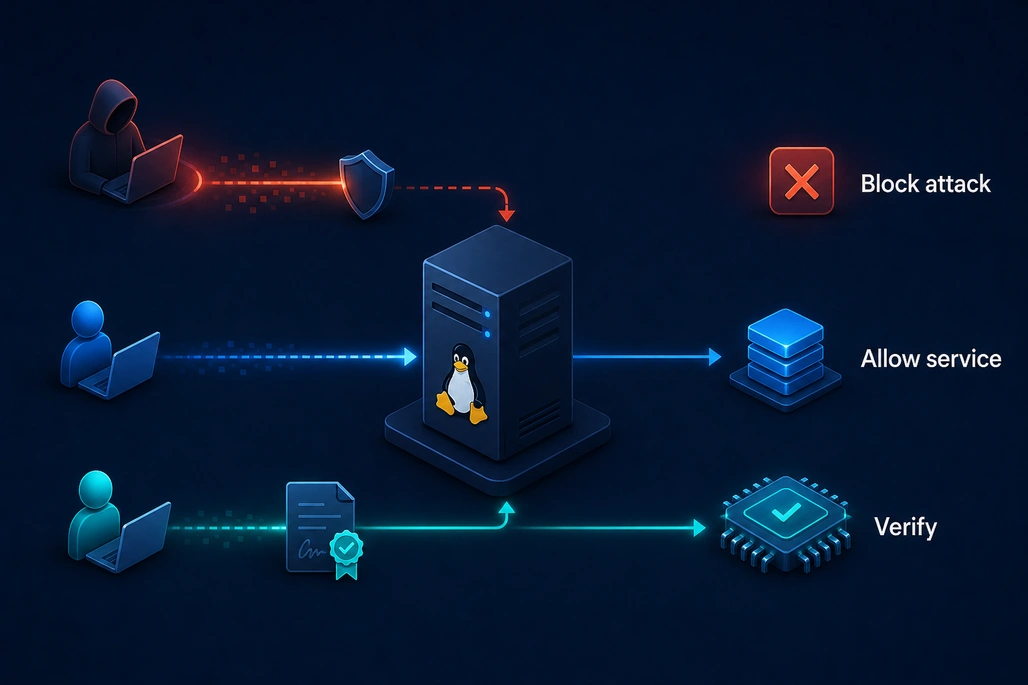
Shirudo tests a targeted protection before an operator approves it for enforcement.
For beginners, eBPF is a Linux feature that lets small programs run at selected points in the operating system. A security tool can use those points to watch activity, such as process execution or network behavior, and in some cases prevent a specific action.
Shirudo uses eBPF-based protections for kernel-level controls. The project also supports signed Java agents, which it calls Java upatches, for application-level protections. The GitHub repository describes upatches as small, focused programs that can be signed, delivered to a target, and verified by an operator.
| Term | What it means in Shirudo | Why it matters |
|---|---|---|
| Shield or upatch | A small temporary security mitigation. | It can block a known attack path before a full vendor patch is in place. |
| eBPF | Linux technology for running constrained programs at operating system hook points. | It lets Shirudo apply targeted runtime checks without a reboot. |
| Signing | A cryptographic check that confirms who approved a protection. | It helps prevent unapproved code from being loaded. |
| TPM attestation | Hardware-backed evidence about the protections loaded on a machine. | It gives operators a way to check a host's reported protection state. |
OpenAI and Cisco say the flow is designed to include a human decision. An agent can investigate a vulnerability, generate a possible shield, and validate it against an exploit and normal workloads. But the security team controls what is deployed. This matters because a shield that blocks malicious traffic but also stops real customer requests would create an outage of a different kind.
What happened in the Java4Shell test
The companies used Java4Shell as their public example. OpenAI said Codex generated a shield that added an input check to Java's Base64 decoder and attached it to a running Elasticsearch process. During the controlled exploit attempt, the check rejected the malicious input and Elasticsearch continued operating.
Java4Shell is reported as CVE-2026-114938, a vulnerability involving OpenJDK's Base64 decoding functionality. TechRadar reported on November 18, 2026 that Oracle had released patches and that organizations should update rather than rely permanently on temporary mitigations. That remains the key point for teams evaluating Shirudo: a shield is a short-term risk reduction tool, not a replacement for the vendor's fix.
OpenAI President and co-founder Greg Brockman described the problem plainly: “finding a bug today doesn’t mean you can patch every system tomorrow.” Shirudo is the companies' attempt to give operators a smaller and more targeted option while they work through that delay.
Security checks and production requirements
Shirudo has several controls intended to limit what can be loaded on a target. OpenAI says shields are cryptographically signed and verified before loading. Linux's eBPF verifier checks eBPF programs against kernel safety rules, and kernel security controls are intended to restrict unauthorized changes.
The project also uses a Trusted Platform Module, or TPM, to record protection changes. A TPM is hardware designed to protect cryptographic operations and measurements. In Shirudo, operators can use TPM-signed evidence to check whether a host has loaded or removed a protection.
There is an important limitation for beginners: Shirudo is not a drop-in tool for every Linux server. Its GitHub repository labels it pre-release. It says production targets need a Linux kernel with the signed-loader ABI, Shirudo's kernel patches, and TPM 2.0. The project runs all CI test tiers on x86-64 and host tests on arm64; riscv64 target validation is still pending.
Availability, licensing, and how developers can try it
The Shirudo source code is available on GitHub. The runtime uses the BSD 2-Clause license, and its BPF programs are dual-licensed under BSD and GPL. OpenAI and Cisco also provide a VM quickstart that uses a software TPM, so developers can sign, load, and verify a test protection without starting on a production machine.
For developers new to Linux security, the safest starting point is the local VM rather than a live workload. Read the system requirements, run the supplied quickstart, inspect the generated evidence, and test what happens when a shield is enabled and removed. Then compare that behavior with your normal patch and incident-response process.
Cisco and OpenAI have also scheduled a technical webinar for December 15, 2026. The companies are asking infrastructure operators, security researchers, and developers to test the runtime, contribute vulnerability reproductions, and report cases where a proposed protection interferes with legitimate traffic.
What is still unknown
Neither company announced a general-availability date, commercial support plan, or a list of Linux distributions that can use Shirudo in production. The project documentation also makes clear that the required kernel support and TPM 2.0 make production deployment more involved than installing a normal application package.
The Java4Shell result was a controlled test, not a promise that Shirudo will block every exploit or generate a safe shield for every vulnerability. Security teams will still need to validate protections, approve deployments, patch affected software, and monitor the service after a shield is applied.
Frequently asked questions
What is Shirudo?
Shirudo is an open-source, pre-release security platform from OpenAI and Cisco for protecting running Linux systems while teams prepare and deploy permanent patches.
Does Shirudo replace software patches?
No. Shirudo is designed to apply temporary protections while teams test and roll out the permanent vendor patch. It does not replace patching.
What does eBPF do in Shirudo?
eBPF lets Shirudo run small, targeted protection programs at selected Linux operating system hook points, allowing the tool to observe or block a vulnerable behavior without a reboot.
Can any Linux server run Shirudo in production?
No. The project is pre-release, and its repository says production targets require a compatible Linux kernel, Shirudo kernel patches, the signed-loader ABI, and TPM 2.0.
How can a developer try Shirudo?
Developers can use the project's local VM quickstart, which includes a software TPM and steps to sign, load, and verify a test protection.
Based on reporting by OpenAI, GitHub, The Register and TechRadar.





RinkiPosted Nov 24, 2026, 6:45 AM EST
💡
Sarthak VarshneyTOP 100Posted Nov 24, 2026, 5:47 AM EST
Very helpful