
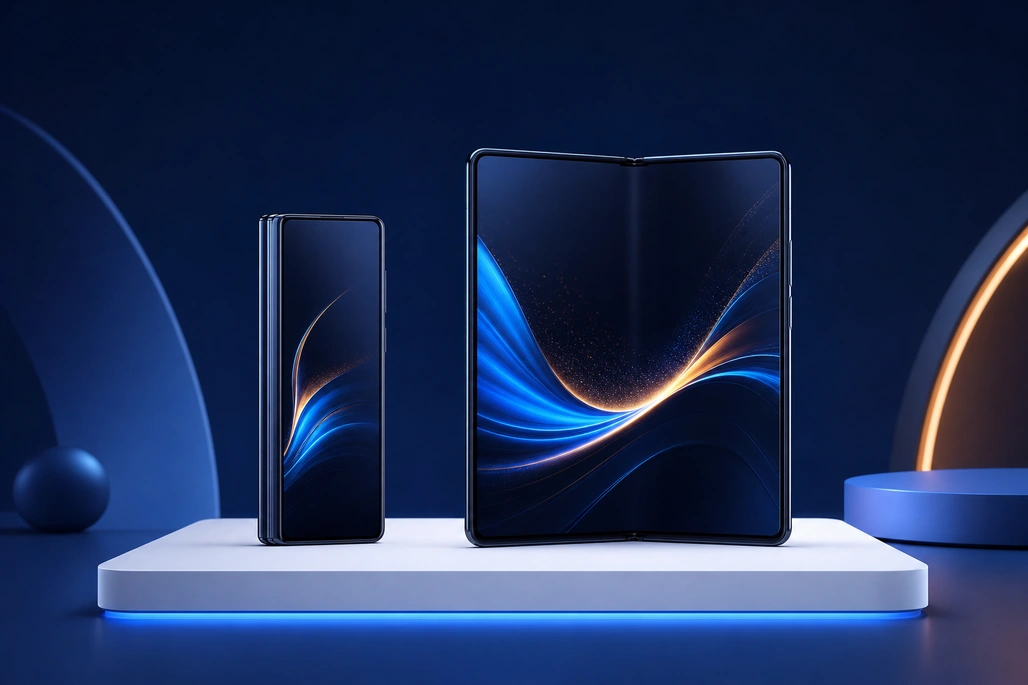
A foldable phone combines a compact outer screen with a larger inner workspace.
Apple’s iPhone Duo, the company’s first foldable iPhone, went on sale at Apple Store locations on Friday, October 23, 2026. It starts at $1,999 in the United States and combines a 5.4-inch outer display with a 7.6-inch inner display, allowing it to work as a compact phone when closed and a larger two-app workspace when opened. For beginners, the key question is not whether it folds: it is whether its larger screen, new iOS 27 multitasking features, and camera flexibility are worth the high price and the extra care a foldable device requires.
Key takeaways
- iPhone Duo is Apple’s first foldable iPhone and became available in initial markets on October 23, 2026.
- It starts at $1,999 in the U.S. with 256GB of storage and is offered in 512GB, 1TB, and 2TB configurations.
- The closed phone has a 5.4-inch outer display, while opening it reveals a 7.6-inch inner display for larger apps, video, and Split View multitasking.
- iPhone Duo uses Touch ID in the side button, is eSIM-only worldwide, and supports Apple Pencil (USB-C).
- The inner display’s built-in nano-texture cover layer should not be removed or covered with a third-party screen protector.
What happened when Apple iPhone Duo hit stores?
Apple began in-store sales of iPhone Duo on Friday, October 23, 2026. Apple said that customers could explore the device at Apple Store locations, through the Apple Store app, and online; the company also offered Personal Setup assistance for transferring data to a new phone. At Apple Domain NORTHSIDE in Austin, Texas, Apple CEO John Ternus and retail chief Deirdre O’Brien welcomed customers, while Greg “Joz” Joswiak and Vanessa Trigub greeted buyers at Apple Fifth Avenue in New York City.
The retail arrival followed preorders that opened on October 16, 2026. Apple’s original announcement said availability would begin October 23 in more than 70 countries and regions, including the United States, Canada, China, India, Japan, the United Kingdom, and several European markets. A further 28 countries and regions are scheduled to receive the phone on October 30, 2026.
Availability may be the most immediate obstacle for prospective buyers. Before launch, TechRadar reported that online delivery estimates had slipped to January 2027 for some orders, although Joswiak said Apple had retained units for stores. That does not mean every store has stock; customers should check their selected Apple Store in the Apple Store app or on Apple’s online store before traveling.
Apple’s October 23 retail announcement confirms the device’s in-store debut. Independent reporting from the Associated Press also documented customers lining up at Apple Fifth Avenue on launch day.
What is iPhone Duo, and how is it different from a regular iPhone?
iPhone Duo is a book-style foldable phone, not a small clamshell-style flip phone. When it is closed, the 5.4-inch outer Super Retina XDR display is the screen used for ordinary tasks such as calls, messages, maps, notifications, and quick photos. When it is opened, a 7.6-inch Super Retina XDR inner display gives the user a larger canvas closer to a compact tablet.
The two screens use the same aspect ratio, which is intended to make content transition proportionally when the device is opened or closed. Instead of treating the outside display as a narrow secondary panel, Apple designed it as a complete phone screen. That matters to beginners: most everyday actions can happen without unfolding the device, while longer reading, video viewing, document work, and side-by-side apps benefit from the inner screen.
| Feature | iPhone Duo when closed | iPhone Duo when open |
|---|---|---|
| Display size | 5.4-inch outer display | 7.6-inch inner display |
| Best suited to | One-handed tasks, calls, texts, navigation, quick photos | Video, games, reading, photos, and two-app multitasking |
| Camera viewfinder | Can be used to frame photos with the rear cameras | Provides a larger editing and viewing surface |
| Working style | Traditional iPhone-style use | Split View, hands-free positioning, and larger app layouts |
Apple says both displays support ProMotion, Always On, and up to 3,000 nits of peak outdoor brightness. The inner display has a nano-texture finish designed to reduce reflections and minimize the visibility of the fold crease. It also contains an under-display FaceTime camera, meaning there is no visible camera cutout in the main viewing area.
How does the folding design work?
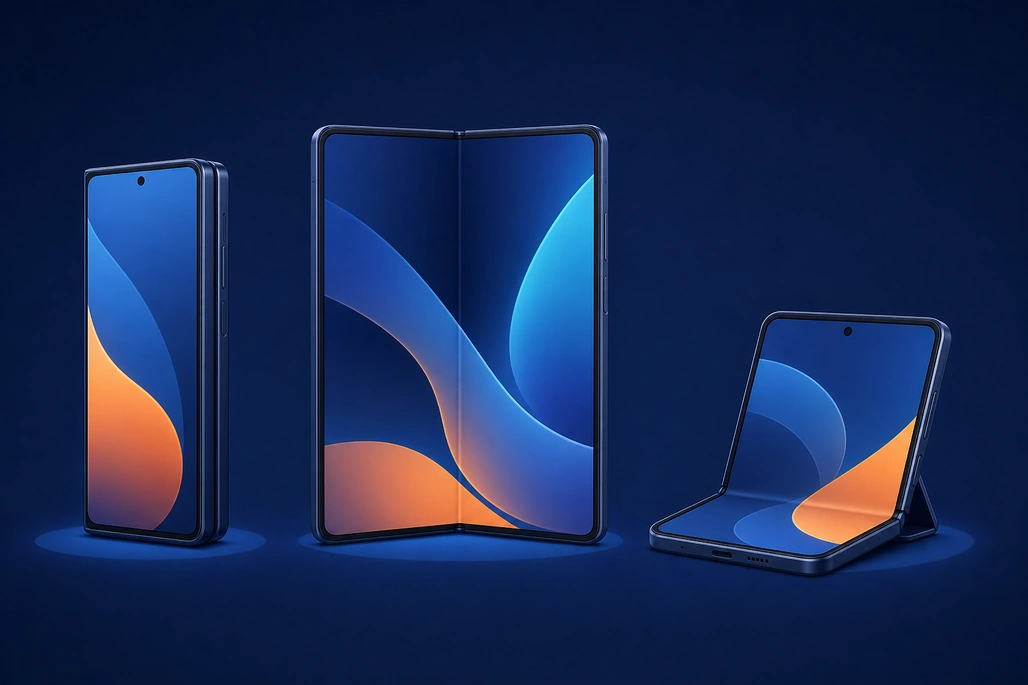
The device can be used as a phone, a larger display, or a hands-free stand.
The core hardware is a precision hinge that lets the two halves open flat or rest at different angles. Apple says the hinge contains more than 100 components, supports the center of the display when the device is open, and works with an integrated magnet array to close securely. The company also says the phone uses a Grade 5 titanium enclosure and hinge cover.
The inner display is not conventional phone glass. Apple describes it as a multilayer folding display protected by a scratch-resistant coating and a custom polymer nano-textured cover layer. Glass layers, adhesives that move as the phone bends, and a titanium plate beneath the display are intended to distribute stress from folding.
In everyday use, this creates three basic positions. Closed mode is the phone mode. Open mode is the tablet-like mode. Partially folded mode lets iPhone Duo support itself on a desk or other flat surface, making it useful for a video call, a timed group photo, or watching a video without holding the phone.
The device is rated IP68 for water and dust resistance, but that rating should not be interpreted as permission to expose the hinge to sand or debris. Folding phones have moving parts and an inner flexible screen. The Associated Press notes that foldables require more deliberate care than conventional smartphones, particularly around the hinge and display.
How does iOS 27 use the larger screen?
iOS 27 changes its layout to suit the outer and inner displays. The clearest new capability is Split View: users can open two apps side by side on the unfolded display. Apple gives the example of browsing a Photos library on one side and dragging a picture into Mail on the other.
For a beginner, Split View is useful when two tasks genuinely belong together. Someone could keep a message thread open while checking a calendar, compare two web pages while shopping, review notes during a video call, or watch a tutorial alongside a related app. It is not simply about putting more content on screen; it reduces the number of times a person must switch back and forth between apps.
Apple’s iPhone User Guide includes a dedicated “Open two apps in Split View on iPhone Duo” section, indicating that the function is built into the operating system rather than requiring a separate download. The company also describes a poseable design that supports hands-free FaceTime calls and StandBy widgets when the phone is positioned upright.
There is an important early-adopter limitation. In a hands-on review, Tom’s Guide found that some third-party apps had not yet been optimized for iPhone Duo’s screen shape. That means an app may initially use the larger display poorly even though the phone itself supports the format. Buyers who rely on a particular work, finance, media, or enterprise app should test it in a store before committing to the device.
What are the key hardware features and specifications?
iPhone Duo is powered by Apple’s A20 Pro chip and uses a dual-battery architecture, with one battery in each half of the device. Apple rates it for up to 31 hours of video playback using the inner display, up to 44 hours using the outer display, and up to 24 hours of typical use when the two displays are used equally. These are Apple laboratory estimates, so actual battery life will vary with network conditions, brightness, apps, and usage.
For charging, Apple says iPhone Duo can reach up to 50 percent in around 20 minutes with compatible wired fast charging equipment. It also supports MagSafe and Qi2 wireless charging. The power adapter required for the fastest wired charging is sold separately.
The rear camera system includes a 48MP Fusion Main camera and a 48MP Fusion Ultra Wide camera. The foldable layout enables features that are less practical on a standard phone: Duo Preview lets a photo subject see themselves on the outer display, while Smart Take can capture photos when the device is positioned hands-free. Apple says iPhone Duo can capture up to 4K video at 120 frames per second.
Apple made a few design choices that buyers should understand before upgrading. iPhone Duo uses Touch ID integrated into the side button rather than Face ID. It is also eSIM-only worldwide, so a buyer needs a carrier and plan that support eSIM activation. Apple says more than 500 carriers support eSIM, but prospective buyers should confirm support with their own carrier before purchase.
Later in 2026, Apple plans to add support for Apple Pencil (USB-C). The phone does not support Apple Pencil hover. This may matter to people who expect an unfolded Duo to replace a small tablet for handwritten notes or annotation.
What does iPhone Duo cost, and what are the trade-offs?
In the United States, iPhone Duo starts at $1,999 for 256GB. It is available in star white and night sky, with 512GB, 1TB, and 2TB storage options. Apple listed a 24-month payment option of $83.29 per month, while its Apple Upgrade leasing program listed eligible U.S. customers from $57.99 per month for 24 months. Buyers should read the terms of any carrier, credit, or leasing offer because the total cost and eligibility requirements can differ.
The price puts iPhone Duo above the rest of Apple’s iPhone range. The Associated Press described it as Apple’s most expensive iPhone and noted that foldables still make up less than 5 percent of the overall smartphone market, according to CCS Insight analyst Ben Wood. The product is therefore best understood as a premium device for people who will use its expanded workspace often, rather than as a default upgrade for every iPhone owner.
There are practical trade-offs. Tom’s Guide reported that the device lacks both a telephoto camera and Face ID, that some apps are not optimized yet, and that the nano-texture display can make colors appear less vivid than on a conventional glossy panel. Its review also found the phone is comparatively heavy. These are not minor considerations for someone whose priority is long-range photography, facial unlocking, the lightest possible phone, or universally optimized apps.
On the other hand, a buyer who regularly reads, multitasks, travels, watches video, edits photos, or needs a larger display without carrying a phone and tablet may find the design more useful than a conventional slab phone. The right decision depends on how often those larger-screen activities occur away from a desk.
How should beginners set up and protect iPhone Duo?
Start with carrier readiness. Because iPhone Duo is eSIM-only, confirm that the current carrier supports eSIM and determine whether the existing number can be transferred. During setup, Apple’s Personal Setup service at Apple Stores can help customers transfer data, and Android users can use the Move to iOS app to transfer photos, contacts, messages, and calendars.
Next, learn the physical controls. Apple’s support documentation identifies the side button with Touch ID, volume buttons, Camera Control, and USB-C connector. The outer display includes a Center Stage front camera, while the inner display has the under-display FaceTime camera.
Most importantly, protect the inner display correctly. Apple says the nano-texture cover layer is an integral part of that display and specifically says not to remove it. The company also warns that applying an external screen protector can compromise display performance. Before closing iPhone Duo, check that nothing is left on the inner screen: closing keys, coins, or another hard object inside can damage it.
A case is sensible for most buyers, especially because the device costs $1,999 before accessories and service coverage. Apple sells an iPhone Duo Case for $79 and an iPhone Duo Folio with Kickstand for $129. Regardless of accessory choice, avoid forcing cables into the USB-C port, keep grit away from the hinge area, and use the device’s folding mechanism deliberately rather than treating it like a conventional rigid phone.
Who should buy Apple iPhone Duo?
iPhone Duo is most suitable for people who want a single Apple device that can cover both quick phone tasks and larger-screen work. It is especially easy to justify for people who frequently use two apps at once, consume long-form video or reading material on the go, or value a hands-free camera and video-call setup.
It is less compelling for someone who primarily messages, browses briefly, takes zoom-heavy photos, or wants the lowest-cost iPhone upgrade. The new form factor is useful, but it also adds price, weight, app-transition uncertainty, and display-care requirements. Beginners should try Split View, test their essential apps, fold and unfold a store demo, and verify eSIM support before placing an order.
Frequently asked questions
When did Apple iPhone Duo go on sale?
iPhone Duo went on sale in initial markets on Friday, October 23, 2026. Apple said another 28 countries and regions would receive it beginning October 30, 2026.
How much does Apple iPhone Duo cost?
iPhone Duo starts at $1,999 in the United States for the 256GB model. Higher storage options include 512GB, 1TB, and 2TB.
Does iPhone Duo use Face ID?
No. iPhone Duo uses Touch ID integrated into its side button for authentication.
Can iPhone Duo run two apps at once?
Yes. When opened, iPhone Duo supports Split View in iOS 27, allowing two apps to be used side by side on the 7.6-inch inner display.
Should a screen protector be added to iPhone Duo’s inner display?
No. Apple says the inner display’s nano-texture cover layer is integral to the display, should not be removed, and can have its performance compromised by an external screen protector.
Sources
- Apple unveils iPhone Duo — Apple — September 9, 2026
- iPhone Duo arrives at Apple Store locations worldwide — Apple — October 23, 2026
- iPhone Duo — Apple — October 2026
- iPhone Duo User Guide — Apple Support — October 2026
- Important handling information for iPhone — Apple Support — October 2026
- New Apple CEO unveils latest iPhone lineup, including a foldable model called Duo — Associated Press — September 9, 2026
- One Tech Tip: As Apple’s Duo phone is released, here are dos and don’ts for folding phones — Associated Press — October 2026
- Apple iPhone Duo review: All of your questions answered — Tom’s Guide — October 22, 2026
- Apple says iPhone Duo units are available in stores — TechRadar — October 22, 2026

Join the conversation! Your thoughts help the community grow.