

Pre-requisite to understand this
Kubernetes Basics – Understanding Pods, Deployments, and Services
Containerization (Docker) – How applications are packaged and run
CPU Requests & Limits – Required for HPA decision making
Metrics Server – Provides CPU utilization metrics to Kubernetes
Declarative YAML – Kubernetes resources are defined using YAML
Auto-scaling Concepts – Horizontal vs Vertical scaling
Introduction
Horizontal Pod Autoscaler (HPA) is a native Kubernetes feature that automatically adjusts the number of pod replicas in a Deployment, StatefulSet, or ReplicaSet based on observed resource usage such as CPU or memory. In enterprise environments where workloads are unpredictable and demand fluctuates frequently, HPA ensures optimal performance while minimizing infrastructure costs. CPU-based HPA is the most commonly adopted scaling strategy because CPU usage directly reflects application load. By continuously monitoring CPU metrics and scaling pods accordingly, HPA provides elasticity, resilience, and cost efficiency without manual intervention.
What problem we can solve with this?
In enterprise systems, applications often experience unpredictable traffic patterns such as peak business hours, seasonal spikes, or sudden user surges. Without auto scaling, applications may suffer from performance degradation or waste resources during low usage periods. CPU-based HPA dynamically scales workloads to maintain consistent performance and service reliability. It reduces the operational burden on DevOps teams and supports SLA compliance. Additionally, it integrates seamlessly with CI/CD pipelines and cloud-native architectures.
Problems addressed:
Avoids application downtime during traffic spikes
Prevents over-provisioning of compute resources
Ensures consistent response time and throughput
Reduces manual intervention and operational overhead
Improves cost efficiency in cloud environments
Enables scalable microservices architectures
How to implement/use this?
To implement CPU-based HPA, the application must define CPU requests in its pod specification so Kubernetes can calculate utilization percentages. Metrics Server must be installed to collect CPU usage data. The HPA resource is then configured with target CPU utilization and minimum/maximum replica limits. Once deployed, HPA continuously monitors metrics and automatically adjusts the replica count. This setup integrates well with enterprise monitoring, logging, and alerting tools. Scaling decisions occur at runtime without redeploying the application.
Implementation steps:
Install Metrics Server in the cluster
Define CPU requests and limits in the Deployment
Create an HPA resource linked to the Deployment
Set minReplicas, maxReplicas, and target CPU utilization
Monitor scaling behavior via
kubectl get hpa
Sample Deployment YAML (CPU Requests Required)
apiVersion: apps/v1
kind: Deployment
metadata:
  name: web-app
spec:
  replicas: 2
  selector:
    matchLabels:
      app: web-app
  template:
    metadata:
      labels:
        app: web-app
    spec:
      containers:
      - name: web-app
        image: nginx
        resources:
          requests:
            cpu: "200m"
          limits:
            cpu: "500m"
Sample HPA YAML (CPU Based Autoscaling)
apiVersion: autoscaling/v2
kind: HorizontalPodAutoscaler
metadata:
  name: web-app-hpa
spec:
  scaleTargetRef:
    apiVersion: apps/v1
    kind: Deployment
    name: web-app
  minReplicas: 2
  maxReplicas: 10
  metrics:
  - type: Resource
    resource:
      name: cpu
      target:
        type: Utilization
        averageUtilization: 70
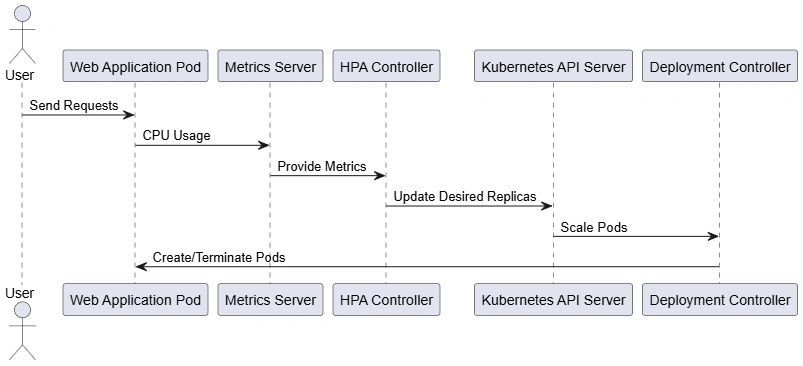
Sequence Diagram – HPA CPU Scaling Flow
This sequence diagram illustrates the runtime interaction between Kubernetes components during CPU-based autoscaling. User traffic increases CPU consumption on application pods, which is collected by the Metrics Server. The HPA Controller evaluates this data against the configured threshold and updates the desired replica count via the API Server. The Deployment Controller then reconciles the state by creating or terminating pods. This process is continuous and automated, ensuring responsiveness to load changes.
Key Points:
Metrics Server collects real-time CPU usage
HPA Controller evaluates scaling rules
API Server acts as control plane gateway
Deployment Controller enforces scaling
Pods dynamically scale based on demand
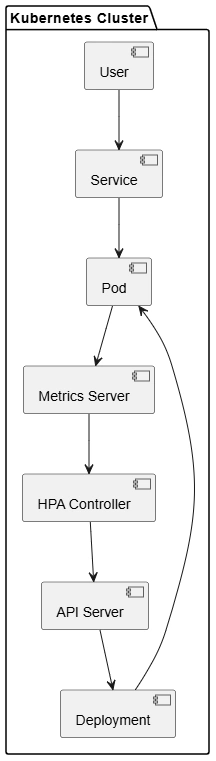
Component Diagram – HPA Architecture
This component diagram represents the architectural view of CPU based HPA in an enterprise Kubernetes cluster. Users access the application via a Service, which routes traffic to pods managed by a Deployment. Pods expose CPU metrics that are collected by the Metrics Server. The HPA Controller evaluates these metrics and communicates scaling decisions through the API Server. The Deployment component ensures the desired number of pods are running. This architecture supports high availability, scalability, and fault tolerance.
Component responsibilities:
Service abstracts pod networking
Metrics Server provides observability
HPA Controller performs scaling logic
API Server coordinates state changes
Deployment maintains desired replicas
Advantages
Automatic scaling based on real CPU usage
Improved application performance and reliability
Reduced infrastructure and operational costs
Seamless integration with Kubernetes native components
Supports enterprise SLAs and high availability
Works well with microservices and CI/CD pipelines
Summary
CPU-based Horizontal Pod Autoscaling is a foundational capability for enterprise Kubernetes deployments. It enables applications to dynamically adjust capacity based on real-time demand, ensuring performance stability and cost optimization. By leveraging Metrics Server, HPA Controller, and Deployment reconciliation, Kubernetes provides a robust and automated scaling mechanism. When implemented correctly with proper CPU requests and thresholds, HPA becomes a critical building block for resilient, scalable, and cloud-native enterprise architectures.
Join the conversation! Your thoughts help the community grow.