
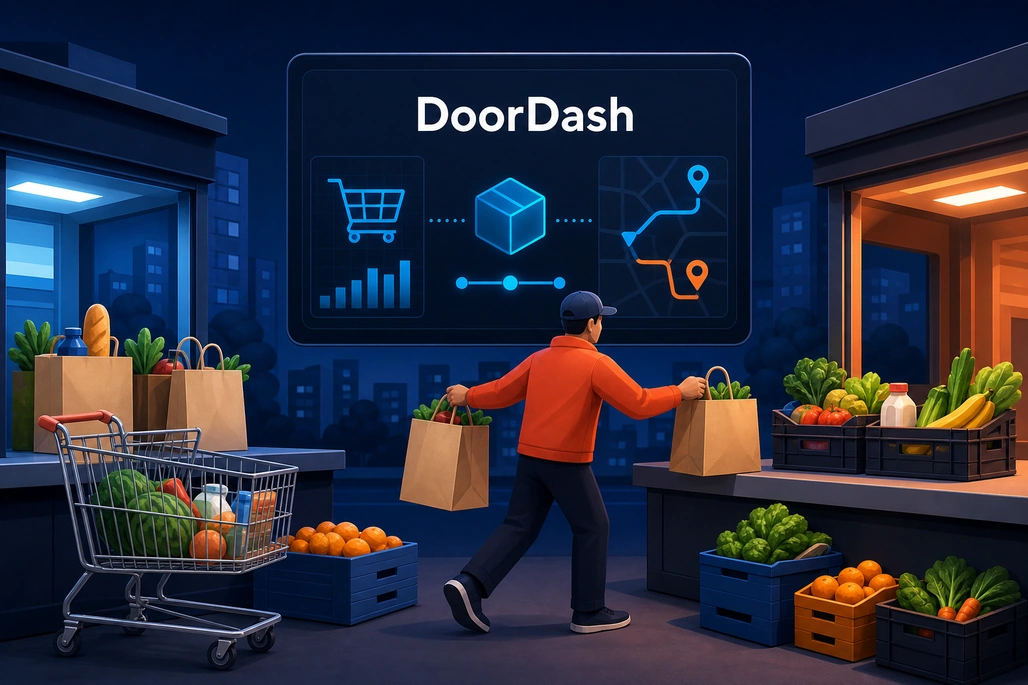
DoorDash has proposed acquiring Instacart in a transaction valued at approximately $17 billion.
DoorDash announced on October 29, 2026, that it has signed an agreement to acquire Instacart in a transaction valuing Instacart at approximately $17 billion. The proposed acquisition is not complete: Instacart stockholders and regulators must approve it, and the companies expect closing at the end of 2027 or during the first half of 2028. If it closes, DoorDash says it expects to retain the Instacart brand, app, and enterprise technology products while combining DoorDash’s delivery network with Instacart’s grocery, fulfillment, advertising, and retail technology.
Key takeaways
- DoorDash offered Instacart stockholders consideration valued at $65.00 per Instacart share, a 26% premium to Instacart’s October 22, 2026 closing price.
- The agreement is primarily cash-funded, although stockholders may elect cash, DoorDash shares, or a mix, subject to limits and proration.
- DoorDash and Instacart remain separate, independent companies until the transaction closes.
- The proposed deal requires Instacart stockholder approval and regulatory clearances, including the U.S. Hart-Scott-Rodino waiting period.
- DoorDash says it plans to keep Instacart’s consumer brand, app, and enterprise products after closing.
What did DoorDash announce?
DoorDash and Maplebear Inc., which operates as Instacart, announced a definitive agreement under which DoorDash would acquire Instacart. A definitive agreement is a signed acquisition contract: it means the companies have agreed on the major terms and are moving into the approval and closing process. It does not mean DoorDash owns Instacart today.
According to DoorDash’s October 29, 2026 announcement, the transaction gives Instacart an equity value of approximately $17 billion. The boards have approved the agreement, but Instacart stockholders still need to vote, and the companies must obtain required regulatory approvals.
Independent reporting describes the proposal as a major consolidation in U.S. grocery delivery. The Associated Press reported that the combination would put a large restaurant-and-local-commerce delivery network together with a company focused on grocery technology and grocery fulfillment. AP’s coverage also noted that the deal could affect existing retailer relationships, which is one reason the eventual operating details matter as much as the headline price.
How much is DoorDash paying for Instacart?
The headline figure is approximately $17 billion in equity value. Equity value is the value assigned to a company’s shares in the transaction. For a beginner, the simpler number to watch is the per-share consideration: Instacart stockholders are being offered value equal to $65.00 for each Instacart share.
DoorDash said that $65.00 figure represented a 26% premium to Instacart’s closing price on October 22, 2026, the last trading day before media reports about a possible transaction. A premium is common in public-company acquisitions because the buyer usually needs to offer shareholders more than the unaffected trading price to gain support for a sale.
| Deal term | What it means |
|---|---|
| Approximate equity value | About $17 billion is the value DoorDash assigns to Instacart’s shares in the proposed deal. |
| Per-share value | Each Instacart share is valued at $65.00 under the agreement. |
| Premium | The $65.00 value was 26% above Instacart’s October 22, 2026 closing price. |
| Cash and stock structure | At least 75% of aggregate consideration will be cash; DoorDash stock can make up no more than 25%. |
| Expected close | End of 2027 or first half of 2028, if all conditions are satisfied. |
The structure is more detailed than a simple all-cash purchase. Instacart stockholders can elect $65.00 in cash, 0.3372 DoorDash shares, or a mixed option of $48.75 cash plus 0.0843 DoorDash shares for each Instacart share. However, DoorDash has capped the total stock portion at 25% of the overall deal consideration.
That cap introduces an important term: proration. If too many stockholders elect DoorDash shares, not every election can be fulfilled entirely in stock. The agreement provides for allocations so the transaction stays within its planned mix of at least 75% cash and at most 25% DoorDash stock. In practical terms, a shareholder’s final consideration can differ from the option they selected when elections exceed the available stock pool.
How will DoorDash finance the proposed acquisition?
DoorDash says it expects to fund the cash portion through cash on hand and debt financing. It entered a financing commitment letter with JPMorgan Chase Bank for a 364-day senior unsecured bridge loan facility to support the debt portion of the transaction.
A bridge loan is temporary acquisition financing intended to help a buyer complete a deal while it arranges longer-term financing or uses other sources of capital. DoorDash said the transaction is not subject to a financing condition, meaning the agreement does not allow DoorDash to simply walk away because it cannot obtain financing. The company has also said it is targeting an investment-grade capital structure.
For beginners, this distinction matters. A company can announce a very large acquisition without paying the entire amount immediately from an existing bank balance. Deals are often funded through a planned combination of cash, borrowings, and—when applicable—buyer stock.
Why does DoorDash want to buy Instacart?
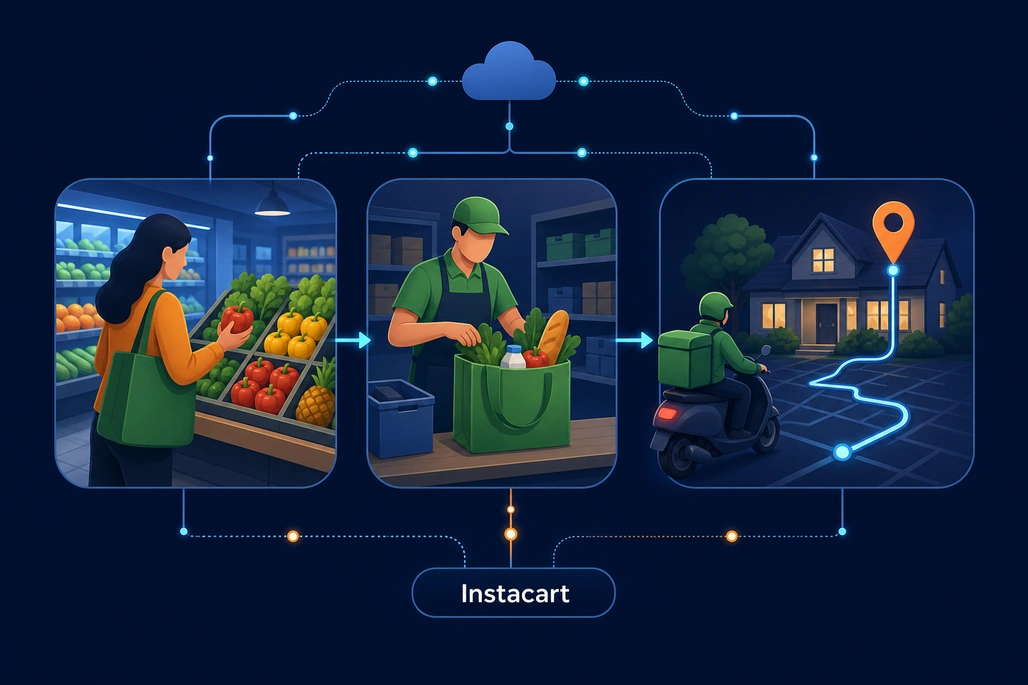
The proposed combination brings grocery technology together with a delivery network.
The companies describe the proposed combination as a way to bring together two different sets of capabilities. DoorDash has built a delivery and local-commerce network, while Instacart offers a grocery marketplace, grocery fulfillment tools, retailer ecommerce products, in-store technology, advertising products, and AI offerings for retail partners.
DoorDash says the combined company could offer retailers its delivery network alongside Instacart’s grocery and fulfillment technology, both inside the consumer apps and on retailers’ own websites. The stated goal is to help grocers and other retailers offer online ordering, delivery, advertising, and related services without building every component themselves.
This is important because grocery delivery involves more than moving a bag from a store to a home. A platform must connect a retailer’s catalog to online ordering, manage substitutions when an item is unavailable, coordinate a shopper or fulfillment workflow, assign a delivery worker, communicate order status, process payments, and handle support when something goes wrong. The companies’ executives emphasized grocery-specific challenges such as selecting fresh products and maintaining product quality during delivery.
DoorDash also says Instacart customers could gain access to more than 50,000 additional stores, in addition to the nearly 100,000 stores already on the Instacart platform. It projects that combining DashPass and Instacart+ could let members pay one membership fee rather than two and estimates $100 million in annual membership-fee savings. These are company projections and commitments, not outcomes that have already occurred.
What could change for customers, shoppers, and retailers?
What changes are planned for consumers?
DoorDash says consumers could receive more store choice, faster delivery options, and combined membership value. The company has not said that the two apps will become one app. Its stated plan is to retain the Instacart brand and app after closing.
That means a customer should not assume that their Instacart account, membership, prices, delivery fees, store selection, or service policies will change immediately. Until closing, the two companies say they will operate separately. After closing, specific product and membership changes would depend on future decisions by the combined company.
What changes are planned for Instacart Shoppers and DoorDash Dashers?
DoorDash says the combined company could create more earning opportunities by giving workers more kinds of delivery orders. It also says Instacart Shoppers would retain the flexibility to decide how much they work, see information used to decide whether to accept batches, and choose whether to take DoorDash orders or continue shopping only on Instacart.
These statements are post-close commitments from DoorDash, not a guarantee of individual earnings, batch availability, or compensation levels. Gig workers should distinguish between a commitment to offer access and a promise about how much work or income will be available in a particular market.
What changes are planned for grocery stores and retail partners?
DoorDash says local grocers will not be required to use one exclusive grocery-delivery platform. The company’s announced commitment is that grocers can continue to work with any platform they choose.
For retailers, the potential appeal is a broader toolkit: Instacart’s online grocery and advertising technology paired with DoorDash fulfillment and delivery services. The potential concern is that a larger combined platform may have more influence over the services, terms, data, and customer experience that retailers depend on. The final commercial impact will vary by retailer agreement and has not been fully detailed.
What approvals are still required?
The transaction is subject to Instacart stockholder approval, the expiration or termination of the waiting period under the Hart-Scott-Rodino Antitrust Improvements Act, other regulatory approvals—including in Canada and Israel—and customary closing conditions. DoorDash says stockholders holding about 19% of Instacart’s outstanding shares have already agreed to vote in favor of the transaction, but that does not replace the required stockholder vote.
The Hart-Scott-Rodino, or HSR, process is a U.S. premerger notification process for certain large transactions. The Federal Trade Commission explains that parties to covered transactions submit information to the FTC and Department of Justice before closing, and they may not close until the statutory waiting period has expired or been terminated early.
Regulatory review does not automatically mean a deal will be blocked. It does mean regulators can evaluate whether the transaction may substantially reduce competition and decide whether to allow it, seek changes, or challenge it. DoorDash’s own announcement lists delays, approval conditions, failure to obtain approvals, and failure to complete the deal as risks.
When could the DoorDash and Instacart deal close?
The companies expect the transaction to close at the end of 2027 or in the first half of 2028. That is an estimate, not a fixed deadline. The timing depends on the shareholder vote, regulatory reviews, and the satisfaction or waiver of other closing conditions.
The long proposed timetable underscores the difference between an announcement and a completed acquisition. DoorDash and Instacart will continue as separate and independent companies until closing. Customers, workers, and business partners should therefore treat current apps, policies, contracts, and support processes as separate unless either company announces a specific change.
TechCrunch reported that DoorDash plans to retain Instacart’s brand, enterprise technology products, and app, while noting that the companies will operate independently before closing. That approach could preserve a distinct Instacart customer experience even if ownership eventually changes, but the operating model will not be final until the deal receives approvals and closes.
How should beginners follow this acquisition?
Start with the status: this is a proposed acquisition, not a completed merger. The most reliable updates will come from the companies’ investor-relations pages and filings with the U.S. Securities and Exchange Commission, particularly the planned registration statement and proxy statement/prospectus.
Next, separate confirmed terms from expected benefits. The $65.00 per-share value, stockholder election options, anticipated financing, approval conditions, and expected closing window are transaction terms. Statements about lower costs, more orders, membership savings, better delivery, or stronger retailer tools are expectations that must be measured after a closing, if the closing occurs.
Finally, watch for concrete product announcements rather than assuming the headline creates immediate changes. Useful future questions include whether DashPass and Instacart+ benefits are combined, whether store selection expands in a particular city, how retailer agreements evolve, and whether shoppers or Dashers are offered new workflows or order types.
Frequently asked questions
Has DoorDash already bought Instacart?
No. DoorDash and Instacart announced a definitive acquisition agreement on October 29, 2026, but the transaction still requires stockholder approval, regulatory clearances, and other closing conditions.
How much is DoorDash paying for Instacart?
The proposed transaction values Instacart at approximately $17 billion, with consideration valued at $65.00 per Instacart share.
Will the Instacart app disappear?
DoorDash says it expects to keep the Instacart brand, app, and enterprise technology products after closing. Until the transaction closes, the companies will continue operating separately.
When is the DoorDash-Instacart deal expected to close?
The companies expect the deal to close at the end of 2027 or in the first half of 2028, subject to required approvals and closing conditions.
Why does the acquisition need regulatory review?
The proposed transaction requires review under the U.S. Hart-Scott-Rodino premerger process and other regulatory approvals. These reviews give competition authorities information about large acquisitions before the parties can complete them.
Based on reporting by LinkedIn, DoorDash Investor Relations, DoorDash, Associated Press, TechCrunch and Federal Trade Commission.

Join the conversation! Your thoughts help the community grow.