

Introduction
Xamarin is a platform that allows us to create a multi-platform app for Android, Windows, or iOS through a single integrated development environment (IDE). And with Xamarin.forms, the interface design for all three platforms can be accomplished within its XAML-based standard, native user-interface control.
Step 1
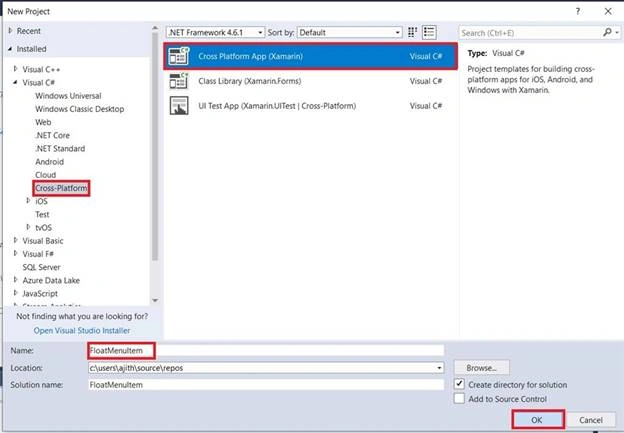
Open Visual Studio and go to New Project >> Installed >> Visual C# >> Cross-Platform.
Select the Cross-Platform app, then give your project a name and location.
Step 2
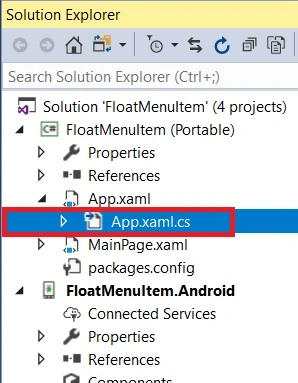
Open Solution Explorer >> Project Name(Portable) >> App.xaml.cs >> double-click will open the design view of this page.
The Code is given below.
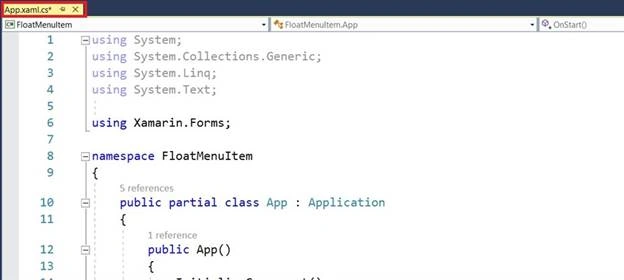
C# Code
- using System;
- using System.Collections.Generic;
- using System.Linq;
- using System.Text;
- using Xamarin.Forms;
- namespace FloatMenuItem
- {
- public partial class App : Application
- {
- public App()
- {
- InitializeComponent();
- MainPage = new NavigationPage(new MainPage());
- }
- protected override void OnStart()
- {
- // Handle when your app starts
- }
- protected override void OnSleep()
- {
- // Handle when your app sleeps
- }
- protected override void OnResume()
- {
- // Handle when your app resumes
- }
- }
- }
Step 3
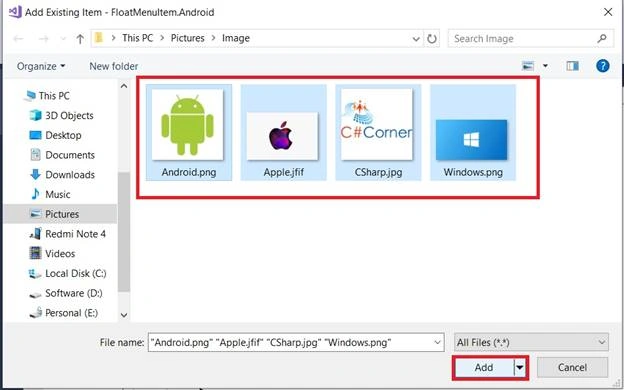
Next, add an image to Solution Explorer >> Project Name.Android >> Resourses >> Right Click >> drawable >> Add >> Existing Item.
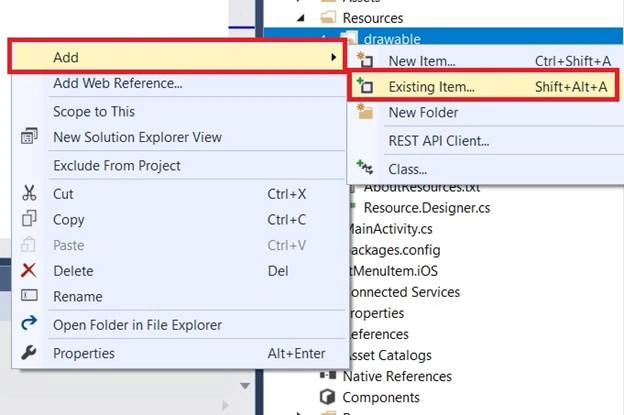
Next, a dialogue box will open. Choose image location and add images.
Step 4
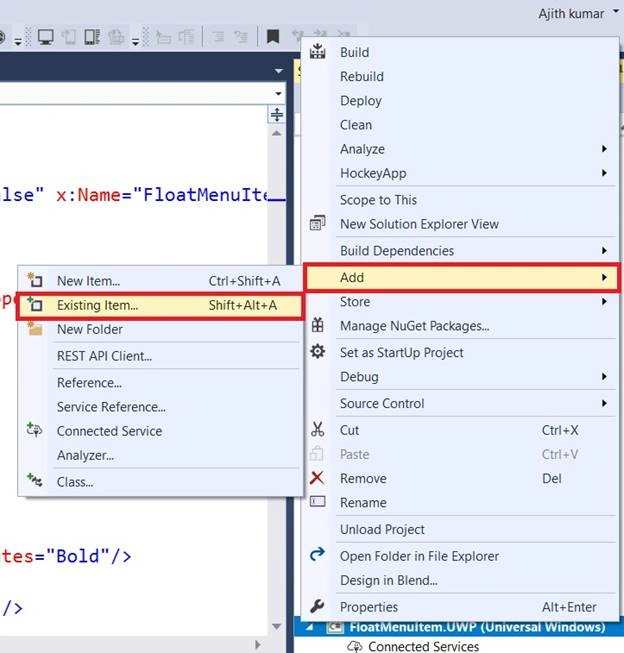
Next, add an image to Solution Explorer >> Project Name.Universal Windows Platform >>Right Click >> Add >> Existing Item.
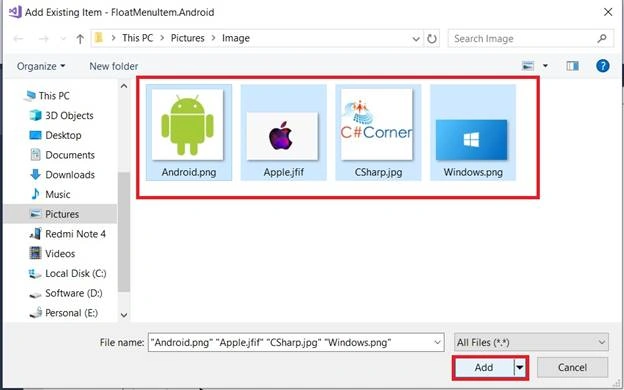
Next, a dialogue box will open Choose image location and add images.
Step 5
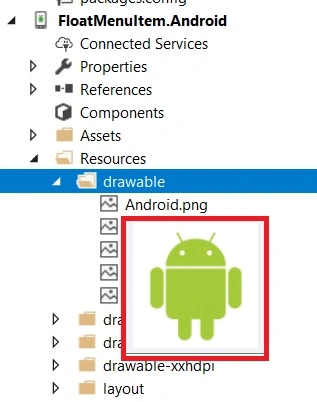
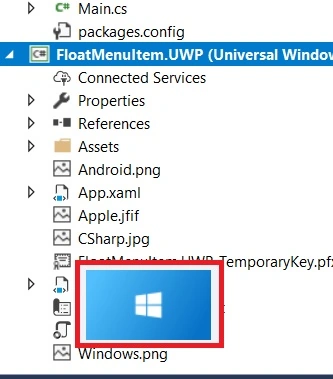
The Image is added successfully for Android and UWP.
Step 6
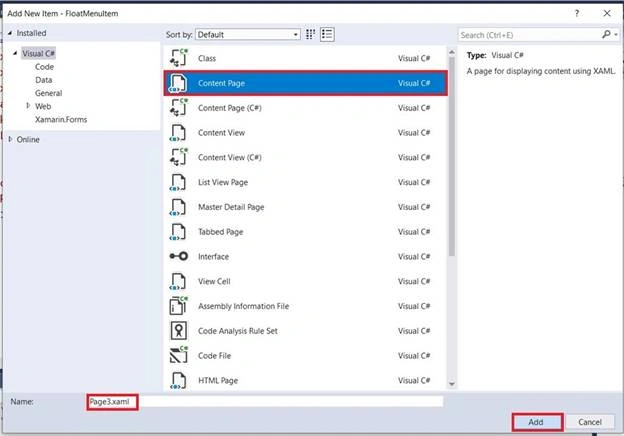
Next, Open Solution Explorer >> Project Name(Portable) >> Right-Click >> Add >> New Item or Ctrl+Shift+A.
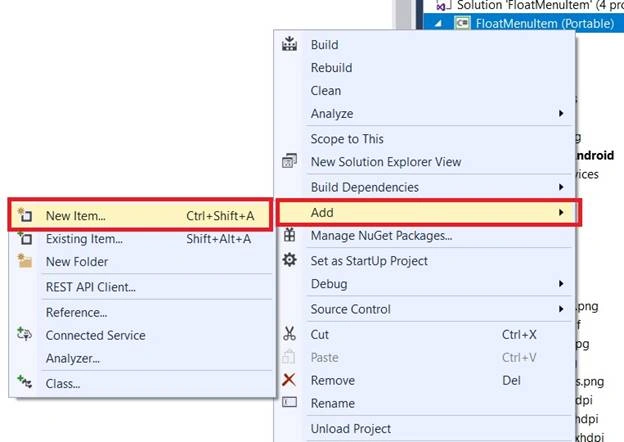
A new dialogue box will open. Now, add the XAML page and give it a name. Click the "Add" button.
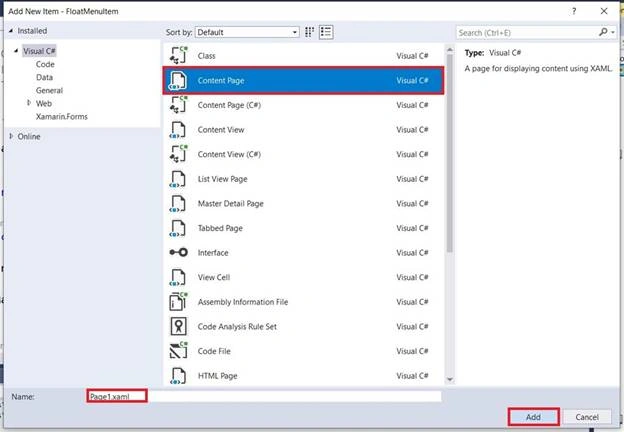
Similarly, add the XAML page and give your name - "Page 2".
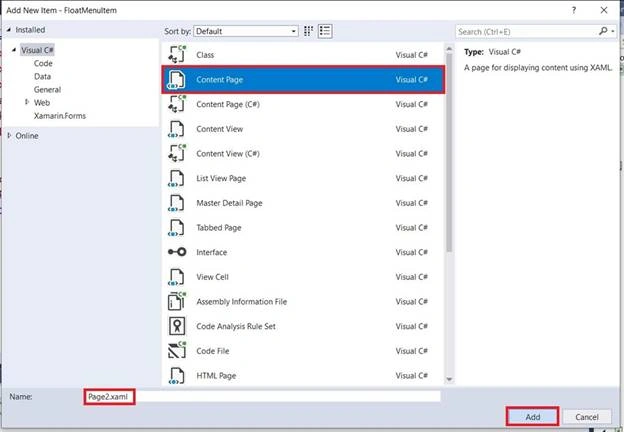
Similarly, add the XAML page and give your name - "Page 3".
Step 7
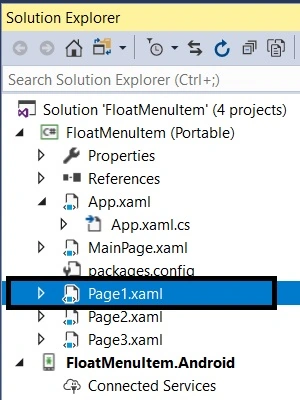
Open Solution Explorer >> Project Name >> Page1.xaml. Open the design view of this page.
The Code is given below.
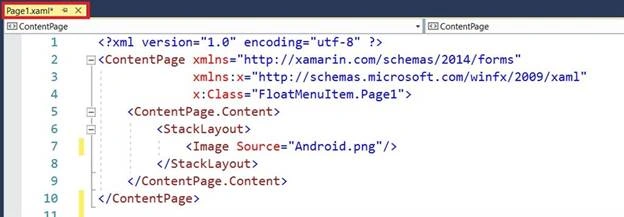
Xaml Code
- <?xml version="1.0" encoding="utf-8" ?>
- <ContentPage xmlns="http://xamarin.com/schemas/2014/forms"
- xmlns:x="http://schemas.microsoft.com/winfx/2009/xaml"
- x:Class="FloatMenuItem.Page1">
- <ContentPage.Content>
- <StackLayout>
- <Image Source="Android.png"/>
- </StackLayout>
- </ContentPage.Content>
- </ContentPage>
Step 8
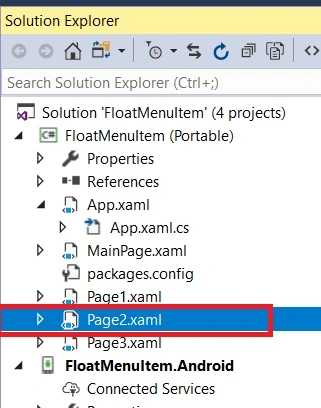
Open Solution Explorer >> Project Name >> Page2.xaml. Open the design view of this Page.
The Code is given below.
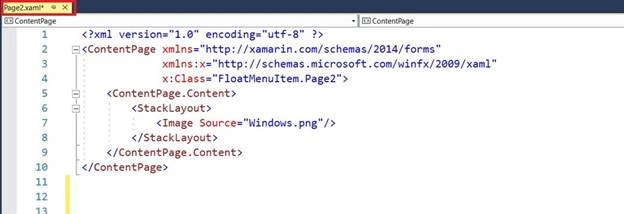
Xaml Code
- <?xml version="1.0" encoding="utf-8" ?>
- <ContentPage xmlns="http://xamarin.com/schemas/2014/forms"
- xmlns:x="http://schemas.microsoft.com/winfx/2009/xaml"
- x:Class="FloatMenuItem.Page2">
- <ContentPage.Content>
- <StackLayout>
- <Image Source="Windows.png"/>
- </StackLayout>
- </ContentPage.Content>
- </ContentPage>
Step 9
Open Solution Explorer >> Project Name >> Page3.xaml. Open the design view of this Page.
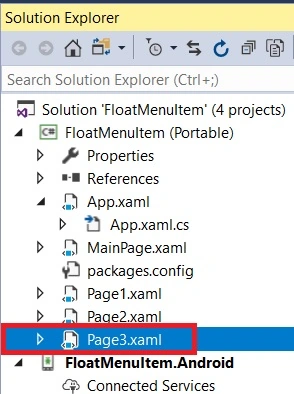
The Code is given below.
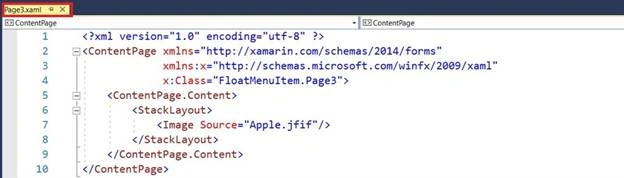
Xaml Code
- <?xml version="1.0" encoding="utf-8" ?>
- <ContentPage xmlns="http://xamarin.com/schemas/2014/forms"
- xmlns:x="http://schemas.microsoft.com/winfx/2009/xaml"
- x:Class="FloatMenuItem.Page3">
- <ContentPage.Content>
- <StackLayout>
- <Image Source="Apple.jfif"/>
- </StackLayout>
- </ContentPage.Content>
- </ContentPage>
Step 10
Open Solution Explorer >> Project Name >> MainPage.xaml. Open the design view of this Page.
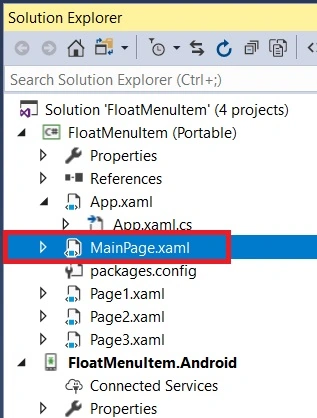
The Code is given below.
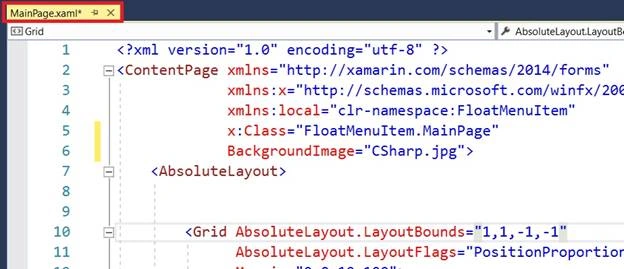
Xaml Code
- <?xml version="1.0" encoding="utf-8" ?>
- <ContentPage xmlns="http://xamarin.com/schemas/2014/forms"
- xmlns:x="http://schemas.microsoft.com/winfx/2009/xaml"
- xmlns:local="clr-namespace:FloatMenuItem"
- x:Class="FloatMenuItem.MainPage"
- BackgroundImage="CSharp.jpg">
- <AbsoluteLayout>
- <Grid AbsoluteLayout.LayoutBounds="1,1,-1,-1"
- AbsoluteLayout.LayoutFlags="PositionProportional"
- Margin="0,0,10,100">
- <Grid.RowDefinitions>
- <RowDefinition/>
- <RowDefinition/>
- <RowDefinition/>
- </Grid.RowDefinitions>
- <StackLayout Grid.Row="0" Orientation="Horizontal" IsVisible="False" x:Name="FloatMenuItem1">
- <Label Text="Android" VerticalOptions="Center"/>
- <Frame BackgroundColor="Red" CornerRadius="30">
- <Frame.GestureRecognizers>
- <TapGestureRecognizer x:Name="FloatMenuItem1Tap" Tapped="FloatMenuItem1Tap_OnTapped" />
- </Frame.GestureRecognizers>
- </Frame>
- </StackLayout>
- <StackLayout Grid.Row="1" Orientation="Horizontal" IsVisible="False" x:Name="FloatMenuItem2">
- <Label Text="Windows" VerticalOptions="Center"/>
- <Frame BackgroundColor="Green" CornerRadius="30">
- <Frame.GestureRecognizers>
- <TapGestureRecognizer x:Name="FloatMenuItem2Tap" Tapped="FloatMenuItem2Tap_OnTapped" />
- </Frame.GestureRecognizers>
- </Frame>
- </StackLayout>
- <StackLayout Grid.Row="2" Orientation="Horizontal" IsVisible="False" x:Name="FloatMenuItem3">
- <Label Text="iOS" VerticalOptions="Center"/>
- <Frame BackgroundColor="LightBlue" CornerRadius="30">
- <Frame.GestureRecognizers>
- <TapGestureRecognizer x:Name="FloatMenuItem3Tap" Tapped="FloatMenuItem3Tap_OnTapped" />
- </Frame.GestureRecognizers>
- </Frame>
- </StackLayout>
- </Grid>
- <Frame BackgroundColor="Blue" CornerRadius="30" HasShadow="True"
- AbsoluteLayout.LayoutFlags="PositionProportional"
- AbsoluteLayout.LayoutBounds="1,1,-1,-1"
- Margin="10">
- <Label Text="C#" TextColor="White" FontSize="Medium" FontAttributes="Bold"/>
- <Frame.GestureRecognizers>
- <TapGestureRecognizer Tapped="TapGestureRecognizer_OnTapped"/>
- </Frame.GestureRecognizers>
- </Frame>
- </AbsoluteLayout>
- </ContentPage>
Step 11
Open Solution Explorer >> Project Name >> MainPage.xaml.cs. Open the design view of this Page.
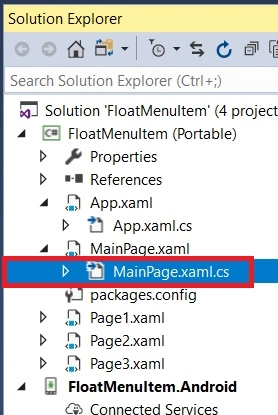
The Code is given below.
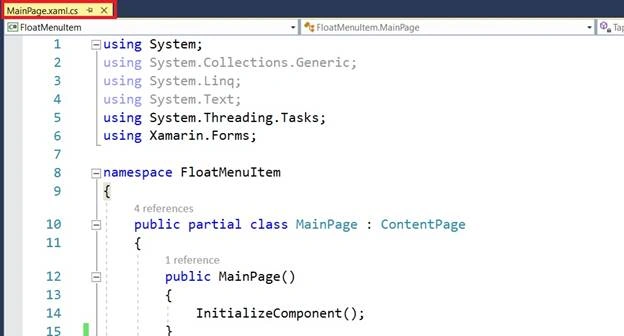
C# Code
- using System;
- using System.Collections.Generic;
- using System.Linq;
- using System.Text;
- using System.Threading.Tasks;
- using Xamarin.Forms;
- namespace FloatMenuItem
- {
- public partial class MainPage : ContentPage
- {
- public MainPage()
- {
- InitializeComponent();
- }
- private bool isOpen = false;
- private async void TapGestureRecognizer_OnTapped(object sender, EventArgs e)
- {
- if (isOpen == false)
- {
- isOpen = true;
- //Scale to smaller
- await ((Frame)sender).ScaleTo(0.8, 50, Easing.Linear);
- //Wait a moment
- await Task.Delay(100);
- //Scale to normal
- await ((Frame)sender).ScaleTo(1, 50, Easing.Linear);
- //Show FloatMenuItem1
- FloatMenuItem1.IsVisible = true;
- await FloatMenuItem1.TranslateTo(0, 0, 100);
- await FloatMenuItem1.TranslateTo(0, -20, 100);
- await FloatMenuItem1.TranslateTo(0, 0, 200);
- //Show FloatMenuItem2
- FloatMenuItem2.IsVisible = true;
- await FloatMenuItem2.TranslateTo(0, 0, 100);
- await FloatMenuItem2.TranslateTo(0, -20, 100);
- await FloatMenuItem2.TranslateTo(0, 0, 200);
- //Show FloatMenuItem3
- FloatMenuItem3.IsVisible = true;
- await FloatMenuItem3.TranslateTo(0, 0, 100);
- await FloatMenuItem3.TranslateTo(0, -20, 100);
- await FloatMenuItem3.TranslateTo(0, 0, 200);
- }
- else
- {
- isOpen = false;
- //Scale to smaller
- await ((Frame)sender).ScaleTo(0.8, 50, Easing.Linear);
- //Wait a moment
- await Task.Delay(100);
- //Scale to normal
- await ((Frame)sender).ScaleTo(1, 50, Easing.Linear);
- //Hide FloatMenuItem1
- await FloatMenuItem1.TranslateTo(0, 0, 100);
- await FloatMenuItem1.TranslateTo(0, -20, 100);
- await FloatMenuItem1.TranslateTo(0, 0, 200);
- FloatMenuItem1.IsVisible = false;
- //Hide FloatMenuItem2
- await FloatMenuItem2.TranslateTo(0, 0, 100);
- await FloatMenuItem2.TranslateTo(0, -20, 100);
- await FloatMenuItem2.TranslateTo(0, 0, 200);
- FloatMenuItem2.IsVisible = false;
- //Hide FloatMenuItem3
- await FloatMenuItem3.TranslateTo(0, 0, 100);
- await FloatMenuItem3.TranslateTo(0, -20, 100);
- await FloatMenuItem3.TranslateTo(0, 0, 200);
- FloatMenuItem3.IsVisible = false;
- }
- }
- private async void FloatMenuItem1Tap_OnTapped(object sender, EventArgs e)
- {
- await Navigation.PushAsync(new Page1());
- }
- private async void FloatMenuItem2Tap_OnTapped(object sender, EventArgs e)
- {
- await Navigation.PushAsync(new Page2());
- }
- private async void FloatMenuItem3Tap_OnTapped(object sender, EventArgs e)
- {
- await Navigation.PushAsync(new Page3());
- }
- }
- }
Step 12
Next, select the "Build and Deploy" option followed by selecting from the list of Android Emulator or simulator. You can choose any API(Application Program Interface) Level Emulator or simulator to run it.
Output
After a few seconds, you will see your app working.
Android Output
You can choose the Android Platform.

Click the "C#" Float item menu in Android, Windows, iOS.
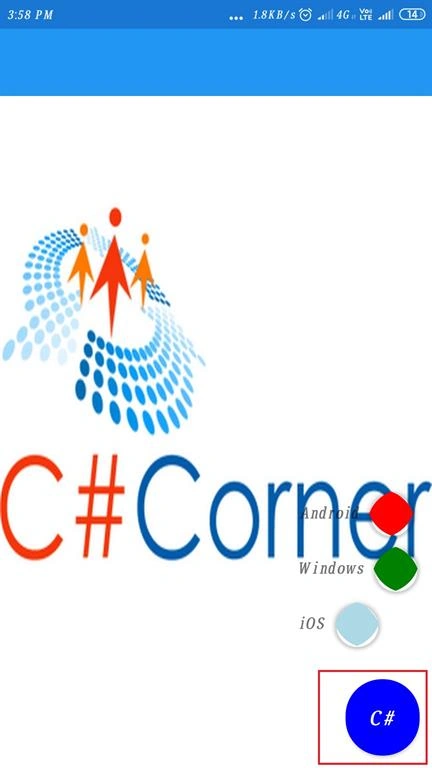
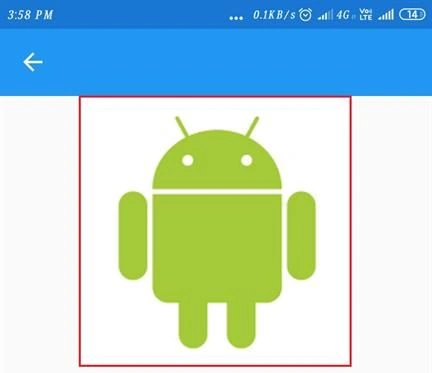
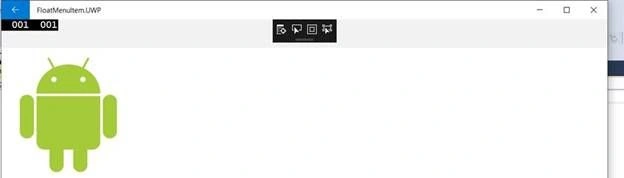
Click Android Navigate and the Page 1 result is displayed.
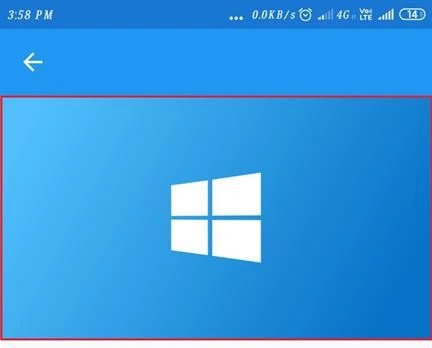
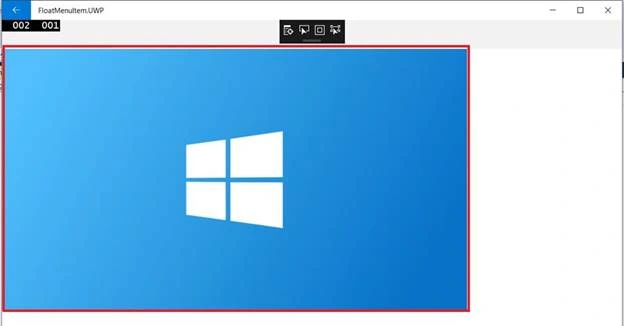
Click Windows Navigate and the Page 2 result is displayed.
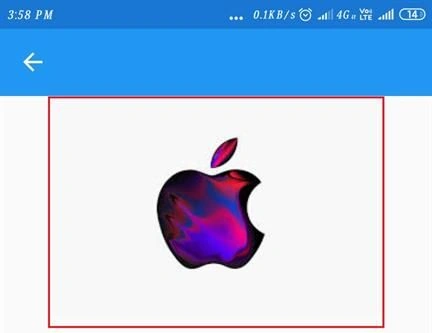
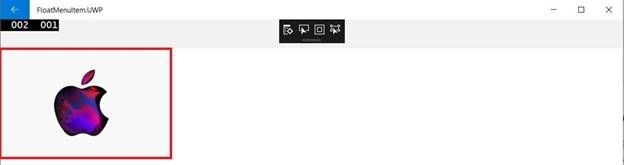
Click iOS Navigate the Page 3 result is displayed.
Windows Output
You can choose the UWP Platform.
Click the "C#" Float item menu in Android, Windows, iOS.
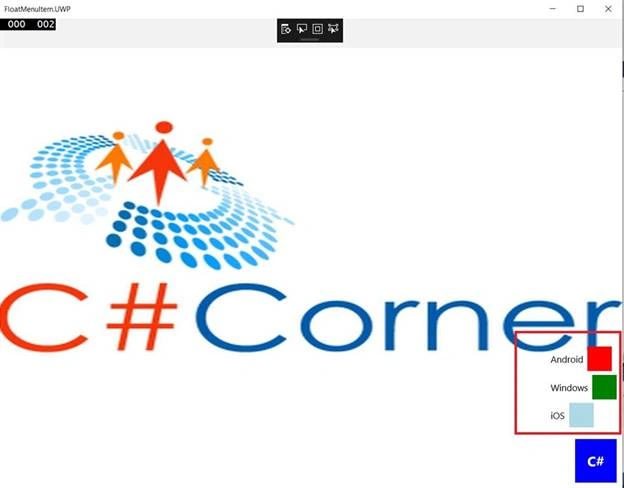
Click Android Navigate and the Page 1 result is displayed.
Click Windows Navigate and the Page 2 result is displayed.
Click iOS Navigate and the Page 3 result is displayed.
Finally, we have successfully created our desired Xamarin.Forms application.
Conclusion
I hope you have learned about Float Item Menu Working Navigation Android and UWP Using Xamarin.Forms with C#.
DeepanPosted Aug 21, 2019, 2:03 AM
Simple way of teaching