
A trusted-looking coding assignment became the reported entry point to Binance systems.
A fake job interview was the first known step in the attack that led to approximately $6.34 billion in virtual assets being stolen from Binance on October 29, 2026. According to Binance’s preliminary investigation, attackers used a convincing recruitment process to persuade an engineer to run a malicious coding assignment, then moved through internal systems, obtained privileged deployment access, and reached wallet-signing operations. The incident shows why social engineering is not merely an email problem: a trusted-looking conversation and one unsafe software download can become an entry point to critical infrastructure.
Key takeaways
- Binance said approximately $6.34 billion in digital assets were affected by the October 29, 2026 incident.
- The attack reportedly began with a fake recruiter, two interviews, and a malicious repository presented as a technical task.
- The FBI attributed the theft of more than $6 billion in virtual assets to North Korean activity it calls TraderTraitor.
- Binance said it rebuilt affected wallet and AI systems, replaced affected devices, and revoked associated credentials and tokens.
- Developers should treat interview assignments, developer-tool installers, browser extensions, and chat-based downloads as potential supply-chain risks.
What happened in the Binance hack?
Binance disclosed that a severe security incident affected approximately $6.34 billion in virtual assets on October 29, 2026. In its preliminary incident report, the exchange said the operation was a multi-stage campaign involving fake recruitment interviews, malicious downloads, endpoint compromise, abuse of an internal AI tool, and an advanced transaction-authorization method.
The FBI later stated that North Korea was responsible for the theft of more than $6 billion in virtual assets and identified the activity as TraderTraitor. The agency said it had observed the actors converting stolen assets primarily into Ether and warned virtual-asset service providers about addresses allegedly associated with laundering activity.
The scale of the theft made the incident exceptional, but its entry point was familiar: a person was persuaded to do something that seemed reasonable in a normal job search. That distinction matters for beginners. The initial compromise was not described as a password guessed by brute force or a blockchain flaw. It began with social engineering.
How did a fake interview become a security breach?
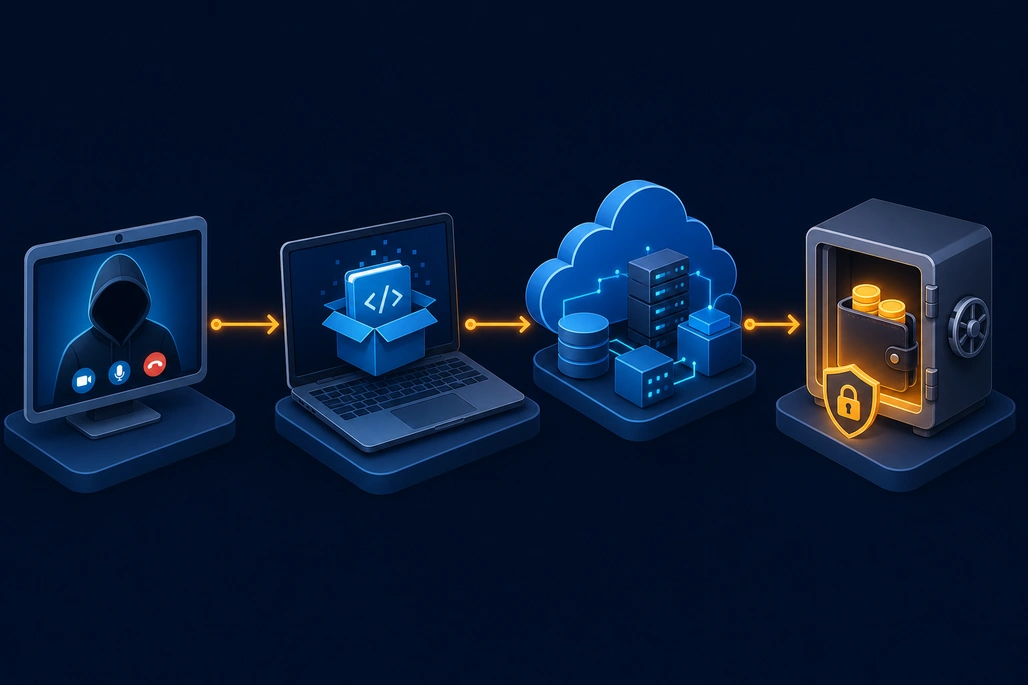
The reported intrusion moved from social engineering to a compromised endpoint and then privileged systems.
Social engineering is the practice of manipulating people into taking an action that benefits an attacker. Instead of breaking a technical control directly, an attacker creates urgency, trust, curiosity, or professional credibility and asks the target to open, install, approve, share, or run something.
Binance said Software Engineer B was contacted through a legitimate job-search platform in September 2026 by someone posing as a project director. The engineer’s public profile mentioned experience at Binance, which made the person a valuable target for an attacker looking for a path toward exchange infrastructure.
The purported employer used two interview stages. Binance said the first was a live video interview with someone claiming to be an HR representative, who shared a social-media account with personal photos and videos to build trust. The second interview was held in a messaging application with a person claiming to be the CEO of a fictitious company.
Near the end of the second interview, the engineer was asked to download a technical task: a code repository intended to look like an interview assignment. Binance said the repository contained malicious code that executed during setup. The assignment was therefore not a test of the candidate’s skills; it was a delivery mechanism for malware.
This is an important lesson for developers. A real-looking recruiter profile, a video call, a polished personal account, and a plausible coding exercise do not prove that a request is safe. Attackers can spend days or weeks building credibility because a trusted target is more valuable than a quick click.
How did the malware establish a foothold?
A foothold is an attacker’s initial, persistent presence inside a device or environment. Once the malicious interview repository ran on the work computer, Binance said the malware used obfuscation and evasion techniques to avoid endpoint protection and communicate with an attacker-controlled server.
Specifically, Binance reported that the malicious code replaced a legitimate component of the pyenv developer tool with a malicious version. This kind of replacement is dangerous because developers and security tools may continue to see a familiar command name while the command is no longer performing only its expected job.
In simple terms, the attack turned a trusted local tool into a controlled doorway. When a developer or automated process invokes the altered tool, the attacker may be able to run additional commands or maintain access. Binance described the malware as zero-day at the time, meaning its specific behavior was not detected by the endpoint protection tools then in use.
Independent reporting by BleepingComputer described the same sequence: a fake interview led to a malicious coding assignment, which compromised the engineer’s device and ultimately enabled access to wallet infrastructure. Chainalysis characterized this broader approach as a fake-interview or “contagious interview” playbook targeting people with access to cryptocurrency systems.
Why was an internal AI tool part of the attack path?
Artificial intelligence tools can be useful inside engineering organizations because they summarize information, assist with code, retrieve knowledge, and automate workflows. But any internal tool is also part of the organization’s access-control design. If it can reach sensitive systems or act on a user’s behalf, a compromised user session can turn that tool into a bridge for an attacker.
Binance said that on October 20, 2026, the attackers used Engineer B’s compromised computer and an internal AI tool to gain control over two additional wallet-infrastructure engineers, identified as Engineer A and Engineer C. Binance did not publish all technical details of how that access was expanded, appropriately limiting information that could help attackers reproduce the method.
The key beginner concept is identity propagation. A system may correctly authenticate a user, but if an attacker has taken over that user’s device or session, the system can be misled into treating attacker actions as legitimate employee actions. Security therefore requires more than login screens and multifactor authentication; it also requires strict boundaries on what each identity, session, tool, and token can do.
Binance said the attackers found a container-deployment permission token on Engineer A’s computer. A deployment token can be legitimate for operational work, but it is highly sensitive because it can enable changes to running systems. The incident illustrates why credentials should have the narrowest possible permissions and should not remain broadly usable if a workstation is compromised.
How did the attackers reach wallet-signing operations?
According to Binance, the attackers accessed Engineer C’s computer on October 29, used credentials stolen from Engineer A, deployed a container, and triggered a malicious script. Binance said this enabled access to wallet-signing operations between 17:15 and 19:56 UTC.
Wallet signing is the moment when a cryptocurrency transaction is authorized. Protecting this process is central to exchange security because a signed transaction can move assets on a blockchain. Binance’s initial updates said there was no evidence that private wallet keys had leaked; the reported attack path instead involved compromised endpoints, credentials, deployment capability, and wallet operations.
This distinction is useful. In a traditional breach, an attacker may steal a database. In a cryptocurrency environment, an attacker may aim to obtain authorization to move assets. The outcome can be immediate because blockchain transfers are designed to settle across distributed networks rather than wait for a bank’s manual approval process.
| Attack stage | What Binance reported | Why it matters |
|---|---|---|
| Trust building | A fake recruiter and staged interviews targeted an engineer. | People can be the first security boundary. |
| Initial compromise | A technical assignment contained malicious code. | Repositories and installers require verification. |
| Lateral movement | An internal AI tool and compromised endpoints helped attackers reach other engineers. | Internal tools need strong authorization boundaries. |
| Privilege use | Attackers found a container-deployment permission token. | Tokens should be short-lived and narrowly scoped. |
| Asset movement | Malicious actions reached wallet-signing operations. | High-value transactions need independent controls. |
What was EIP-7702’s role in the incident?
Binance said that pausing withdrawals did not immediately stop every unauthorized movement because malicious EIP-7702 authorizations already existed on-chain. EIP-7702 is an Ethereum proposal and capability that enables an externally owned account to delegate behavior to code under particular conditions.
Binance reported that attackers submitted 50 signing transactions to establish malicious delegation authorizations. Once those authorizations existed on-chain, Binance said they could operate independently of its normal withdrawal infrastructure. This meant that stopping ordinary exchange withdrawals did not automatically remove the on-chain permissions already created.
Binance also said its hot wallet used multi-party computation, or MPC. MPC is designed so that no single participant holds the whole private key. That design can reduce the risk of one key being stolen, but it also meant there was no single private key that Binance could use to instantly revoke the malicious authorizations. Binance said it had to execute additional on-chain actions to remove the delegation code.
The lesson is not that MPC or Ethereum authorizations are inherently unsafe. The lesson is that security controls need to account for the full life cycle of an authorization: how it is created, who can create it, how it is monitored, and how it can be revoked during an incident.
What did Binance and law enforcement do after the theft?
Binance temporarily suspended withdrawals, revoked affected authorizations, and worked with law enforcement, blockchain analytics firms, token issuers, and other partners to trace and freeze assets. In its November 3 update, Binance said approximately $2.85 billion in virtual assets had been frozen or intercepted, subject to reconciliation and market-price changes.
The exchange also said it would absorb the financial impact rather than pass the loss to users. Binance reported that, as of November 3, 2026, 98% of affected token assets had been replenished and that it had reserved more than the funds needed to cover the loss. Those are Binance’s preliminary statements, and its investigation and planned independent cybersecurity review were still ongoing.
For remediation, Binance said it rebuilt the affected wallet system and internal AI tool, replaced affected devices, disabled credentials and tokens tied to the affected engineers, completed enhanced device scans, strengthened wallet-service controls, and improved behavioral anomaly detection.
What should developers learn from this attack?
The most practical lesson is to separate job-search activity from production access. A take-home assignment, recruiter-provided repository, browser extension, or “required” developer-tool installer should never run on a workstation that can access source code, cloud consoles, production credentials, wallets, or deployment systems.
Developers should use an isolated environment for untrusted interview tasks. That can mean a disposable virtual machine, a dedicated device, or a sandboxed environment with no corporate single sign-on session, SSH keys, cloud credentials, password-manager data, wallet extensions, or production network access. Isolation limits what an attacker can reach if the task is malicious.
Organizations should make the secure choice easy. They can provide managed sandbox environments for external code, maintain approved package registries and developer-tool sources, restrict access tokens by role and duration, and require independent approval for high-value production actions. Detection also matters: unexpected package installation, unusual endpoint behavior, new container deployments, and abnormal signing requests should be correlated and investigated quickly.
Finally, security training should cover more than generic phishing emails. Teams should practice scenarios involving fake recruiters, video interviews, chat applications, cloned repositories, npm or package-manager dependencies, browser extensions, and AI-tool requests. The Binance case demonstrates that sophisticated social engineering can look like ordinary professional work.
How can job candidates safely handle coding assignments?
- Verify the employer independently. Use the company’s official website and known contacts rather than relying only on a recruiter profile, chat account, or video call.
- Do not run unknown code on a work device. Keep interview tasks away from employer systems and from personal devices that hold wallets, credentials, or sensitive files.
- Inspect before installing. Review repository files, installation instructions, dependency manifests, and scripts; be especially cautious of instructions requiring elevated privileges or downloads from unofficial sources.
- Use a disposable environment. A fresh virtual machine or sandbox should have no saved browser sessions, SSH keys, cloud access, password-manager integration, or corporate VPN connection.
- Report suspicious activity quickly. If a task behaves unexpectedly, disconnect the environment and notify the relevant security team. Fast reporting can reduce the chance of lateral movement.
Frequently asked questions
Did a fake interview alone cause the Binance hack?
No. Binance described the interview as the social-engineering entry point in a multi-stage campaign. The reported sequence also involved malware, compromised devices, use of an internal AI tool, stolen credentials, deployment permissions, and wallet-signing access.
Who did the FBI blame for the Binance theft?
The FBI said on October 31, 2026 that North Korea was responsible for the theft of more than $6 billion in virtual assets from Binance. The bureau refers to this activity as TraderTraitor.
What is a fake interview attack?
A fake interview attack is a social-engineering scheme in which an attacker pretends to recruit a candidate and uses messages, interviews, assignments, repositories, documents, or software downloads to deliver malware or steal credentials.
Why did suspending withdrawals not immediately stop the attack?
Binance said malicious EIP-7702 authorizations had already been established on-chain. Because those authorizations operated outside normal withdrawal infrastructure, Binance had to take separate on-chain actions to revoke them.
How can developers safely complete a coding interview task?
Developers should verify the employer through independent channels and run unfamiliar code only in an isolated, disposable environment with no work credentials, cloud tokens, wallet data, VPN access, or sensitive browser sessions.
Based on reporting by Binance Blog, Federal Bureau of Investigation, Chainalysis and BleepingComputer.


RinkiPosted Nov 6, 2026, 5:29 AM EST
Thanks for sharing