

The pledge raises questions about ownership, eligibility, and secure delivery.
Elon Musk said on October 19, 2026, that he plans to give one of his SpaceX shares to every “kid in America” in 2027. The announcement is a pledge, not a completed program: Musk has not stated who will qualify, how children will receive shares, whether parents must enroll, or how the transfer will comply with rules governing accounts for minors. At SpaceX’s October 16 closing price of $146.03, a one-share gift for roughly 72 million to 73 million U.S. children would have an estimated market value above $10.5 billion, but that estimate can change as the stock price changes.
Key takeaways
- Elon Musk made the pledge in an October 19, 2026 post on X, saying the distribution would happen next year.
- The term “every kid in America” has not been defined, so citizenship, age, residency, enrollment, and account requirements remain unknown.
- A direct SpaceX share is different from cash in a child investment account, and the announced distribution method has not been confirmed.
- Trump Accounts exist for eligible children, but during their growth period they generally may hold qualifying index mutual funds or ETFs rather than an individual company stock.
- Families should not pay anyone, provide sensitive information, or make investment decisions based on the pledge until official distribution instructions are published.
What did Elon Musk announce?
In a post published shortly before 4 a.m. Eastern Time on October 19, 2026, Musk wrote: “Next year, I will give one of my SpaceX shares to every kid in America. This will be the first of many.” The original statement appeared on Musk’s X account.
The word pledge matters. The post sets out Musk’s intent, but it does not provide program terms, a registration portal, a record date, eligibility rules, tax treatment, custody arrangements, or a timetable within 2027. Reporting by the Associated Press, Axios, and CBS News likewise found that the announcement did not explain how the shares would be distributed.
That absence of operational detail means the announcement should not yet be treated as an offer that families can claim. It is also not a government benefit announcement. It is a proposed private share gift by Musk, which may eventually use an existing federal account system, another financial intermediary, or a newly designed process.
How large could the proposed gift be?
The scale depends on two variables: the number of eligible children and SpaceX’s market price at the time of a transfer. The Associated Press reported that SpaceX closed at $146.03 on Friday, October 16, 2026, and estimated approximately 73 million people in the United States were under age 18. That produces an illustrative value of about $10.66 billion if every child received exactly one share at that price.
Axios used the Census Bureau figure of just over 72 million people under 18 and estimated a little over $10.5 billion using the same $146.03 closing price. Neither calculation is a guaranteed value. Share prices move every trading day, and the eventual eligible group may be smaller or larger than the under-18 population depending on the rules Musk adopts.
| Item | What is known as of October 20, 2026 | Why it matters |
|---|---|---|
| Gift size | One SpaceX share per qualifying child is the stated intention. | The number of shares, rather than a fixed dollar amount, determines each child’s initial holding. |
| Timing | Musk said “next year,” meaning 2027. | No specific distribution date has been announced. |
| Potential value | SpaceX closed at $146.03 on October 16, 2026. | The share value at any later transfer could be higher or lower. |
| Potential population | Reports cite roughly 72 million to 73 million U.S. residents under 18. | “Kid in America” is broader and less precise than a legal eligibility definition. |
| Distribution plan | Not announced. | This is the main unanswered implementation question. |
What does owning one share mean for a child?
A share is a unit of ownership in a company. If a child ultimately receives one SpaceX share directly, the child would own a very small fraction of the company, with the value of that ownership rising or falling with the market price. A share does not guarantee a profit, and it does not provide a fixed annual payment.
For a minor, the practical owner and the legal decision-maker are often different people. Financial institutions normally require a parent, guardian, custodian, or trustee to manage an account for a child. The exact model matters because it affects who receives account notices, who can make permitted choices, when the child gains control, and whether the share can be sold or transferred.
There are also two fundamentally different ways a program could be structured. The first is a direct stock transfer into a custodial brokerage account. The second is a contribution to a child-focused investment account, where the donated asset might be sold and the proceeds invested under that account’s rules. Musk has not said which approach, if either, will be used.
Could the pledge be connected to Trump Accounts?
It could be connected, but that has not been confirmed by Musk. Trump Accounts are a federal program created for eligible children. The Internal Revenue Service describes them as a type of traditional IRA established for the exclusive benefit of a child; a parent, guardian, or other authorized individual makes the election to establish the account using Form 4547 or the available IRS online process.
Treasury announced on July 2, 2026, that it would accept large philanthropic contributions of readily tradable public-company stock to support Trump Accounts. Under that process, approved stock can be transferred to Treasury and contributed to eligible children’s accounts under donor instructions, applicable law, and Treasury guidance. Because SpaceX is publicly traded, this provides a possible administrative route for a large donation, but it does not confirm that Musk will use it.
There is an important limitation for beginners to understand. During the Trump Account “growth period,” funds generally can be invested only in qualifying mutual funds or exchange-traded funds that track an equity index of primarily U.S. companies, do not use leverage, and have annual fees and expenses of no more than 0.1%. An individual SpaceX share is not itself a broad index mutual fund or ETF.
Therefore, a literal deposit of one SpaceX share that remains a SpaceX share inside a Trump Account would appear inconsistent with the investment restrictions described in the IRS’s proposed regulations. If Trump Accounts are used, the program would need an announced mechanism that fits those rules, such as a sale or conversion followed by investment in an eligible fund. That is an inference from the published rules, not a distribution plan announced by Musk or the government.
Who might qualify for a SpaceX share?
No one knows yet. Musk’s words were “every kid in America,” but the phrase leaves several key questions unresolved. It could mean every U.S. resident below a stated age, every U.S. citizen below a stated age, children with Social Security numbers, children whose parents complete an enrollment step, or a more limited group.
These distinctions are not minor administrative details. For example, the IRS says an initial Trump Account generally can be established for a child who is under age 18 at the end of the election year and has a valid Social Security number. The federal $1,000 pilot contribution has narrower eligibility: the child must be a U.S. citizen, have a Social Security number, and have been born from January 1, 2025, through December 31, 2028.
The pilot contribution criteria do not automatically apply to Musk’s proposal. They simply show why families should wait for the actual terms. A private donation can define its eligibility differently, subject to applicable law and the system used to distribute it.
How would a nationwide stock distribution work?
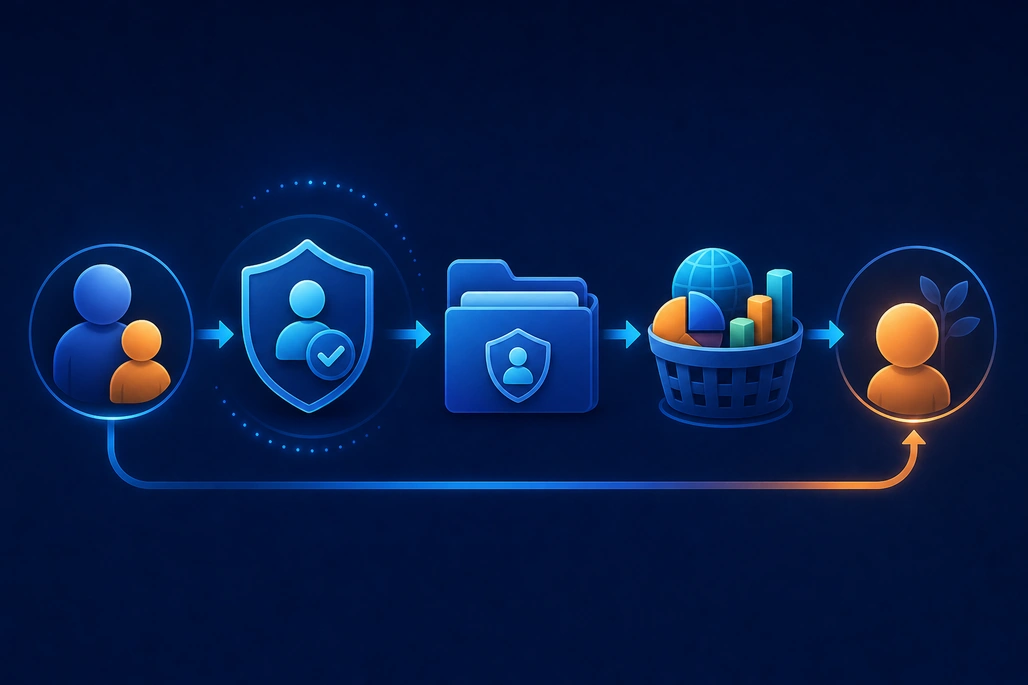
A nationwide asset gift would require verified eligibility and custodial account administration.
Distributing tens of millions of shares is primarily an identity, custody, and recordkeeping project. A workable program would need to establish the eligible child population, avoid duplicate claims, protect personal data, create or identify accounts, transfer the shares or their value, and provide tax documents and customer support.
What would the basic workflow look like?
- Publish official rules: Define eligibility, the date used to determine eligibility, documentation requirements, and whether enrollment is automatic or opt-in.
- Choose a custodian or account program: A brokerage, bank trustee, federal account system, or another authorized institution would need to hold assets for minors.
- Verify families safely: Parents or guardians may need to confirm identity and their authority to act for a child.
- Allocate the asset: The operator would transfer a share, a fractional share, or proceeds from a sale, depending on the final structure.
- Provide disclosures and support: Families would need statements, tax information, instructions, and a process for correcting records.
This sequence is illustrative rather than an announced SpaceX plan. The point is that a social-media promise is only the first step. The difficult work lies in operating a secure, lawful program at national scale.
What are the benefits and risks for families?

A single company share carries concentration risk that diversified funds seek to reduce.
The potential benefit is straightforward: a child could receive an asset at no purchase cost and have a starting point for learning about ownership, long-term investing, and market risk. If the value grows over time, that asset could become more valuable. But growth is not guaranteed, and a single-company holding can decline sharply.
The main investment risk is concentration. One SpaceX share ties the child’s outcome to one business, its execution, market conditions, competition, regulation, and investor sentiment. Broad index funds spread exposure across many companies; one company share does not.
There are also practical risks. Scammers often imitate high-interest giveaways with fake registration pages, requests for crypto payments, or demands for Social Security numbers. Until Musk, SpaceX, a federal agency, or a verified financial institution announces a formal process, families should assume that unsolicited claim links and payment requests are fraudulent.
What should parents and guardians do now?
For now, the appropriate action is to monitor verified announcements rather than attempt to claim anything. No distribution portal or official enrollment process for Musk’s stated 2027 SpaceX-share pledge was identified in the announcement or in the reporting published by October 20, 2026.
Families that are independently interested in Trump Accounts can review the IRS guidance. Opening such an account is a separate decision from Musk’s pledge. The IRS says an authorized individual can establish an account for an eligible child and that the account must have a bank or other IRS-approved nonbank trustee.
- Do not send money to “unlock” a promised share.
- Do not provide a child’s Social Security number through an unverified link, social-media direct message, or phone call.
- Check announcements from Musk’s verified account, SpaceX, the IRS, Treasury, and the chosen financial institution if a program is announced.
- Read the eligibility, custody, investment, and tax documents before completing enrollment.
- Remember that a share gift is an investment asset, not a guaranteed savings balance.
When will SpaceX shares be available to U.S. children?
Musk said the gift would occur in 2027, but no date, enrollment period, or transfer process has been announced. The accurate beginner-level conclusion is simple: the pledge is real, but the program details are not yet public.
That distinction will remain important as further information emerges. A credible implementation announcement should name the sponsor or administrator, identify who qualifies, explain how custodial ownership works, state whether recipients get shares or cash-equivalent value, and provide official support channels.
Frequently asked questions
Did Elon Musk already give SpaceX shares to U.S. children?
No. On October 19, 2026, Musk said he intends to give one SpaceX share to every “kid in America” next year. As of October 20, 2026, no completed nationwide distribution or official claim process has been announced.
How much is one SpaceX share worth?
SpaceX closed at $146.03 on October 16, 2026, according to Associated Press reporting. That is a historical closing price, not a guaranteed future value; the share price can rise or fall before any distribution occurs.
Who will be eligible for Musk’s SpaceX share gift?
The eligibility rules are unknown. Musk did not define “kid,” state an age cutoff, or specify whether eligibility depends on citizenship, residence, Social Security numbers, or enrollment by a parent or guardian.
Will the SpaceX shares go into Trump Accounts?
That has not been confirmed. Treasury can accept certain philanthropic public-stock contributions for Trump Accounts, but Trump Accounts generally limit investments during the growth period to qualifying index mutual funds and ETFs, not individual company shares.
Should families sign up or pay a fee now?
No. Families should wait for verified instructions from official sources. A legitimate stock gift should not require an upfront payment, cryptocurrency transfer, or submission of sensitive information through an unverified website.
Sources
- Elon Musk post announcing the planned SpaceX share gift — X, October 19, 2026
- Musk pledges to give a share of his SpaceX company to every kid in America — Associated Press, October 19, 2026
- Musk pledges 1 SpaceX share for every child in America — Axios, October 19, 2026
- Elon Musk says he plans to gift a SpaceX share to every child in the U.S. — CBS News, October 19, 2026
- Treasury and IRS issue proposed regulations on eligible investments for Trump Accounts — Internal Revenue Service, August 20, 2026
- Treasury and IRS to Accept Philanthropic Stock Contributions for Trump Accounts — U.S. Department of the Treasury, July 2, 2026
- Instructions for Form 4547, Trump Account Election(s) — Internal Revenue Service, December 2025

Join the conversation! Your thoughts help the community grow.