

Partitioning
Partitioning in virtualization is a critical concept that revolutionizes how computing resources are utilized and managed in modern IT infrastructures. By dividing a single physical server into multiple virtual machines (VMs), partitioning enables efficient resource allocation, enhanced security, and operational flexibility. This article explores the key aspects, benefits, and implications of partitioning in detail.
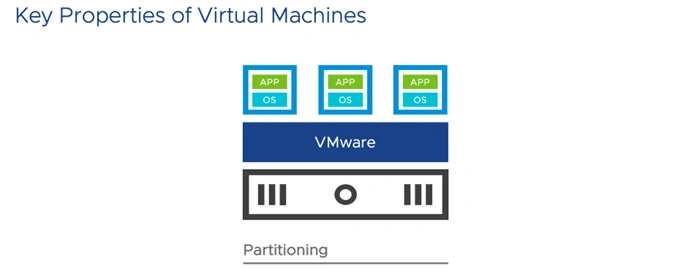
Related Image © VMware
Key Aspects of Partitioning
- Resource Allocation
- CPU Partitioning: One of the foundational aspects of partitioning is the allocation of CPU resources among virtual machines. The hypervisor, which acts as a virtualization layer, assigns specific portions of the physical CPU's processing power to each VM. This allocation ensures that multiple VMs can share the underlying CPU efficiently without contention, optimizing overall system performance.
- Memory Partitioning: Similar to CPU partitioning, memory (RAM) is divided among VMs to ensure each virtual machine has sufficient resources to operate effectively. The hypervisor dynamically manages memory allocation, adjusting it based on the workload demands of each VM. This dynamic management prevents overallocation or underutilization of memory, thereby improving system reliability and performance.
- Storage Partitioning: Disk storage within a virtualized environment is partitioned into separate virtual disks for each VM. These virtual disks function as independent storage units, isolated from one another to prevent data interference. Storage partitioning allows VMs to store and access data as if they were running on dedicated physical hardware, enhancing data integrity and accessibility.
- Network Partitioning: Networking resources, including bandwidth and network interface controllers (NICs), are allocated to VMs to ensure reliable connectivity. Virtual networking components manage traffic flow efficiently, enabling VMs to communicate with each other and external networks as required by their operational needs. Network partitioning enhances network security by isolating traffic and preventing unauthorized access between VMs.
- Isolation and Security
- Operational Isolation: Each VM operates in its own isolated environment, independent of other VMs running on the same physical server. This operational isolation prevents issues within one VM from affecting others, ensuring system stability and reliability. Administrators can manage and troubleshoot VMs individually without impacting the overall system's performance.
- Security Isolation: VMs are also isolated from each other at a software level, reducing the risk of security breaches and unauthorized access. This isolation minimizes the attack surface by containing vulnerabilities within individual VMs, thereby enhancing overall system security. Security policies and access controls can be enforced at the VM level, ensuring compliance with organizational security standards.
- Dynamic Resource Management
- Elastic Resource Allocation: One of the significant advantages of partitioning is its ability to dynamically allocate resources based on workload demands. The hypervisor can adjust CPU, memory, and storage allocations in real time, scaling resources up or down as needed. This elasticity allows organizations to handle peak workloads efficiently without overprovisioning resources, optimizing cost-effectiveness and performance.
- Resource Pooling: Partitioning enables resource pooling across multiple physical servers within a virtualized environment. Resources such as CPU cycles, memory, and storage can be pooled together and dynamically allocated to VMs as required. This pooling enhances resource utilization and scalability, allowing organizations to build flexible and resilient infrastructures capable of adapting to evolving business needs.
Operational Efficiency
- Simplified Management: Partitioning simplifies the management of IT resources by centralizing administration through a single interface. Administrators can oversee multiple VMs, perform tasks like provisioning, backup, and recovery more efficiently, and automate routine management processes. This centralized management reduces operational complexity and enhances productivity across IT operations.
- Cost Savings: By maximizing the utilization of physical resources through partitioning, organizations can achieve significant cost savings. Reduced hardware requirements lead to lower capital expenditures (CapEx), while efficient resource allocation minimizes operational expenditures (OpEx) associated with power, cooling, and maintenance. Partitioning also extends the lifecycle of existing hardware investments by optimizing resource usage and performance.
Benefits of Partitioning
- Enhanced Utilization: Partitioning facilitates better utilization of physical resources such as CPU, memory, and storage, ensuring optimal performance and efficiency. By dividing resources into manageable units (VMs), organizations can allocate resources based on workload demands, preventing resource underutilization and improving overall system efficiency.
- Scalability: VMs can be easily scaled up or down by adjusting resource allocations dynamically. This scalability allows organizations to respond to changing business requirements and workload fluctuations without disrupting ongoing operations. Whether scaling vertically (increasing resources for a single VM) or horizontally (adding more VM instances), partitioning provides a flexible solution that supports growth and scalability.
- Improved Flexibility: Partitioning offers the flexibility to run multiple operating systems (OS) and applications on the same physical hardware platform. This flexibility is particularly advantageous for environments that require diverse software environments or compatibility with legacy applications. VMs can be configured with different OS versions, software stacks, and configurations, enabling organizations to meet specific business needs without compromising performance or security.
- Increased Security: The isolation provided by partitioning enhances security by preventing cross-VM interference and reducing the attack surface. Each VM operates within its own isolated environment, with dedicated resources and security controls. Security policies can be enforced at the VM level, ensuring compliance with regulatory requirements and protecting sensitive data from unauthorized access or malicious activities.
Conclusion
Partitioning in virtualization represents a foundational technology that empowers organizations to optimize resource utilization, enhance security, and improve operational efficiency. By dividing physical servers into multiple virtual machines, partitioning enables flexible resource allocation, dynamic scalability, and robust security controls. As businesses continue to embrace virtualization for its cost-effectiveness and agility benefits, partitioning remains a cornerstone technology that supports modern IT infrastructures in meeting evolving business demands.
Join the conversation! Your thoughts help the community grow.