
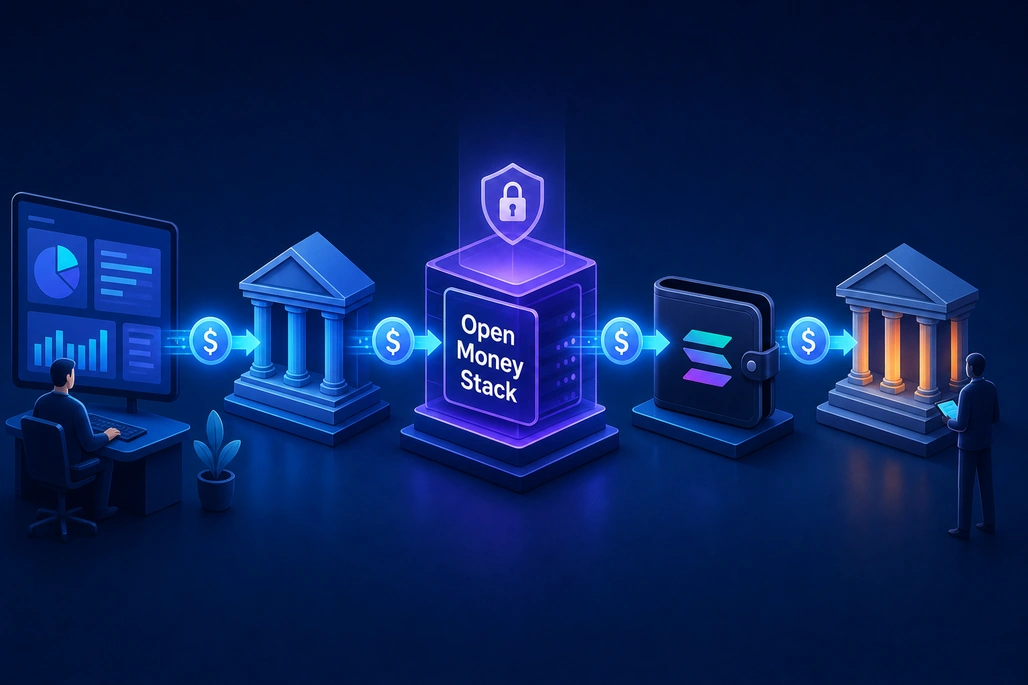
Polygon OMS connects bank funding, Solana wallets, routing, and payouts in one payment flow.
Polygon Open Money Stack (OMS) added Solana support on October 29, 2026, giving businesses that build on Solana a single integration for payment flows that begin with fiat money and can end with a bank, card, cash, or crypto payout. In practical terms, a payments product can accept a bank pay-in, convert funds into a supported asset, hold it in a Solana wallet, route it across supported networks when necessary, and pay out without requiring the end user to operate a bridge.
Key takeaways
- Polygon announced that Solana businesses can use Open Money Stack for bank pay-ins, wallets, conversion, routing, and payouts in one product flow.
- The announced supported assets are USDC, USDT, PYUSD, SOL, and wrapped SOL.
- Polygon says the Solana flow can route value among Solana, Polygon, TRON, and EVM-compatible chains.
- Solana support is live as of October 29, 2026, but OMS remains an enterprise-oriented product with access and onboarding details handled through Polygon.
- Using one provider does not remove a business’s responsibilities for compliance, customer support, ledger reconciliation, and payment-risk controls.
What did Polygon announce?
On October 29, 2026, Polygon said that Polygon Open Money Stack now supports Solana. The announcement is significant because OMS is designed to combine services that are often implemented separately: fiat on-ramps, accounts and wallets, stablecoin conversion, cross-chain routing, and fiat off-ramps.
Before this type of integration, a team building a Solana payment application might need to connect a bank-rail provider, a wallet platform, an exchange or liquidity service, a bridge or interoperability provider, and a payout network. OMS presents those pieces as a connected stack, while Solana can remain the application’s principal blockchain environment.
The launch follows Polygon’s earlier OMS work. Polygon described the stack in June 2026 as a technical preview with API keys, webhooks, role-based access control, single sign-on, sandbox and live environments, bank ramps, wallets, and stablecoin transfers. The October 29 announcement specifically expands the payment flow to Solana.
What is a full stablecoin payment flow?
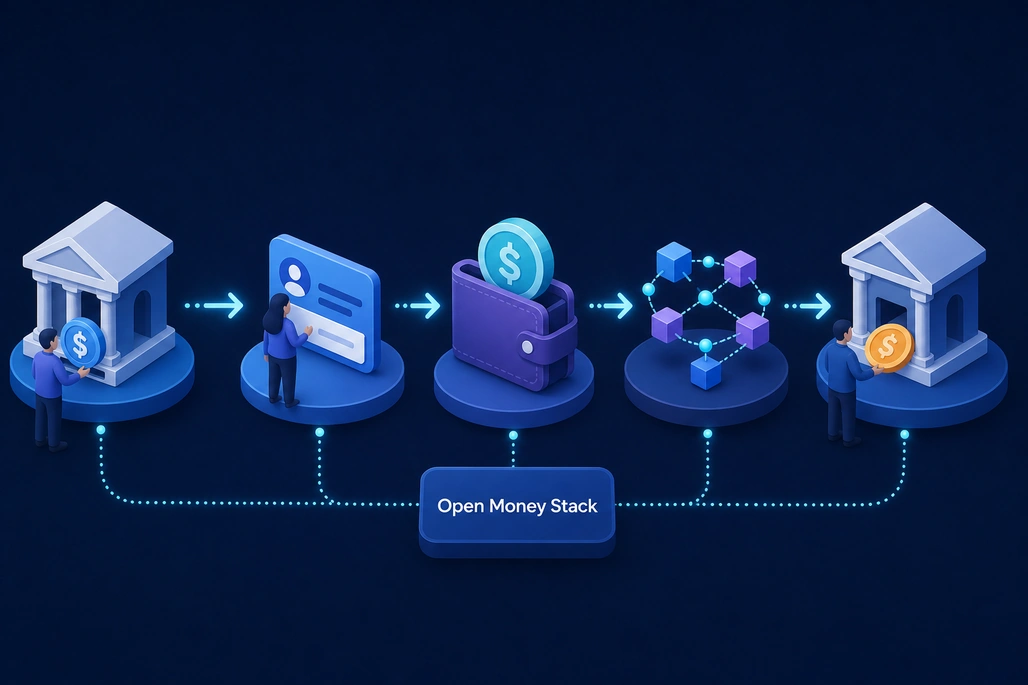
The OMS model combines intake, wallet balances, routing, and delivery.
A stablecoin payment flow is more than sending a token from one wallet to another. Businesses that want customers to start and finish with familiar payment methods also need a way to accept fiat money, identify the customer’s account, custody or connect a wallet, move value to the required network, and deliver a payout.
OMS describes this as a sequence: money comes in, becomes a stablecoin balance, moves where it needs to go, and is paid out. The chain transaction is an important settlement step, but it is only one part of the customer experience.
| Step | What the customer sees | What OMS says it provides |
|---|---|---|
| 1. Pay-in | A bank transfer, card, cash, or crypto deposit | Fiat and crypto intake options, including business bank rails |
| 2. Account and wallet | A balance inside the application | Custodial or embedded wallets, including Solana support |
| 3. Conversion | A stablecoin or crypto balance | Fiat-to-crypto and crypto-to-fiat conversion |
| 4. Routing | A payment sent to the recipient | Movement among Solana, Polygon, TRON, and EVM-compatible networks |
| 5. Payout | Funds received at a bank, card, cash location, or wallet | Off-ramp and payout delivery options |
For beginners, the most important idea is that the user should not need to understand every underlying rail. A customer may see “add money,” “send,” and “withdraw,” while the application coordinates accounts, stablecoins, wallet addresses, and payout instructions behind the scenes.
How does the Solana integration work?
Polygon says that a business can accept funds, establish a stablecoin balance on Solana, and then pay out through a single API-based integration. It also says that its embedded wallets support Solana through the same API used for EVM wallets, which matters because Solana accounts and EVM accounts use different transaction models and address formats.
The announced asset set includes USDC, USDT, PYUSD, SOL, and wrapped SOL. Availability of a specific asset, payment method, chain route, or payout destination can still depend on the customer’s jurisdiction, the product configuration, and compliance review. Developers should treat the list of supported assets as a capability announcement, not as permission to offer every option to every end user.
What is a virtual account?
A virtual account is an account identifier assigned to a business or customer so incoming bank transfers can be matched to the right balance. In a payments application, this avoids asking an operations team to manually determine which customer sent a transfer.
Polygon says OMS provides virtual accounts for the bank pay-in stage. After the funds arrive and the required checks are complete, the application can reflect the appropriate stablecoin balance in the customer’s wallet or account experience.
What is cross-chain routing?
Cross-chain routing is the process of moving value from one blockchain environment to another. It is needed when the sender’s money arrives on one chain or in one asset, but the recipient needs a different chain or asset.
For example, Polygon says an application can accept USDC from an Ethereum wallet and settle in SOL for a Solana user, or execute the reverse path. The key product goal is abstraction: the customer initiates a payment instead of selecting a bridge, manually changing networks, and managing multiple wallets.
What would a beginner payment application look like?
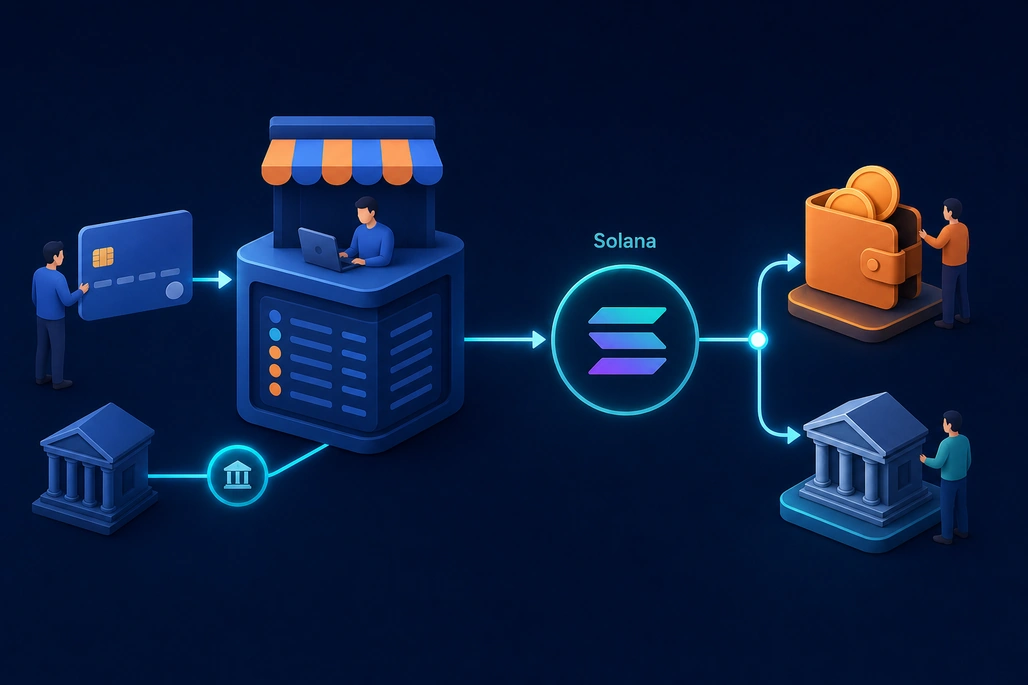
A marketplace can separate its customer experience from the payment rails behind it.
Consider a fictional marketplace called Coastline Parts. U.S. buyers pay the marketplace in dollars, while overseas suppliers prefer to receive stablecoins on Solana or receive a local fiat payout. Coastline Parts wants one operational view of incoming funds, seller balances, and outgoing payments.
- A buyer makes a payment using a supported pay-in method.
- The marketplace associates the incoming payment with the buyer or order through its customer and account records.
- After payment processing and required compliance checks, the application records the available balance and uses the selected stablecoin settlement path.
- If the supplier uses Solana, the business can use a Solana-compatible wallet flow. If the recipient needs another network, the application requests a supported route instead of exposing bridge steps to the recipient.
- The supplier chooses a delivery method: a crypto wallet, bank account, card, or eligible cash payout location.
- The marketplace records the final payment status, transaction references, fees, exchange rates where applicable, and any exception requiring review.
This example illustrates why a payment stack cannot be reduced to a blockchain transfer. The marketplace still needs its own order system, internal ledger, refund policy, customer-support process, access controls, and reconciliation jobs. OMS can reduce integration surface area, but it does not replace the application’s financial operations.
Why would a Solana business use Polygon Open Money Stack?
The principal benefit is consolidation. A team that already uses Solana for application logic or settlement can add bank connectivity, wallet infrastructure, conversion, routing, and payout capabilities without building direct relationships with a separate provider for every layer.
Polygon also positions OMS as modular. A business can use the full stack or combine selected components with its existing wallet provider, compliance system, internal ledger, or settlement arrangement. That distinction matters for established fintechs: replacing a functioning compliance or ledger system can be more difficult than adding a new payment rail.
Independent reporting identified cross-border payments company Kira as an early user of the expanded Solana integration. According to those reports, Kira uses Solana stablecoin transfers and Polygon’s infrastructure to help clients convert funds into U.S. dollars for bank-account and supplier-payment use cases.
What are the trade-offs and risks?
A single integration can simplify application development, but it also increases reliance on one platform’s service availability, pricing, supported corridors, onboarding decisions, and product roadmap. Teams should review contractual service levels, data exports, audit trails, incident processes, and a contingency plan before making a provider central to payment operations.
Stablecoins introduce additional considerations. Their names may imply price stability, but businesses must understand issuer risk, redemption mechanics, liquidity, smart-contract risk, sanctions screening, transaction monitoring, and local legal requirements. The availability of USDC, USDT, or PYUSD in a technical product does not itself establish that a particular business is authorized to offer that asset in every location.
Cross-chain flows also create reconciliation complexity. A developer should persist immutable internal records for the business event, the OMS request, the wallet or bank destination, the asset and amount, the route selected, the chain transaction identifier when applicable, and the final payout state. A customer-facing “completed” message should be tied to an explicit business definition of completion rather than to transaction submission alone.
When is Solana support available?
Polygon announced that Solana support in Open Money Stack went live on October 29, 2026. However, Polygon’s public OMS materials describe the product as enterprise payments infrastructure and direct prospective builders to contact its team or seek early access; the announcement does not state that all developers can self-serve every feature immediately.
That means a beginner should separate two questions: whether the Solana capability exists, and whether a particular company can obtain access to a specific pay-in method, asset, route, or payout corridor. The answer to the first is yes, according to Polygon’s October 29 announcement. The second requires product onboarding and compliance confirmation.
How should developers get started?
First, define the narrowest real payment use case. A good starting point is one business customer type, one pay-in method, one stablecoin, one Solana wallet pattern, and one payout destination. Avoid launching with multiple countries, several assets, and several chains before the basic reconciliation and support processes work.
Second, map the payment lifecycle in the application before requesting an integration. Identify who owns the customer relationship, what event makes funds available, how long a payment can be reversed or disputed, when the business recognizes revenue, and what happens when a payout fails.
Third, request OMS documentation and sandbox access from Polygon, then implement event-driven processing around the documented API and webhooks. Polygon’s earlier technical-preview materials list API keys, webhooks, RBAC, SSO, and sandbox/live environments as OMS capabilities. Developers should verify the exact current endpoint, authentication, Solana account, asset, and payout requirements in the onboarding documentation rather than relying on an announcement post.
Finally, test negative cases as carefully as successful transfers: duplicate webhook delivery, delayed bank funding, unsupported destinations, insufficient balance, an interrupted cross-chain route, payout rejection, and manual review. Payments software earns trust when it explains exceptions clearly and leaves a complete audit record.
Frequently asked questions
What did Polygon add to Open Money Stack for Solana?
Polygon added a Solana payment flow covering pay-ins, custodial or embedded wallets, fiat and crypto conversion, cross-chain routing, and payouts through its OMS integration.
Which assets does Polygon OMS support for the Solana integration?
Polygon lists USDC, USDT, PYUSD, SOL, and wrapped SOL as supported assets for the announced routing and payment flow.
Does this mean every Solana developer can use OMS without approval?
No. Polygon says Solana support is live, but its public OMS materials position the service as enterprise infrastructure and do not state that every pay-in, payout, or corridor is available by unrestricted self-service signup.
Does OMS eliminate compliance work for a payments business?
No. OMS can provide payment infrastructure and regulated rail capabilities, but a business still needs to meet its own legal, operational, customer-support, reconciliation, and risk-management obligations.
Why does cross-chain routing matter for stablecoin payments?
It lets an application accept funds where the sender holds them and deliver value on the network or in the asset the recipient needs, without requiring the customer to manually use a bridge.
Based on reporting by X (formerly Twitter), Polygon, The Block and CoinDesk.

Join the conversation! Your thoughts help the community grow.