
For the past three years, the industry has been obsessed with Retrieval-Augmented Generation (RAG). We built vector databases, chunked documents, and glued them to LLMs. But in enterprise environments, basic RAG has hit a hard ceiling.
Why RAG Alone Is No Longer Enough
Inability to Reason: RAG retrieves context; it doesn't reason over it. If a user asks, "Compare the Q3 risk profile of Client A with Client B, and flag any regulatory breaches," a standard RAG pipeline will simply provide retrieved documents and rely on the LLM to perform all reasoning.
Context Window Limits & Cost: Stuffing large numbers of retrieved chunks into prompts is expensive, slow, and can lead to the "lost in the middle" problem.
Lack of Tool Use: Traditional RAG cannot query databases, call APIs, or execute code for calculations.
The Problem with Single-Agent Systems
Early agent implementations solved the tool-use problem but introduced new challenges. A single agent responsible for planning, retrieval, calculations, and summarization suffers from context degradation. As intermediate outputs accumulate, the agent can lose track of the original objective, increasing hallucinations and failure loops.
Why Enterprises Are Moving to Multi-Agent AI
Enterprises are increasingly adopting Multi-Agent Systems (MAS). Instead of relying on a single "god" agent, responsibilities are divided among specialized agents.
Examples include:
Retriever Agent: Searches vector databases.
SQL Agent: Generates and executes database queries.
Supervisor Agent: Routes tasks and synthesizes final responses.
This mirrors human organizational structures, reduces context pollution, enables specialized prompting, and supports parallel execution.
Why LangGraph Is the Industry Standard
Frameworks such as LangChain, AutoGen, and CrewAI all have strengths, but LangGraph has emerged as a leading choice for enterprise-grade agentic workflows.
Key Advantages
Deterministic Control: Explicit state machines provide predictable execution paths.
First-Class State Management: Supports memory, persistence, and Human-in-the-Loop (HITL) workflows.
Cyclic Graphs: Enables retry and refinement loops common in enterprise systems.
Chains vs. Agents vs. Graphs
Chains (DAGs)
Linear and predictable.
Suitable for simple ETL and basic RAG.
Limited reasoning flexibility.
Agents (Autonomous Loops)
Highly flexible.
Non-deterministic and difficult to debug.
Risk of infinite loops.
Graphs (State Machines)
Combine agent flexibility with chain determinism.
Allow LLM-driven decisions within controlled boundaries.
Why Memory and State Are Critical
In enterprise AI:
State represents the current workflow snapshot.
Memory represents persisted knowledge across time.
Without robust state and memory management, agents cannot effectively handle long-running investigations or maintain enterprise compliance requirements.
Real Enterprise Use Case: Banking Risk Investigation Platform
Business Problem
Global banks must investigate potential Anti-Money Laundering (AML) and fraud alerts. Investigators typically need to:
Query transaction databases.
Retrieve KYC documents.
Check sanctions lists.
Analyze communication records.
Produce compliance reports with regulatory citations.
Current Manual Process
Analysts spend 4–8 hours per alert navigating multiple systems, reviewing extensive documentation, and preparing reports.
Pain Points
High investigation latency.
Human error.
Inconsistent report quality.
Limited auditability.
Expected AI Solution
A Multi-Agent RAG platform where an investigator submits an Alert ID and the system:
Plans the investigation.
Dispatches specialized agents.
Cross-references findings.
Drafts compliance-ready reports.
Supports Human-in-the-Loop review and approval.
Business KPIs and Expected ROI
KPIs
Investigation time reduced by 70%.
False-positive resolution under 15 minutes.
Complete audit trail generation.
ROI
Saving four analyst hours per alert at $50/hour results in approximately $200 saved per alert. At 100,000 alerts annually, this represents roughly $20 million in annual savings.
Business Requirements
Functional Requirements
Multi-source retrieval.
Dynamic planning.
Human-in-the-Loop workflows.
Citation and provenance tracking.
Non-Functional Requirements
Scalability.
Low latency.
Security and PII masking.
Auditability.
High availability.
Observability.
Cost controls.
System Architecture
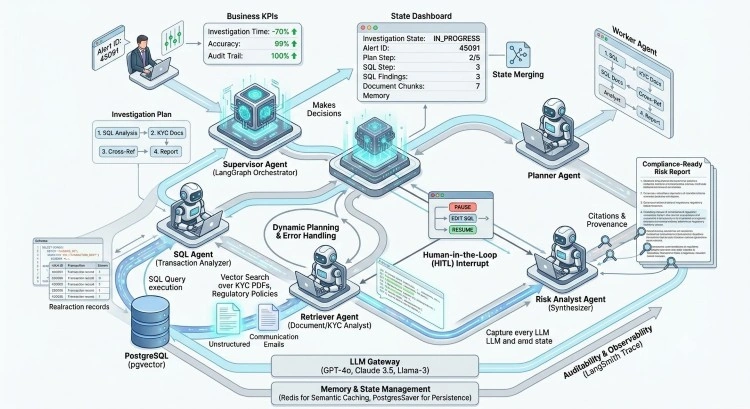
Core Components
API Gateway
FastAPI
LangGraph Orchestrator
Supervisor Agent
Worker Agents
State and Memory Layer
LLM Gateway
Technology Stack
| Technology | Justification |
|---|---|
| Python 3.11+ | AI ecosystem standard with async improvements |
| LangGraph | Deterministic workflows and persistence |
| FastAPI | Native asyncio and OpenAPI support |
| PostgreSQL + pgvector | Unified transactional and vector storage |
| Redis | Semantic caching and session state |
| OpenAI / Anthropic | Multi-model strategy |
| LangSmith | Tracing and evaluation |
| Kubernetes | Auto-scaling infrastructure |
Understanding LangGraph Fundamentals
Nodes and Edges
Nodes: Functions that read state and return updates.
Edges: Define workflow transitions.
Normal edges follow fixed paths.
Conditional edges determine the next node dynamically.
StateGraph and MessagesState
StateGraph provides structured workflow state management, while MessagesState automatically manages message accumulation through reducers.
Checkpointing and Persistence
Available options include:
MemorySaver
PostgresSaver
RedisSaver
These enable workflow recovery and persistence across executions.
Human-in-the-Loop (HITL)
LangGraph supports pausing execution with interrupts, allowing human review and input before continuing execution.
Understanding State
State functions as the shared blackboard used by all agents. Agents do not communicate directly; instead, they read from and write to the shared state.
State Validation
Pydantic-based schemas ensure type safety and immediate detection of invalid agent outputs.
Understanding Memory
Enterprise memory consists of multiple layers:
Short-Term Working Memory
Conversation Memory
Checkpoint Memory
Long-Term Semantic Memory
Episodic Memory
When to Use Each Type
Working Memory for active tasks.
Semantic Memory for preferences and policies.
Episodic Memory for prior investigations and examples.
Multi-Agent Design
Supervisor Agent
Routes tasks.
Never executes tools directly.
Prevents infinite loops.
Planner Agent
Breaks investigations into actionable tasks.
Produces structured plans.
SQL Agent
Queries transaction databases.
Uses schema inspection and retry mechanisms.
Retriever Agent
Searches KYC and policy documents.
Uses advanced retrieval techniques such as HyDE.
Risk Analyst Agent
Synthesizes findings into final reports.
Enforces citation requirements.
Data Flow
The investigation lifecycle follows a structured workflow:
User submits an investigation request.
API Gateway validates and redacts sensitive data.
LangGraph initializes state.
Supervisor routes to Planner.
Planner creates execution plan.
SQL and Retriever Agents gather evidence.
Risk Analyst generates the report.
Human review occurs if required.
Final report is streamed to the user.
Building the LangGraph
Why StateGraph Over MessageGraph?
Enterprise workflows require structured state beyond message history, making StateGraph the preferred choice.
The Power of Conditional Edges
Conditional routing enables dynamic, LLM-driven workflows while maintaining deterministic execution boundaries.
Graph Compilation and Checkpointing
Checkpointing ensures investigations can resume after failures, while interrupts support review workflows before final report generation.
How Industry Leaders Extend These Concepts
Microsoft: Integrates AutoGen, Semantic Kernel, Azure AI Search, and Entra ID.
Uber: Focuses on cost routing and latency optimization.
Stripe: Emphasizes deterministic guardrails and auditability.
AWS: Uses managed infrastructure through Bedrock Agent patterns.
Summary
Basic RAG systems are no longer sufficient for enterprise workloads that require reasoning, tool use, auditability, and multi-step investigations. Multi-agent architectures built with LangGraph provide deterministic orchestration, robust state management, memory persistence, human-in-the-loop controls, and specialized worker agents. By combining structured planning, retrieval, database access, and compliance-focused synthesis, organizations can dramatically reduce investigation times while improving accuracy, consistency, traceability, and operational efficiency.

Join the conversation! Your thoughts help the community grow.