

Introduction
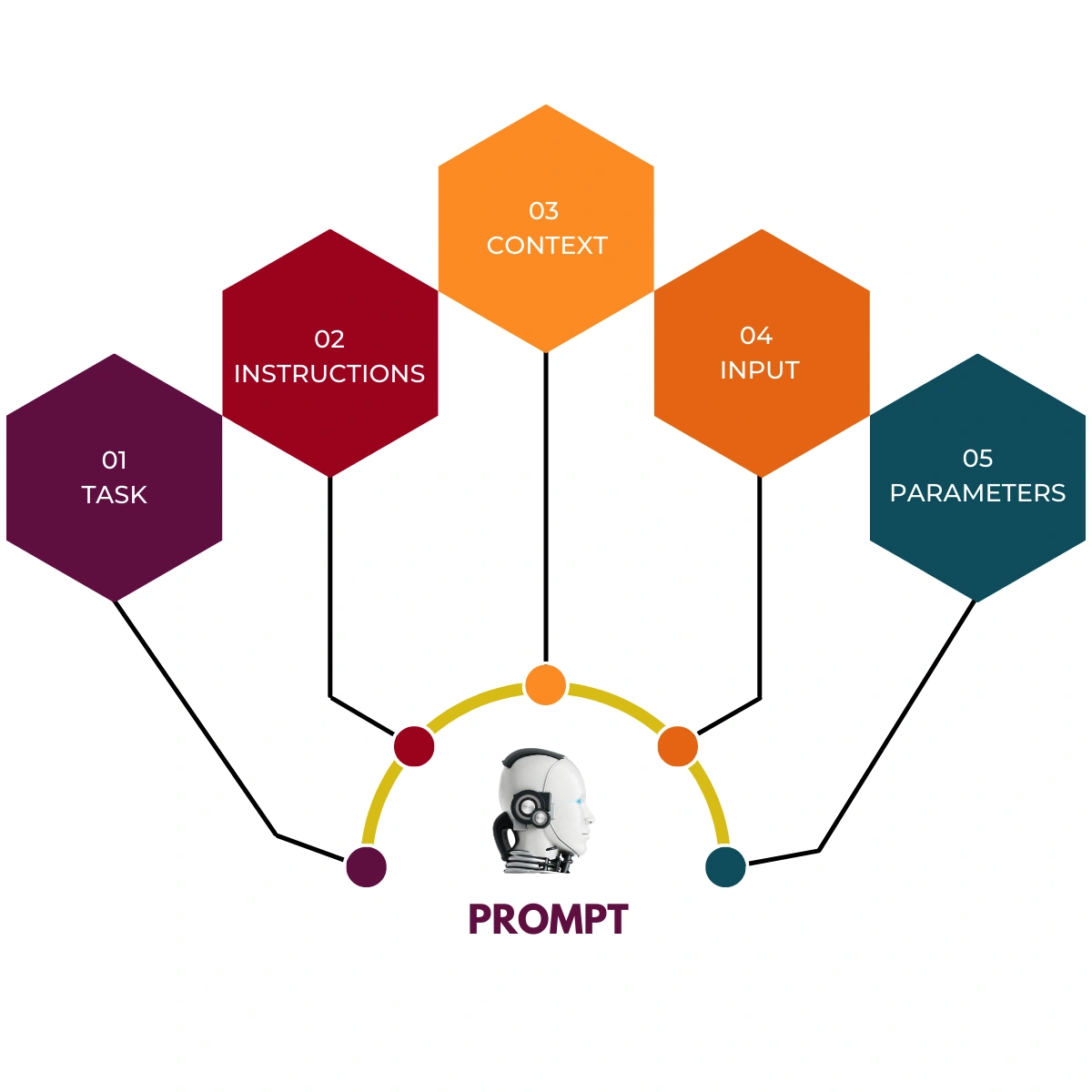
Prompt engineering is the skill of designing clear, context-rich instructions that guide AI models (like ChatGPT) to deliver the precise answers you need—first time, every time. Think of it as programming through language: the better your “code,” the stronger and more reliable your AI “app” becomes.
1. Why Prompt Engineering Matters
-
Maximize Output Quality: Well-crafted prompts drastically reduce vague or off-track responses.
-
Save Time & Cost: Fewer trial-and-error loops mean you spend less time tweaking and, for paid APIs, fewer tokens.
-
Build Trustworthy AI Tools: Consistency and clarity make AI more dependable for business or mission-critical tasks.
2. Core Components of a Winning Prompt
-
Clear Task Definition
-
❌ “Tell me about marketing.”
-
✅ “List three growth-hacking strategies for a B2B SaaS startup.”
-
-
Role or Persona
-
“As a seasoned growth marketer,…”
-
-
Relevant Context
-
Supply data, text, or background: “Here’s our Q2 product summary…”
-
-
Examples (Few-Shot Learning)
-
Show 1–3 ideal outputs so the model infers your format and tone.
-
-
Output Format
-
Bullet list, JSON, table, or word limit: “Provide five bullet points, each under 12 words.”
-
3. Proven Prompting Techniques
-
Zero-Shot: Instructions only—fast to write, but less reliable for complex tasks.
-
One-Shot & Few-Shot: Include sample prompt→response pairs to teach the model your style.
-
Chain-of-Thought: Ask the model to “think aloud,” revealing its reasoning steps for improved transparency and accuracy.
-
Role-Play Prompting: “You are an expert data scientist. Analyze these trends…”
4. Step-by-Step Prompt Refinement
-
Draft & Test: Run your initial prompt.
-
Evaluate: Check for relevance, accuracy, and tone.
-
Diagnose Gaps: Is the output too broad? Missing data? Off-brand style?
-
Tweak: Add context, tighten scope, refine instructions.
-
Repeat: Iterate until the model reliably nails it.
5. Best Practices & Guardrails
-
Be Laser-Focused: Narrow tasks avoid meandering answers.
-
Explicit Constraints: “Do not exceed 150 words” or “Avoid industry jargon.”
-
Structured Outputs: If you need CSV or JSON, state it.
-
Safety Nets: For sensitive subjects, include “Do not generate medical or legal advice.”
6. Tools, Templates & Frameworks
-
Prompt Libraries: Maintain reusable templates with placeholders.
-
Automated Evaluation: Set up tests comparing AI output to gold standards.
-
Visualization: Map prompt→response→feedback loops to spot friction points.
7. Real-World Example
Prompt:
“You’re a cybersecurity analyst. Scan the following log entries for anomalies and list any suspicious IPs in bullet form.”Why It Works:
Role Defined (“cybersecurity analyst”)
Clear Task (“scan…list…suspicious IPs”)
Structured Output (bullet list)
8. Challenges & Future Trends
-
Hallucinations: AI can invent facts—robust prompt design and verification remain essential.
-
Evolving Models: As new LLMs arrive, prompts must be updated and re-tested.
-
Auto-Optimization: Emerging platforms will tweak prompts via machine learning—freeing you to focus on strategy.
Conclusion
Prompt engineering is the linchpin of successful AI applications. By mastering its core components—clarity, context, examples, and structure—you’ll transform generic AI interactions into powerful, reliable, and scalable solutions.
Join the conversation! Your thoughts help the community grow.