

Introduction
In this blog, we will understand what a SQL Join is and how to join two or more SQL tables without using a foreign key. We will look into the various types of join as well.
Step 1
Table-1 Employee
- CREATE TABLE [dbo].[Employee](
- [EmployeeId] [int] IDENTITY(1,1) NOT NULL,
- [Name] [nvarchar](50) NULL,
- [Gender] [char](10) NULL,
- [Position] [nvarchar](50) NULL,
- [Salary] [int] NULL,
- [Department_Id] [int] NULL,
- [Incentive_Id] [int] NULL,
- PRIMARY KEY CLUSTERED
- (
- [EmployeeId] ASC
- )WITH (PAD_INDEX = OFF, STATISTICS_NORECOMPUTE = OFF, IGNORE_DUP_KEY = OFF, ALLOW_ROW_LOCKS = ON, ALLOW_PAGE_LOCKS = ON) ON [PRIMARY]
- ) ON [PRIMARY]
- GO
Table-2 Department
- CREATE TABLE [dbo].[Department](
- [DepartmentId] [int] IDENTITY(1,1) NOT NULL,
- [DepartmentName] [nvarchar](50) NULL,
- PRIMARY KEY CLUSTERED
- (
- [DepartmentId] ASC
- )WITH (PAD_INDEX = OFF, STATISTICS_NORECOMPUTE = OFF, IGNORE_DUP_KEY = OFF, ALLOW_ROW_LOCKS = ON, ALLOW_PAGE_LOCKS = ON) ON [PRIMARY]
- ) ON [PRIMARY]
- GO
Table-3 Incentive
- CREATE TABLE [dbo].[Incentive](
- [IncentiveId] [int] IDENTITY(1,1) NOT NULL,
- [IncentiveAmount] [int] NULL,
- PRIMARY KEY CLUSTERED
- (
- [IncentiveId] ASC
- )WITH (PAD_INDEX = OFF, STATISTICS_NORECOMPUTE = OFF, IGNORE_DUP_KEY = OFF, ALLOW_ROW_LOCKS = ON, ALLOW_PAGE_LOCKS = ON) ON [PRIMARY]
- ) ON [PRIMARY]
- GO
Step 2 - Insert some demo data to all three tables
Insert records into the employee table.
- /*INESRT VALUES IN EMPLOYEE TABLE*/
- insert into Employee values('Anisha Agarwal','Female','Sales Excutive',30000,6,3)
- insert into Employee values('Manish Agarwal','Male','Accountant',40000,1,6)
- insert into Employee values('Fayaz Ansari','Male','UI Developer',50000,3,8)
- insert into Employee values('Rahul Sharma','Male','Software Engineer',45000,3,8)
- insert into Employee values('Abdul Rahim','Male','HR',30000,3,5)
- insert into Employee values('Arvind Kumar','Male','HR',32000,3,5)
- insert into Employee values('Priya Jain','Female','Marketing',25000,4,4)
- insert into Employee values('Zoya','Female','Sales Excutive',30000,6,3)
- insert into Employee values('Monika Agarwal','Female','Marketing',25000,4,4)
- insert into Employee values('Suresh Kumar','Male','Assistant',20000,null,4)
Insert records into the department table.
- /*INESRT VALUES IN DEPARTMENT TABLE*/
- insert into Department values('Accountant')
- insert into Department values('HR')
- insert into Department values('IT')
- insert into Department values('Markeing')
- insert into Department values('Payroll')
- insert into Department values('Sales')
Insert records into the incentive table.
- /*INESRT VALUES IN INCENTIVE TABLE*/
- insert into Incentive values(1000)
- insert into Incentive values(2000)
- insert into Incentive values(3000)
- insert into Incentive values(4000)
- insert into Incentive values(5000)
- insert into Incentive values(6000)
- insert into Incentive values(7000)
- insert into Incentive values(8000)
- insert into Incentive values(9000)
- insert into Incentive values(10000)
Join
A Join clause is used for combining two or more tables in the SQL Server database based on their relative column or relationship with the primary and the foreign key. It gives us the desired output.
Types of joins in SQL server?
There are 5 major types of joins in SQL.
- Inner join or simple join
- Right join (right outer join)
- Left join (left outer join)
- Full join (full outer join)
- Cross join
INNER JOIN
Syntax
- /*INNER JOIN*/
- select Name,Gender,Position,Salary,DepartmentName,IncentiveAmount
- from Employee
- INNER JOIN Department
- on Employee.Department_Id=Department.DepartmentId
- INNER JOIN Incentive
- on Employee.Incentive_Id=Incentive.IncentiveId

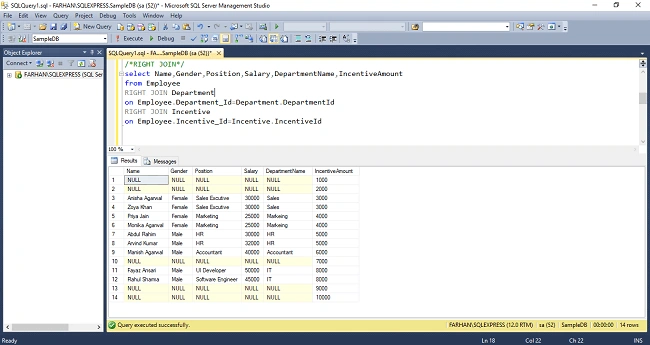
RIGHT JOIN (RIGHT OUTER JOIN)
- /*RIGHT JOIN*/
- select Name,Gender,Position,Salary,DepartmentName,IncentiveAmount
- from Employee
- RIGHT JOIN Department
- on Employee.Department_Id=Department.DepartmentId
- RIGHT JOIN Incentive
- on Employee.Incentive_Id=Incentive.IncentiveId
LEFT JOIN (LEFT OUTER JOIN)
Syntax
- /*LEFT JOIN*/
- select Name,Gender,Position,Salary,DepartmentName,IncentiveAmount
- from Employee
- LEFT JOIN Department
- on Employee.Department_Id=Department.DepartmentId
- LEFT JOIN Incentive
- on Employee.Incentive_Id=Incentive.IncentiveId

FULL JOIN (FULL OUTER JOIN)
Syntax
- /*FULL OUTER JOIN*/
- select Name,Gender,Position,Salary,DepartmentName,IncentiveAmount
- from Employee
- FULL OUTER JOIN Department
- on Employee.Department_Id=Department.DepartmentId
- FULL OUTER JOIN Incentive
- on Employee.Incentive_Id=Incentive.IncentiveId

CROSS JOIN
Syntax
- /*FULL OUTER JOIN*/
- select Name,Gender,Position,Salary,DepartmentName,IncentiveAmount
- from Employee
- CROSS JOIN Department
- CROSS JOIN Incentive
All three tables will produce 600 records when we cross join.
Sreekanth ReddyPosted Jan 17, 2019, 6:05 AM
What is the approach you think, when you join multiple joins ? Do you think any parameters like joining 1st and 2nd next 2nd and 3rd or joining 1st and 3rd next 3rd and 2nd tables (I mean about order if all are having the ralationship) ?