
Google Gen AI SDK 3.0.0 changes the default Gemini Developer API endpoint for Python clients.
Google released version 3.0.0 of the Google Gen AI Python SDK on November 6, 2026, changing the default Gemini Developer API version from the preview-oriented v1beta endpoint to the stable v1 endpoint. The release, published in the googleapis/python-genai GitHub repository, also replaces httpx with httpx2 as the SDK’s default HTTP client, making this a breaking upgrade for some existing Python applications.
The package is available as google-genai 3.0.0 on PyPI, where it lists Python 3.11 or later as a requirement. Developers using the Gemini Developer API should test the upgrade before deploying it, particularly if their applications depend on beta-only API capabilities, customized HTTP clients, or specific TLS certificate settings.
Key takeaways
- Google Gen AI SDK 3.0.0 now sends Gemini Developer API requests to
v1by default instead ofv1beta. - Gemini Enterprise and Vertex AI clients using
vertexai=Trueorenterprise=Trueare unaffected and continue to default tov1beta1. - The SDK now installs and uses
httpx2by default;httpxis no longer installed automatically. - Developers can restore an earlier API default with
GOOGLE_GENAI_API_VERSIONor override it inHttpOptions. - The PyPI release requires Python 3.11 or newer.
What did Google announce in Google Gen AI SDK 3.0.0?
The most significant change is the default endpoint for developers who use the Gemini Developer API. Before version 3.0.0, a basic genai.Client() configuration targeted v1beta; after the upgrade, it targets v1 unless the application explicitly selects another API version.
Google describes v1 as the stable Gemini API version, while v1beta contains early-access capabilities that can change as they are developed. That distinction matters for beginners: code using only stable, generally available API features should have a clearer default target, but code built around preview functionality may need an explicit beta configuration.
The default change applies to Gemini Developer API clients. It does not change the default for Gemini Enterprise or Vertex AI clients. According to the release notes, clients configured with vertexai=True or enterprise=True continue to use v1beta1 unless developers configure a different version.
| Client configuration | Default before 3.0.0 | Default in 3.0.0 |
|---|---|---|
| Gemini Developer API | v1beta | v1 |
| Gemini Enterprise / Vertex AI | v1beta1 | v1beta1 |
Why does the Gemini API v1 default matter?
An API version identifies the contract between an SDK and an online service. The version determines which routes, request fields, response fields, and features an application can use. Google’s Gemini API documentation says the stable v1 version is supported through the lifetime of the API’s major version, while v1beta is intended for features still being refined.
For a new Python project using standard Gemini generation features, the new default reduces the need to set api_version='v1' manually. For an existing project, however, an implicit upgrade can expose differences if the code relies on a capability that remains available only in beta.
Developers who need to retain the previous Gemini Developer API behavior can set an environment variable before starting their application:
export GOOGLE_GENAI_API_VERSION=v1betaThe release notes also support the shortcut value beta. That setting restores v1beta for the Gemini Developer API and v1beta1 for Gemini Enterprise or Vertex AI when the application has not already chosen a version in code.
What changes for existing Python apps?
Google Gen AI SDK 3.0.0 makes httpx2 the required dependency and the default HTTP client. The older httpx package is no longer installed by default. HTTPX2’s migration documentation says its public API is largely unchanged, but its package and import name are different and it uses the operating system’s certificate trust store through truststore rather than the certifi certificate bundle by default.
This may affect applications that import httpx directly, pass httpx-specific types such as timeouts or transports through SDK options, or depend on a custom certificate bundle. In many straightforward migrations, Google says developers can change the import to import httpx2 as httpx.
Applications that must continue using the old client can install the optional extra and select it with an environment variable:
pip install "google-genai[httpx]"
export GOOGLE_GENAI_HTTP_CLIENT=httpx
Alternatively, developers can pass an httpx.Client and httpx.AsyncClient in HttpOptions after installing the optional extra. The SDK release notes warn that objects passed through client arguments and unwrapped transport exceptions must match the active HTTP-client package.
How can developers set the API version in code?
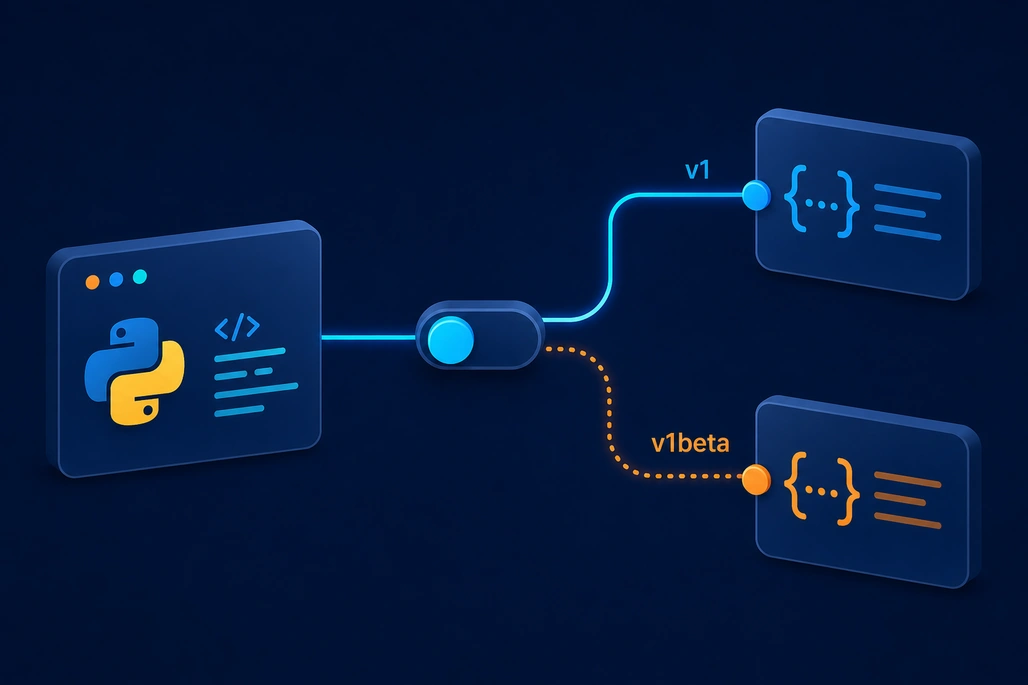
Projects can explicitly select an API version in environment variables or client options.
Code-level configuration takes precedence over GOOGLE_GENAI_API_VERSION. That makes it the safer option when a team wants the behavior to be visible in source control and consistent across local machines, continuous-integration jobs, and production environments.
from google import genai
from google.genai import types

client = genai.Client(
    http_options=types.HttpOptions(api_version="v1beta")
)
A project can replace v1beta with v1 or v1beta1 when those versions fit its selected platform and required features. Beginners should avoid changing versions only to resolve an error without first checking whether the model, API feature, and selected platform support that version.
What other changes are in the release?
Version 3.0.0 adds source_text to AudioTranscriptionConfig and adds SmartTranscriptionMode. The command-line transcription workflow now uses gemini-3.5-transcribe as its default model, and the SDK adds MALFORMED_RESPONSE to FinishReason.
The release also changes CodeExecutionResultStep.result from a string to a union type. Existing code that assumes result is always text must check which result variant it received before reading it. Google notes that JSON for text-only results is unchanged.
Other updates include Office and OpenDocument MIME-type support in interactions, multimodal content support in code-execution results, a retry correction in which retries equal attempts minus one, and documentation examples updated to use gemini-embedding-2. The release notes say video generation is disabled for the Gemini API in this SDK release.
When is Google Gen AI SDK 3.0.0 available?
Google published the GitHub release on November 6, 2026, with release notes dated November 5, 2026. PyPI lists the google-genai 3.0.0 source distribution and universal Python wheel as uploaded on November 6, 2026, with provenance verified by PyPI.
Developers can install the version with pip install --upgrade google-genai. Because this is a major version release with documented breaking changes, teams should pin and test the version in a virtual environment or staging deployment before upgrading a production workload. The release materials do not announce a pricing change.
Frequently asked questions
Does Google Gen AI SDK 3.0.0 use Gemini API v1 by default?
Yes. Version 3.0.0 changes the default for Gemini Developer API clients from v1beta to the stable v1 API version.
Does the API version change affect Vertex AI clients?
No. Clients configured for Gemini Enterprise or Vertex AI with vertexai=True or enterprise=True continue to default to v1beta1.
How can a Python app keep using Gemini API v1beta?
Set GOOGLE_GENAI_API_VERSION=v1beta, or set api_version="v1beta" in types.HttpOptions. The code setting takes precedence over the environment variable.
What replaced httpx in Google Gen AI SDK 3.0.0?
The SDK now uses httpx2 by default. Developers who need the prior backend can install google-genai[httpx] and set GOOGLE_GENAI_HTTP_CLIENT=httpx.
Which Python version is required for google-genai 3.0.0?
PyPI lists Python 3.11 or later as the requirement for google-genai 3.0.0.
Based on reporting by GitHub, PyPI, Google AI for Developers and Pydantic HTTPX2 Documentation.

Join the conversation! Your thoughts help the community grow.