
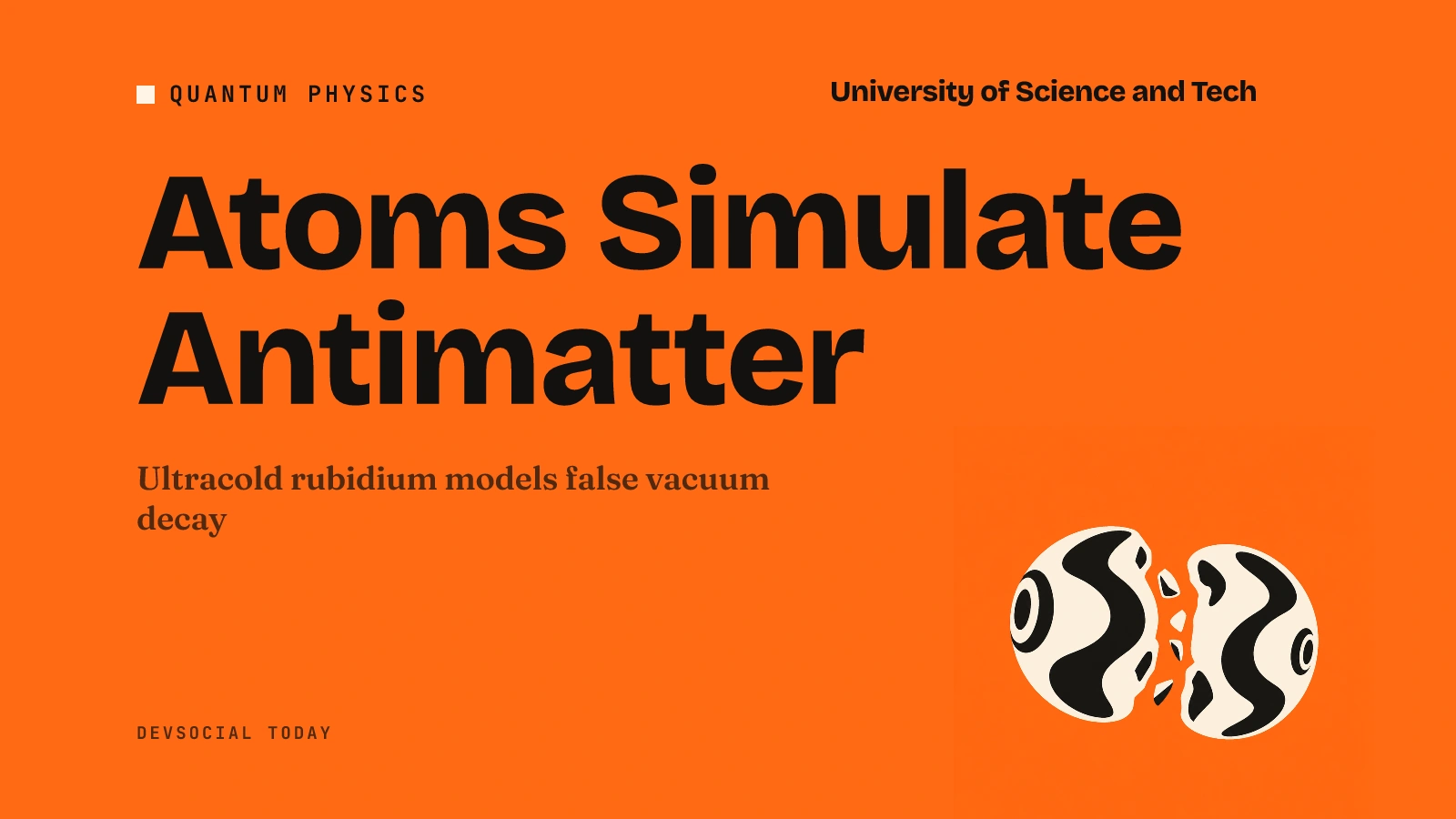
Researchers from the University of Science and Technology of China and collaborating institutions used ultracold rubidium atoms to simulate particle–antiparticle pair production from a false vacuum. Their one-dimensional optical-lattice system implements a U(1) lattice gauge theory, with atomic arrangements representing the vacuum and particle pairs. By tuning the effective particle mass and background electric field, the team measured changes in pair-production rates and found oscillatory dynamics in the zero-mass limit. The work was published in Physical Review Letters on October 1, 2026. Future studies are expected to examine particle collisions and scattering, higher-dimensional systems, and additional gauge-theory phenomena.
Why it matters
The experiment provides a controllable quantum-simulation platform for studying field-theory processes that are strongly suppressed in ordinary laboratory electric fields. It may enable investigations of false-vacuum decay, particle creation, string inversion, and related gauge-theory dynamics without creating real matter–antimatter pairs.
Key points
- The experiment used ultracold rubidium-87 atoms in a one-dimensional optical lattice.
- The initial false-vacuum configuration placed two atoms on alternating sites, with the intervening sites empty; the experiment used ten atoms.
- Increasing the effective particle mass suppressed pair production, as did making the background field dominant relative to the other interactions.
- The study was published in Physical Review Letters, volume 137, article 141601, on October 1, 2026.
- The researchers plan to investigate collisions and scattering and extend the simulator to higher dimensions and other gauge theories.
Based on reporting by The original announcement and Phys.org Quantum.



Join the conversation! Your thoughts help the community grow.