
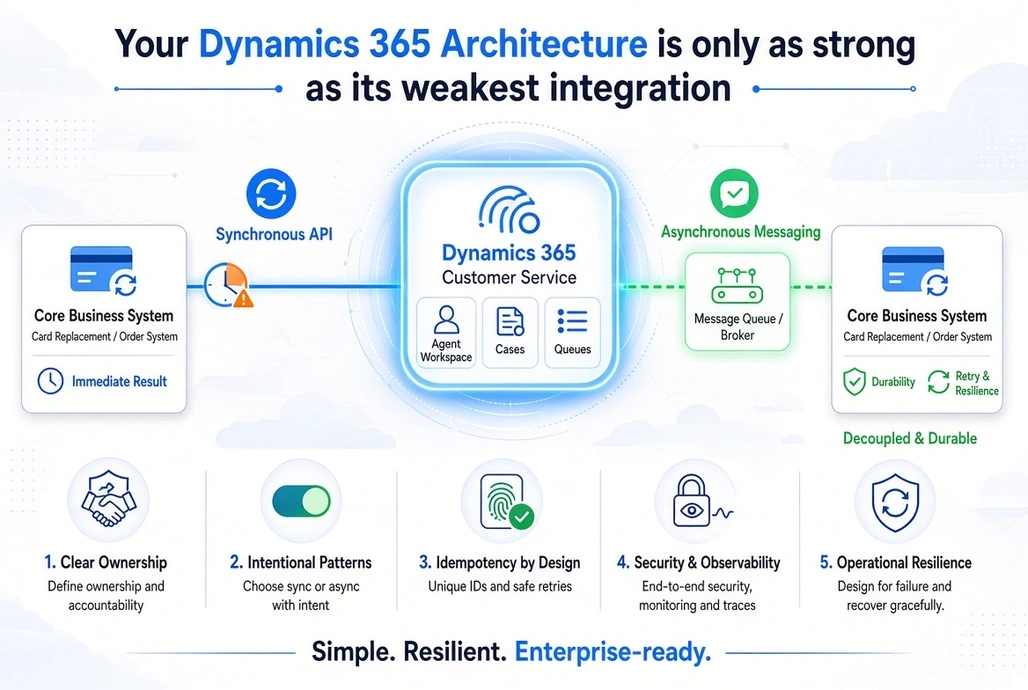
A Dynamics 365 Customer Service implementation is not just a CRM project. It is a business capability that sits inside a larger enterprise. The real work of customer service often happens across multiple systems—card management, payments, core banking, fulfillment, and more. Your architecture has to respect those boundaries, handle disagreement between systems, survive failures, and remain operable when things go wrong.
This is a reference architecture for a fictional large organization with complex customer service processes. The examples are illustrative.
The real problem
Many teams start by wiring systems together with plugins, Power Automate flows, and direct HTTP calls. That works for a small scope. As volume, integrations, and teams grow, five common problems appear:
Business logic scatters. Validation ends up in plugins, flows, and external APIs. No one is sure who owns a given decision.
Synchronous calls create tight coupling. A slow downstream service makes the agent experience slow or fails the CRM operation entirely.
Retries create duplicates. A timeout does not mean the downstream work failed. Retrying without idempotency can produce duplicate cards, payments, or notifications.
Troubleshooting becomes expensive. The CRM team sees a failed case update, the integration team sees a timeout, and the downstream team sees success. Without shared correlation IDs, nobody can reconstruct what happened.
Deployments become risky. CRM customizations, Azure services, API contracts, and secrets evolve independently unless you deliberately coordinate them.
The goal is not to use as many Azure services as possible. It is to create clear ownership, choose the right communication style for each interaction, and make the end-to-end process observable and recoverable.
Guiding principles
Customer service workflows belong in the CRM domain. Downstream systems keep ownership of their own records and decisions.
Define explicit boundaries for validation, orchestration, persistence, and state transitions.
Use synchronous calls only when the user or process truly needs an immediate answer.
Prefer asynchronous messaging when work can finish later, needs buffering, or must scale independently.
Design for failure: timeouts, throttling, duplicates, partial completion, and outages are normal.
Make business processes observable. Correlate technical events with business identifiers.
Govern change. Version, test, and deploy CRM and Azure components through controlled pipelines.
Prefer native platform capabilities when they meet the need. Add custom services only when they clearly help.
Document the important decisions in architecture decision records.
Responsibility boundaries
Dynamics 365 Customer Service / Dataverse owns cases, queues, SLAs, interactions, escalations, and the service request lifecycle. Enforce invariants that must hold no matter how the record is updated (UI, API, or integration) on the server side. Prefer declarative options first. Keep synchronous plugins short.
Integration layer (Azure Functions, ASP.NET services, Service Bus, etc.) owns cross-system concerns: contract translation, multi-service orchestration, retries, timeouts, idempotency, and durable status tracking. Not every integration needs a full microservice. The boundary should follow operational and team ownership needs, not fashion.
Systems of record stay authoritative for their own data. CRM can track that a replacement-card request was submitted. The card system remains the source of truth for whether the card was actually produced and dispatched. Do not treat a CRM field updated by an integration as proof of business completion unless the contract truly guarantees it.
Choosing the right mechanism
Mechanism | Best when | Watch out for |
|---|---|---|
Native rules / business rules | Simple validation and platform behavior | Over-customizing |
Synchronous plugin | Fast server-side invariants | Latency and long-running work |
Asynchronous plugin | Post-transaction work inside Dataverse | Assuming immediate completion |
Power Automate | Approvals, notifications, simple orchestration | Ownership, retries, connection governance |
Custom API | A clean, versioned operation exposed through Dataverse | Contract and authorization design |
Azure Functions / .NET service | Complex logic, transformations, independent scaling | Deployment, monitoring, security ownership |
API Management | Consistent policies and governed exposure | Treating it as the whole security model |
Service Bus | Durable decoupling, buffering, independent scaling | Consumer idempotency and dead-letter handling |
Example: an agent requests a customer statement. If the backend returns quickly and the agent needs an immediate answer, a synchronous call is fine. If generation takes minutes, record the request as pending, return control to the agent, and update status later (asynchronous request-reply).
Design around business outcomes, not HTTP status codes
A weak design calls the card service, gets HTTP 200, and marks the case complete. That confuses technical acceptance with business completion.
A stronger design separates request state from fulfillment state. Possible states (illustrative):
Submitted
Accepted (integration has durably taken the work)
Processing
Completed (downstream confirms success)
Rejected
NeedsInvestigation
Define who can change state, which transitions are valid, how duplicates are handled, and what happens if fulfillment succeeds but the CRM update fails.
Dataverse and the external system do not share a single transaction. If the downstream work succeeds but the status update times out, query the downstream system with a stable business key and reconcile. For multi-step processes, consider an explicit process manager or saga. Compensation is useful when possible, but some actions cannot be safely reversed.
Reliability is a set of coordinated decisions
Set explicit timeouts based on the business need.
Retry only transient failures, with bounded attempts, backoff, and jitter. Respect
Retry-Afteron 429 responses.Give every business command a stable operation identifier and enforce idempotency at the integration boundary.
When using queues: complete the message only after successful processing, monitor dead-letter growth, and provide an audited replay path that checks whether the business outcome already occurred.
The goal is not “exactly once” execution of every component. The goal is the correct business outcome despite retries and partial failures.
Security across the full path
Use Entra ID and managed identities wherever possible. Apply least privilege at every layer:
Agent access via Dataverse security roles and field-level security
Application users for service-to-service access
API authentication and authorization
Azure resource role assignments
Careful handling of sensitive data in logs and telemetry
API Management helps with consistent policies, but it is not a complete security model. Backend services must still enforce their own authorization and should not be reachable through unintended routes.
Treat logs as a potential data leak. Log correlation IDs, case references, outcomes, and timings—not full request bodies, tokens, or unfiltered customer data.
Observability that answers the real question
An engineer should be able to answer: “What happened to this customer’s request from submission to final outcome?”
Propagate a correlation ID (and operation ID where useful) across CRM, integration, and downstream systems. Track both technical metrics (latency, errors, retries, queue depth, dead letters) and business metrics (requests waiting, requests over expected time, reconciliation backlog, time to confirmed completion).
Alert on meaningful impact, not just function exceptions.
ALM and operational readiness
Treat the solution as a versioned product. Use solutions, environment variables, connection references, and source control. Coordinate Power Platform and Azure deployments so contracts stay compatible.
A minimum pipeline should include peer review, automated tests, solution validation, security checks, controlled promotion, and post-deployment health checks. Rollback plans must account for schema changes, queued messages, and already-executed business operations.
Define RTO and RPO for critical journeys. Decide what stays available during a downstream outage, how agents see pending work, how backlog is managed, and who owns reconciliation and customer communication. Test those scenarios before production.
Avoid the two extremes
Putting everything inside CRM creates tight coupling and hard-to-maintain logic. Extracting everything into microservices adds distributed-system complexity without automatic benefit.
Choose the simplest design that meets the actual consistency, latency, security, and operational requirements. Add infrastructure only when evidence shows it is needed.
Practical starting sequence
Map capabilities, ownership, and critical journeys.
Build a solid Dataverse foundation (model, security, solution structure).
Deliver one complete vertical slice end to end.
Add reliability (timeouts, idempotency, dead-letter handling, reconciliation).
Add security and observability.
Automate deployment and testing.
Prove you can handle outages, duplicates, and recovery.
Scale or split only when metrics justify it.
Review checklist (short version)
Clear ownership of business rules and systems of record
Justified sync vs async choices
Idempotency and reconciliation for non-idempotent operations
Least-privilege identities and protected telemetry
End-to-end correlation and actionable alerts
Documented RTO/RPO and recovery ownership
Governed pipelines and failure testing
Final perspective
A good enterprise Customer Service architecture is not measured by the number of Azure boxes on a diagram. It is measured by whether you can deliver a consistent agent experience, protect customer data, survive dependency failures, and change the system safely.
The architecture should make five things explicit:
Who owns each business decision and each piece of data?
What happens when a dependency is slow, down, or returns an ambiguous result?
How do you prevent duplicates and recover from partial completion?
Can you trace, secure, deploy, and support the full process?
Is every component justified by a real requirement?
When those answers are clear, Dynamics 365 Customer Service becomes a reliable, governed part of the broader enterprise service platform rather than an isolated CRM installation.

Join the conversation! Your thoughts help the community grow.