
Every few months, the AI industry experiences the same ritual.
A company launches a new model.
Almost immediately, social media fills with benchmark charts, leaderboard screenshots, and score comparisons.
One model gets 86. Another gets 91. A third lands at 94. And so on.
Within hours, people begin treating those numbers as definitive proof.
The highest score becomes the smartest model. The previous leader suddenly looks outdated. And the discussion moves on.
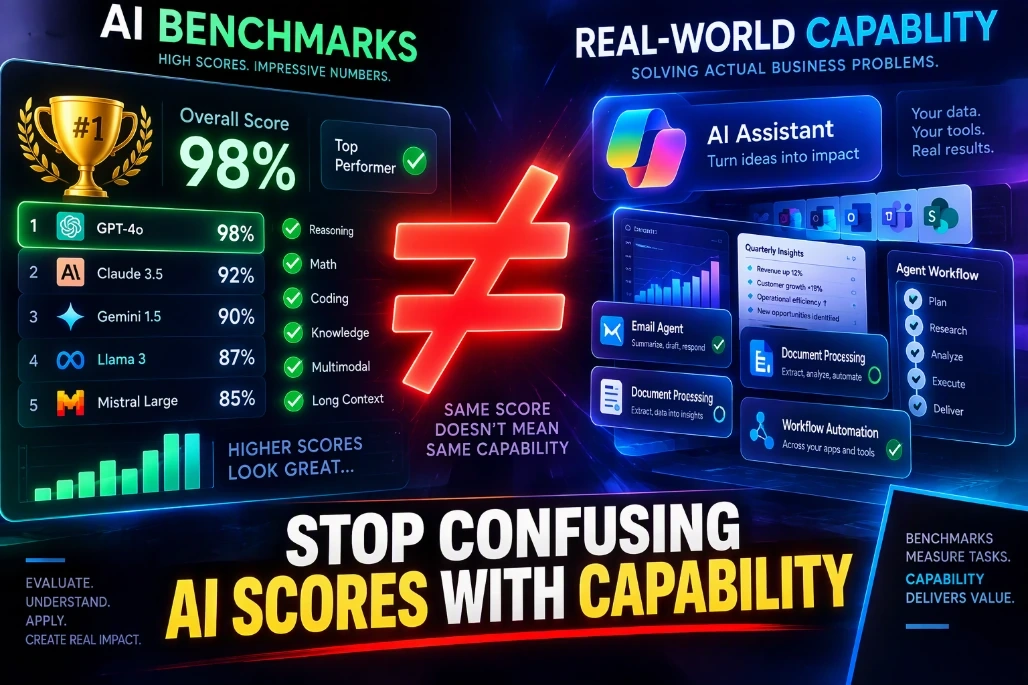
The problem is that AI benchmark scores often receive far more trust than they deserve.
Not because benchmarks are useless but because they're frequently misunderstood.
The comfort of a single number
Humans love simple comparisons.
When faced with something as complex as artificial intelligence, a single score feels reassuring.
A chart gives us certainty. A ranking gives us clarity. A number gives us something concrete to hold onto.
The challenge is that intelligence, helpfulness, safety, reliability, and usability are all incredibly difficult concepts to compress into one metric.
Yet that's exactly what many benchmark discussions attempt to do.
A model scores higher on a test, and people instinctively assume it's better overall.
But what does "better" actually mean?
Better at coding?
Better at reasoning?
Better at writing?
Better at following instructions?
Better at handling real customers?
Those are very different questions.
A benchmark can answer some of them. It cannot answer all of them.
A score only matters if you understand the test
Imagine two students taking different exams.
One scores 95% on a mathematics test.
Another scores 88% on a history exam.
Without understanding what was being tested, those numbers tell us almost nothing about their overall abilities.
AI evaluations work the same way. Every benchmark is designed to measure something specific. Some focus heavily on programming tasks. Others emphasize reasoning. Some evaluate factual knowledge. Others test instruction following, safety behavior, or resistance to adversarial prompts.
When people compare models using a single benchmark result, they're often comparing performance in a very narrow environment.
That's useful information and it just isn't the whole picture.
The difference between measurement and reality
One of the biggest mistakes in technology is confusing a measurement with the thing being measured.
A benchmark score is a measurement. Reality is what happens when real people interact with real products.
Those two things overlap. But they are not identical.
A model can achieve impressive evaluation results and still create frustrating user experiences. Likewise, a model that doesn't dominate every leaderboard can become the preferred choice because it delivers more reliable outcomes for a specific workflow.
The real test begins after users arrive.
Can the model handle ambiguity? Can it maintain consistency? Does it recover gracefully from mistakes? Can it solve actual business problems?
Leaderboards rarely answer those questions.
Small differences often get exaggerated
One of my favorite questions to ask when looking at benchmark charts is simple:
"How meaningful is the difference?"
If a model scores 91 while another scores 87, many people immediately treat that gap as evidence of a major capability advantage.
Sometimes it is. Sometimes it isn't. Context matters.
In product development, teams don't make major strategic decisions based solely on tiny improvements in a metric.
They investigate. They validate. They look at confidence intervals, sample sizes, testing conditions, and methodology.
The same level of skepticism should apply to AI evaluations.
A four-point improvement sounds impressive.
Whether it actually changes user outcomes is a separate question entirely.
Leaderboards create a powerful illusion
Leaderboards are incredibly useful. I use them frequently. Researchers use them. Developers use them. Investors use them.
The issue begins when the leaderboard becomes the conversation rather than the starting point for the conversation.
Once rankings become the primary focus, nuance disappears.
First place is viewed as dominant and third place is treated like a failure.
Yet real-world deployment rarely works that way. Different products have different requirements.
A customer support chatbot has different needs than a coding assistant. Similarly, a legal research tool has different needs than an educational application.
The highest-ranked model isn't automatically the best choice for every scenario.
Sometimes reliability matters more. Sometimes latency matters more. Sometimes cost matters more. And sometimes domain expertise matters more.
The benchmark doesn't know your use case.
You do.
When optimization becomes the goal
There's a famous principle in economics and social science known as Goodhart's Law:
"When a measure becomes a target, it ceases to be a good measure."
The moment an industry starts rewarding benchmark performance, organizations naturally begin optimizing for benchmark performance.
That's not unique to AI.
Schools teach to standardized tests. Businesses optimize for quarterly metrics. Platforms optimize for engagement numbers. The same dynamic appears in machine learning. Researchers focus on improving the measurements that receive the most attention.
Again, this isn't necessarily bad. Progress is progress. But it creates a risk.
If everyone chases the score, the score gradually becomes less representative of real-world performance. The metric starts drifting away from the outcome it was originally designed to reflect.
Your users never see the benchmark
This is perhaps the most important point of all.
Customers don't buy benchmark scores. They buy outcomes.
The average user doesn't care whether a model ranked first on a public leaderboard. They care whether it solved their problem accurately and consistently.
When someone uses an AI writing assistant, they want useful content. When someone uses an AI coding assistant, they want working code. When someone uses an AI customer service tool, they want quick and correct answers. None of those experiences happen inside a benchmark environment.
They happen in the real world. And the real world is far messier than any evaluation dataset.
How I evaluate new AI models today
I still pay attention to benchmark results because ignoring them would be foolish. They're valuable signals. But they're only signals.
When evaluating a model, I'm usually more interested in questions like:
How does it perform on my workflows?
How does it respond to edge cases?
How consistent are the outputs over time?
How often does it fail?
How expensive is it to operate at scale?
How do real users react to the experience?
Those answers tend to reveal much more than a leaderboard position. Benchmarks tell me where to look. Real-world testing tells me what actually matters.
The next benchmark chart you see
The next time a company announces that its latest model is smarter, safer, faster, or more capable, resist the urge to focus only on the score.
Ask deeper questions.
What exactly was measured?
How was it measured?
What wasn't measured?
Does the benchmark reflect real-world usage?
Would the score difference actually matter to end users?
Most people stop at the number. The people making the best decisions dig into the methodology. That's where the real insights are hiding because benchmarks are valuable. They're important. They're worth paying attention to.
But they should be treated as indicators, not verdicts.
A benchmark provides evidence. It does not provide absolute truth and understanding that distinction may be more important than any benchmark score you'll ever see.
What do you think?
Are AI benchmarks becoming better reflections of real-world performance, or has the industry started giving leaderboard rankings too much weight?
I'd love to hear your perspective.

Join the conversation! Your thoughts help the community grow.