Loading
Quick takes from developers at work.
Tips, fixes and short write-ups on what developers ran into this week, in their own words.
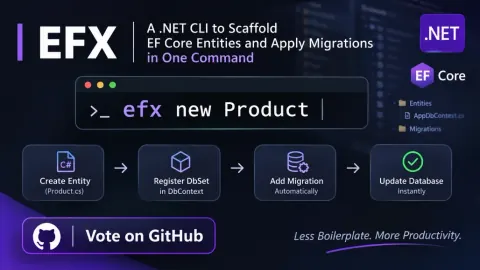
EFX is a .NET global tool that creates EF Core entities, registers DbSets, and runs database migrations from a single command.

A proposal for EF Core CLI commands that create entities, register DbSets, and synchronize migrations and database updates in a streamlined workflow.
Learn how EF Core DbContext pooling differs from SQL Server connection pooling, why connection pools become exhausted, and how to troubleshoot API timeouts.
Learn to build a simple CRUD (Create, Read, Update, Delete) application in .NET Core using Visual Studio, EF Core, and MVC. Step-by-step guide included!
Learn Entity Framework in ASP.NET MVC! This beginner-friendly guide covers EF basics, CRUD operations, and simplifies database interactions with C# objects. Build apps faster!
When querying in Entity Framework Core, both.Include() and .Select() can help shape your data — but they serve different purposes.
It will provide a detailed overview of LINQ queries with Entity Framework, with a focus on beginners who are just starting to use this technology. The blog will likely cover the basics of LINQ and Entity Framework, as well as common query types and how to write them.
In this blog, you will learn about the Entity Framework Code First Approach.
In this blog, we will learn Eager Loading In Repository Pattern Entity Framework Core
When a Temp table is defined in a procedure, it cannot be accessed in the entity framework. This is due to the absence of the schema of the temp table in the entity framework. An example is described below.
Do you wonder if Entity Framework is better than ADO.NET, or when you should be using Entity Framework? In this article, we will discuss the answer to these questions.
In this tutorial, I'm going to show how to create an ASP.NET MVC Web API using Entity Framework for MySql Database.
Accessing table value type in Entity Framework. This blog shows to access stored procedures in Entity Framework that are using custom table type.
This article explains Entity Framework Core migrations and how to use the Table Attributes.
The article describes the way to establish the proper environment in which one can integrate MySQL with Visual Studio using Entity Framework.
The major difference between First and FirstOrDefault is that First() will throw an exception if there is no result data for the supplied criteria whereas FirstOrDefault() returns a default value (null) if there is no result data.
Most of the people are implementing Multi-Tenancy using multiple databases, hence it's a good practice to distinguish tenant data on different databases. But in some cases, we have to implement multi-tenancy in the same database. So, I am going to write my logic on how I have implemented multi-tenancy on the same database. It will definitely help you.
Let us discuss some of the advantages and disadvantages of Code-First approach and Database-First approach of Entity Framework.
In EF (Entity Framework), there are mainly two ways to execute the stored procedure.
As per our old EF, we are using both the approaches that first create classes then you run it or compile it. It will create the database automatically. And the second approach first creates a database then create classes as per the database.
In this blog, we will be talking about how transactions take place in Entity Framework.
This blogs talks about how to verify DB schema before doing insert operation via Entity Framework.
Here, you will learn how to log the database operation to files in Entity Framework 6
Here we going to discuss, how to validate the entity framework connection string in c#. Here we going to discuss, how to validate the entity framework generated database connection string in c# before starting an application.
Everything on Entity Framework, not only its blogs: the Entity Framework page →
Write a blog post and earn +250 SHARP when it is approved.
Write a blog