Loading
Articles by Amira Bedhiafi
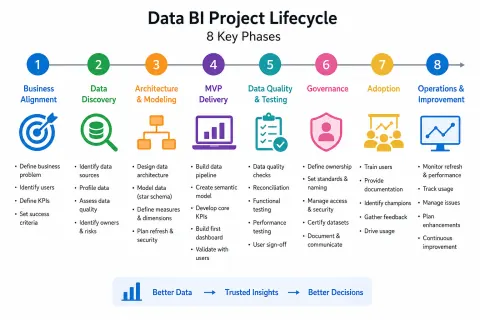
Is managing a data BI project complicated? Challenges, big mistakes, frameworks and real lessons from big companies
Managing a data BI project can look simple from the outside: connect to data, create a model, build dashboards, and publish reports. In reality, a BI project is rarely only about dashboards. It is about business definitions, data quality, governance, architecture, adoption, security, performance and trust.

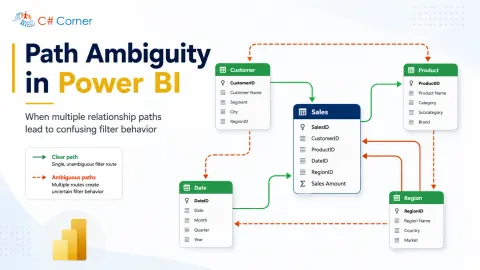
Path ambiguity in Power BI: Why your relationships can produce confusing results ?
Learn to identify and fix confusing relationships causing incorrect results. Master data modeling for reliable reports. #PowerBI #Reporting #BusinessIntelligence
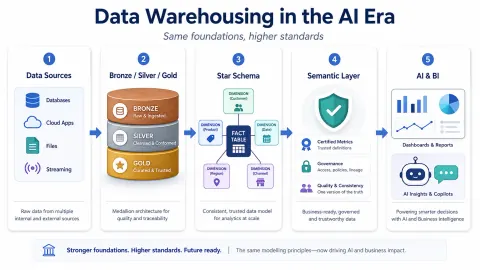
Are we still keeping the same data warehouse modelling standards in 2026 with all this AI?
Data warehouse modeling is crucial in 2026, despite AI. Core principles remain, but must evolve with semantic layers, certified metrics, and data governance.

Stop killing your Fabric Capacity now !
Stop sabotaging your Fabric Capacity! Learn how inefficient models, DAX, reports, and schedules silently kill performance. Optimize for a healthy Fabric environment.
Building a reusable access management layer on Databricks with Python, Notebooks and Genie spaces
What if access requests in Databricks could be handled like a real product instead of a manual admin task? In this article, I show how I built a reusable access management with Python, Git backed Databricks repos, notebooks and Genie Spaces to turn business friendly access requests into governed Unity Catalog permissions. The result is a cleaner, auditable and more scalable way to manage access while also validating the end user experience through natural language data exploration.

Introducing Microsoft Agent Framework
Microsoft unveils the Agent Framework in Azure AI Foundry, simplifying the development, observation, and governance of multi-agent systems. This integrated platform tackles fragmented tooling and ensures responsible AI, featuring an open-source SDK, multi-agent workflows, enhanced observability with OpenTelemetry, Voice Live API, and Responsible AI capabilities for secure and compliant AI solutions.
Data Warehouse: What’s in a name?
Learn how Bill Inmon and his peers coined the term data warehouse, and explore the early evolution of ETL, automated warehouse tools, ELT, and data lakes.
Goals of Data Warehousing and BI Bridging Data and Decision Making
Data Warehousing and Business Intelligence systems are crucial for data-driven decision making, but their success hinges on more than technical excellence. Key factors include adaptability, timely delivery, and security, serving as a trusted decision support tool while gaining widespread user acceptance.
What You Need to Know About Data Warehouses
A data warehouse serves as a centralized data management system aimed at bolstering business intelligence (BI) tasks, particularly in the realm of analytics. It is primarily used for conducting queries and analyses and storing vast volumes of historical information.
Operational Data Stores (ODS) in Business Intelligence
Learn how operational data stores support near-real-time data integration and reporting, how they differ from databases and data warehouses, and how next-generation ODS platforms evolve.
Data Vault: Evolution from 1.0 to 2.0 in Business Intelligence
This article introduces Data Vault, a methodology for designing and developing data warehouse architectures with a focus on flexibility, scalability, and availability. It discusses the core components of Data Vault, its evolution from version 1.0 to 2.0, and key features of each iteration.
Optimizing Data Processes with Staging Areas in Business Intelligence
In the world of Business Intelligence (BI), a staging area or landing zone is an essential component. This article will discuss a use case to comprehend the issue that a staging arena solves, succeeded by an appreciation of its implementation and capabilities.

Microsoft Azure Synapse Analytics and Data Warehousing
Learn about the significance of data warehouses as centralized data repositories, their key features, and their role in enabling data reporting, analysis, and business intelligence (BI) in diverse industries. Explore Azure's end-to-end data warehouse solutions, compare technologies, and gain insights for making informed decisions.
Kimball vs. Inmon: Unraveling the Synergy of Data Warehouse Approaches
Kimball and Inmon methodologies in data warehousing: Complementary approaches, not adversaries.
Feature Selection with RFECV in Python
Clarifying the functionality and steps involved in the Recursive Feature Elimination with Cross-Validation (RFECV) process in Python, and addresses common queries regarding the difference between the initial and final number of features selected and the length of `cv_results_['mean_test_score']`.

SSAS Tabular Models Documentation Guide
Effective documentation of complex SSAS tabular models ensures its maintainability, scalability, and ease of understanding for future users. This guide shares best practices, from utilizing descriptions and data dictionaries to visual diagrams, detailing DAX formulas, outlining refresh strategies, and the use of centralized, accessible information hubs, including leveraging automation tools for efficiency.
Change Data Capture - Another Way To Implement The Incremental Load
As we saw in the previous article the definition and implementation of full load and delta load using different SSIS components, in this article will be presented one of the functionalities of SQL SERVER: CDC (Change Data Capture).
Design The Full Load And Delta Load Patterns In SSIS
Loading Data Design Patterns will provide you with two main recipes for SQL Server Integration Services (SSIS). Design patterns, the full load and the incremental load, to solve common problems encountered when staging data.
Handling Data Load Types In Staging Database
One of the fundamental aspects to consider when creating Data Warehouses is the consolidation of data from different sources, whether they are systems or different areas.
ERP And CAPM - What Are Their Differences?
The industrial sector - large groups as well as VSEs and SMEs - must think about its digital transformation to remain competitive. Among the tools at their disposal, business leaders and managers choose CAPM software or ERP software. What do these two tools have in common? What are their differences ? Which of the two should you choose to improve the management of your production lines and your organization?
Getting Started With MongoDB For Beginners
MongoDB has been developed since 2007 by MongoDB. This company was then working on a Cloud computing system, widely distributed data computing, similar to the service Google's Google App Engine. Its first version considered industrially viable was 1.4, in 2010. MongoDB is an open source document-oriented database that provides high performance, high availability, and autoscaling.
Everything You Need To Know About Hadoop
Hadoop is a free and open source framework written in Java intended to facilitate the creation of distributed and scalable applications that allow applications to work with thousands of nodes and petabytes of data. Thus each node is made up of standard machines grouped into a cluster.
Install And Run Hadoop 3 On Windows For Beginners
Hadoop is an Open Source project managed by Apache Software Fundation based on the Map Reduce principle and Google File System, two Google Corp products. The product is written in Java language. The principle is based on processing distributed over several nodes to drastically increase the computing and storage capacities in order to process very large amounts of data.
Top 10 Hottest And Tricky T-SQL Questions For Beginners
Transact-SQL (T-SQL) is an extension to SQL developed by Microsoft and Sybase used to administer SQL Server.
Happy 155 Years Of Business Intelligence
Business Intelligence is not just about turning data into information rather organizations need that to impact how their business operates and responds to the changing marketplace.