
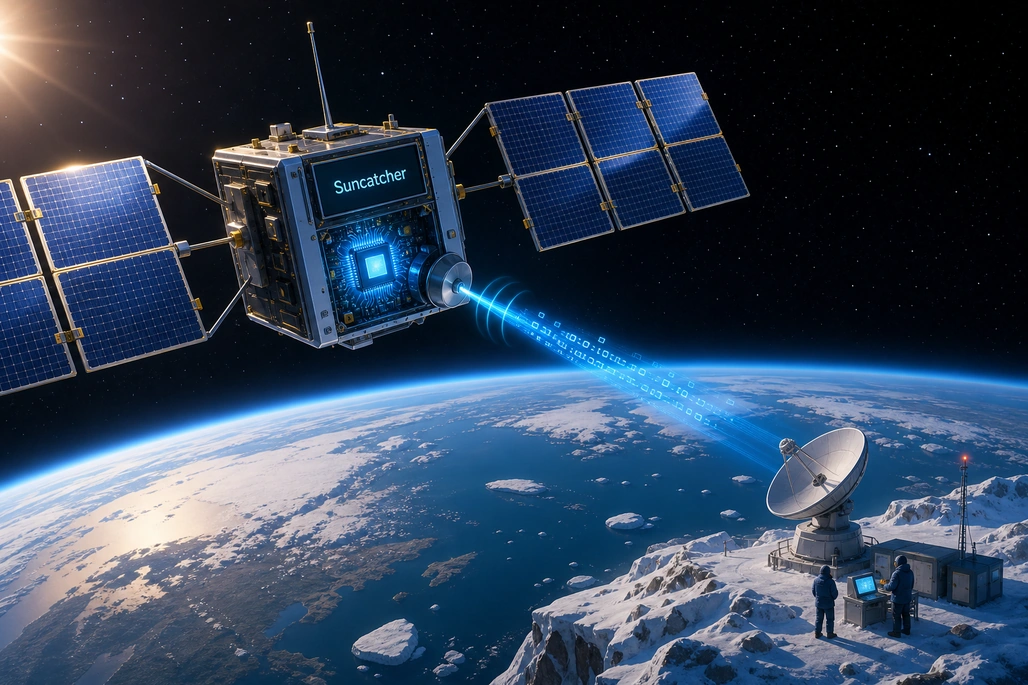
Google’s prototype satellite returned an AI-generated response from orbit on October 30, 2026.
Google’s Project Suncatcher has received an AI-generated response from a prototype satellite in orbit, demonstrating that a data-center-class Tensor Processing Unit (TPU) can accept a prompt and run a model in space. The October 30, 2026 milestone is an early hardware validation, not an operational orbital data center: Google still needs to prove that its TPUs can withstand radiation and thermal stress and that multiple satellites can exchange data at the speeds required for larger AI workloads.
Google launched the prototype satellite on October 1, 2026, then completed commissioning work before sending a prompt to an onboard Gemma 4 open model during a ground-station pass. The satellite returned a short haiku while passing near Svalbard, Norway, which Google describes as its first AI response from a data-center-class TPU in orbit.
Key takeaways
- Google reported its first successful AI response from a Project Suncatcher prototype satellite on October 30, 2026.
- The test sent a prompt from the ground to an onboard Gemma 4 open model running on a TPU, then downlinked the result.
- The mission is testing whether data-center-class AI hardware can operate reliably under orbital radiation and temperature conditions.
- Project Suncatcher is a research effort toward solar-powered networks of satellites connected by high-bandwidth optical links.
- Google’s next stated milestone is a pair of interconnected satellites planned for 2027.
What did Google announce?
In an October 30, 2026 Project Suncatcher update, Google said it had reached a “Hello World” milestone: an AI response generated by a data-center-class TPU in orbit. The announcement followed several weeks of satellite commissioning after the October 1 launch.
Commissioning is the process of checking that a newly deployed spacecraft and its payloads are powered, reachable, and behaving as expected. Google said that it powered the host and TPU trays and ran early machine learning tests before attempting the prompt-and-response demonstration.
For the public test, Google uplinked a request for a haiku about being in space to the Gemma 4 open model installed on the satellite. During a pass near Svalbard, Norway, the system downlinked the generated response to Earth. Google then ran additional space-themed limerick and telemetry prompts.
The result matters because it demonstrated an end-to-end sequence rather than merely powering on a chip. A ground team sent an input, the satellite ran an AI model locally, and the output returned through the communications link. That is a useful first step toward evaluating on-orbit inference, which is the process of using a trained model to generate an answer or prediction.
What is Project Suncatcher?
Project Suncatcher is Google’s long-term research program investigating whether scalable machine learning infrastructure could eventually operate in space. Its proposed architecture uses solar-powered satellites carrying TPUs and connected through free-space optical links, meaning laser communications that travel through open space rather than through fiber-optic cable.
The idea is not to launch one giant conventional data center. Google’s research paper instead proposes a modular system of many smaller satellites, each providing part of the total compute capacity. A modular design could be expanded gradually, but it would also create difficult problems in networking, satellite control, reliability, debris avoidance, repair, and cost.
Google’s underlying research identifies five major requirements: generating power, exchanging data between chips at high bandwidth and low latency, protecting compute hardware from radiation, removing waste heat, and communicating with ground stations. A practical system would need to solve all five at once; success with one satellite does not establish that a constellation can train or serve AI models at data-center scale.
| Project stage | What it is intended to validate | Status as of October 31, 2026 |
|---|---|---|
| Single prototype satellite | Basic operation of the host, TPU payload, model execution, thermal behavior, and radiation exposure | In orbit; Google has reported its first AI response. |
| Two interconnected satellites | High-bandwidth optical communication and coordinated operation between spacecraft | Google says this is the next milestone in 2027. |
| Future satellite constellation | Distributed AI compute at a much larger scale | Research concept; not a commercial service. |
How did the first AI response work?
At a high level, the demonstration worked like a remote request to a computer that happens to be moving around Earth. A ground station transmitted a prompt upward to the spacecraft. The onboard Gemma 4 model processed that prompt using the TPU, and the spacecraft transmitted the text response back to a ground station.
- A ground station waits for a time when the satellite is visible and within communications range. This is called a ground-station pass.
- Operators uplink a prompt, which is the input text for the language model.
- The host system passes the request to the TPU payload, where the model generates text one token at a time.
- The spacecraft downlinks the output and technical telemetry to the ground.
- Engineers inspect the response and telemetry to determine whether the compute payload and supporting systems behaved correctly.
The haiku itself was not the technical objective. A small text generation request is easy compared with training a frontier-scale model, but it is a clear test of the full chain: command uplink, local model execution, accelerator operation, host software, downlink, and verification.
This distinction is important for beginners. Running AI inference means asking an already-trained model to produce output. AI training means repeatedly updating a model’s parameters from large volumes of data, which requires vastly more compute, memory, storage, synchronization, and networking. Project Suncatcher’s public milestone confirms a basic inference workflow, not large-scale model training in space.
Why put AI compute in orbit?
Google’s research begins with a straightforward constraint: AI systems require substantial electricity, and data centers also require land, networking, and cooling infrastructure. Project Suncatcher asks whether solar-powered spacecraft could eventually provide another location for some machine learning compute.
In its 2025 system-design paper, Google proposed satellites in a dawn-dusk, sun-synchronous low Earth orbit. In this type of orbit, a spacecraft can receive sunlight for much of its journey around Earth. The paper argues that this could support sustained solar generation while keeping the satellites relatively close to Earth compared with more distant orbits.
Space also changes the cooling problem, but it does not eliminate it. On Earth, air or liquid can carry heat away from computing equipment. In the vacuum of space, there is no air for convection, so the satellite must conduct heat away from the processors and radiate it outward. Google’s design work discusses heat pipes and radiators as part of that thermal-management system.
Independent reporting before launch emphasized why this prototype is useful: the mission lets Google observe how TPU hardware and cooling behave in the actual space environment, rather than only in laboratory simulations. Space.com reported that the satellite was built by Planet, while Ars Technica described the mission as a test of radiation tolerance, launch stress, and heat removal for Google’s TPU hardware.
What technical problems must Google solve?
Radiation is the first major challenge. High-energy particles in space can damage electronics or cause temporary computational errors, such as bit flips. Google’s current mission will collect real orbital data on how the TPU payload behaves under radiation exposure. Engineers need to know not only whether a chip stays powered on, but also whether its calculations, memory, and error-correction mechanisms remain dependable over time.
Heat is the second major challenge. AI accelerators produce waste heat while performing calculations. A satellite has limited mass, surface area, and power, so its thermal system must move heat from the chip to radiators without exceeding safe component temperatures. The first prototype can help validate whether the physical design works under changing orbital conditions.
Networking is the third major challenge. Modern AI workloads often depend on many accelerators exchanging data rapidly. Google’s paper says a future constellation would need free-space optical links between satellites and analyzes aggregate bandwidth on the order of 10 terabits per second per link. That is far beyond what the single-satellite test needs, which is why the planned two-satellite mission is significant.
Formation flying is the fourth challenge. High-bandwidth laser links become easier when satellites are relatively close, but spacecraft cannot simply remain fixed in place. They move at orbital speed and must maintain safe separations while accurately pointing optical terminals at one another. Google’s research proposes using control systems to maintain the required geometry, but this remains an engineering problem to validate in orbit.
Economics is the fifth challenge. Every kilogram launched to orbit has a cost, and satellites eventually fail or are retired. Google’s paper treats future launch costs as a crucial assumption in its analysis. A system could be technically possible yet still be less economical than improving terrestrial power generation, conventional data centers, and network infrastructure.
What does the October 2026 milestone prove—and what does it not prove?
The milestone proves that Google received a generated response from an onboard Gemma 4 model running through a data-center-class TPU payload in orbit. It also indicates that the team successfully completed enough commissioning work to power the relevant systems, send an input to the satellite, execute an AI request, and receive an output.
It does not prove that the TPU will remain reliable for a long mission, that the thermal system can support sustained heavy workloads, or that several satellites can perform tightly coupled AI work together. It also does not demonstrate that an orbital AI system is cost-effective, environmentally preferable overall, or ready to provide a public cloud service.
That careful interpretation is consistent with Google’s own description of Project Suncatcher as a research moonshot. The company has framed the prototype as a learning mission designed to identify failure modes and guide later spacecraft designs, not as the first unit of a commercial orbital data-center fleet.
What happens next for Project Suncatcher?
Google says the current mission will continue testing TPU performance under thermal stress and radiation exposure. Those measurements will determine whether data-center-class accelerators can reliably execute workloads in orbit and which parts of the spacecraft design need refinement.
The stated next milestone is twin interconnected satellites in 2027. That stage is intended to test the optical communication challenge that a distributed compute system cannot avoid: moving data rapidly and precisely between separate spacecraft.
For developers, Project Suncatcher is best understood as infrastructure research rather than a new platform to deploy applications to today. There is no announced public API, cloud SKU, SDK, or supported workflow for developers to run their own workloads on the prototype. The immediate lesson is architectural: AI systems depend on much more than models and chips. Power, cooling, fault tolerance, networking, operations, and physical location all shape what is feasible.
How should beginners follow this project?
Start with the basic vocabulary. A TPU is Google’s specialized accelerator hardware for machine learning workloads. A language model takes input tokens and generates output tokens. A satellite payload is the set of mission-specific hardware carried by the spacecraft, while telemetry is health and performance data returned from that hardware.
Then separate the confirmed milestone from the long-range vision. The confirmed event is a successful AI response from a prototype satellite on October 30, 2026. The vision is a network of solar-powered, laser-connected satellites supporting scalable machine learning. The gap between those two statements contains the engineering work Google is now testing.
Finally, watch for results from thermal, radiation, and inter-satellite-link tests rather than treating a single demonstration as final proof. Those results will be more informative about whether Project Suncatcher can progress from a successful orbital experiment to a viable distributed computing architecture.
Frequently asked questions
What is Google Project Suncatcher?
Project Suncatcher is Google’s research effort to explore solar-powered AI compute in space using satellites equipped with TPUs and, in a future system, free-space optical links between satellites.
What did Google’s first AI response from orbit demonstrate?
It demonstrated an end-to-end inference test: a ground station sent a prompt to a Gemma 4 model on the prototype satellite, the TPU processed it, and the generated text was downlinked to Earth.
Is Google operating an AI data center in space now?
No. Google is operating a prototype research satellite. It has not announced a commercial orbital data center, a public developer service, or a way for customers to run workloads on the spacecraft.
Why is cooling AI hardware difficult in space?
Space is a vacuum, so heat cannot be removed by airflow. The satellite must conduct heat away from its processors and release it through radiators, within strict limits on mass, power, and surface area.
What is the next Project Suncatcher milestone?
Google says it plans to test twin interconnected satellites in 2027, focusing on the high-bandwidth optical links needed for a future distributed satellite compute system.
Based on reporting by Google, Google Research, Space.com and Ars Technica.

Join the conversation! Your thoughts help the community grow.