Loading
Articles by Aarav Patel
- JavaScript
What are arrow functions and how are they different from regular functions?
Arrow functions provide a simpler and more concise way to write functions in JavaScript. This article explains what arrow functions are, their syntax, and how they differ from regular functions in behavior and use cases.
- JavaScript
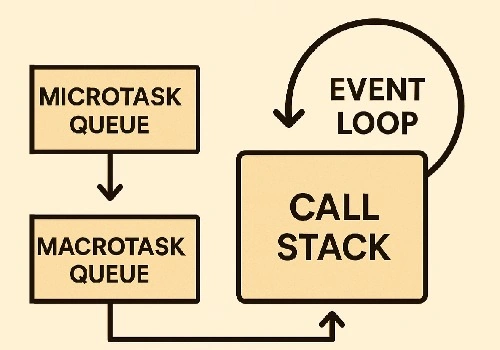
JavaScript Event Loop: Microtasks vs Macrotasks Explained
The JavaScript event loop is one of the most fundamental concepts to understand for mastering asynchronous programming. This article explores how the event loop works, what microtasks and macrotasks are, and how they affect code execution order.
- JavaScript
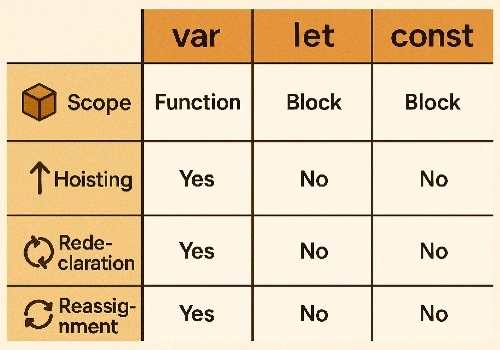
What is the Difference Between var, let, and const in JavaScript?
Understanding the difference between var, let, and const in JavaScript is crucial for writing clean, efficient, and bug-free code. In this article, we break down their scope, hoisting, mutability, and best practices with examples.
- Java
How does a HashMap work internally in Java?
A deep dive into how Java's HashMap works behind the scenes, including how hashing, buckets, and collision resolution work. This article also explores what happens when two keys have the same hashCode().
- Java
What is the difference between ArrayList and LinkedList in Java?
Learn the in-depth differences between Java's ArrayList and LinkedList with practical code examples, performance considerations, and use-case analysis. This article will help Java developers choose the right list implementation for their needs.
- Java
How to Implement Pagination and Sorting in Spring Boot Using Spring Data JPA?
A comprehensive guide to implementing scalable and efficient pagination and sorting mechanisms in Spring Boot applications using Spring Data JPA. Includes real-world examples, best practices, and performance optimization tips to improve your REST API responses.
- Java
What is the difference between Component, Service, and Repository annotations in Spring?
This article explains the differences between Component, Service, and Repository annotations in the Spring Framework. You'll learn what each one does, how they relate to Spring's component scanning and dependency injection, and when to use which one. Includes real-world examples and best practices.
- .NET
How do I secure a .NET Web API (JWT, OAuth, Identity)?
Learn how to secure your .NET Web API using JWT, OAuth2, and ASP.NET Core Identity. Implement token-based authentication, role-based access control, and protect your endpoints with best practices.
- .NET
What are the Best Practices for EF Core Performance Optimization?
Learn how to optimize Entity Framework Core (EF Core) for high-performance data access. This article covers best practices, from query tuning to memory management, with practical C# code examples. Ideal for developers building scalable .NET applications.
- .NET
What are Minimal APIs in .NET, and When Should I Use Them?
Explore the concept of Minimal APIs in .NET. Learn what they are, how they differ from traditional Web APIs, when to use them, and how to implement them with real code examples in .NET 6/7/8.
- .NET
Difference Between Task, async/await, and Threading in .NET
This article explains the core differences between Task, async/await, and traditional Threading in .NET. Learn how they work, when to use each, and how they impact performance, scalability, and readability in your C# applications, with simple explanations and practical code examples.
- .NET
How to implement Dependency Injection in .NET
This code registers application services using Dependency Injection in .NET. IReportService is added as scoped and IEmailSender as transient, promoting modular, testable, and maintainable architecture.
- .NET
How do I Migrate from .NET Framework to .NET 6/7/8?
Migrating from the legacy .NET Framework to modern .NET 6, 7, or 8 can unlock massive performance, cross-platform support, and access to the latest tools. This guide walks you through a smooth and safe migration process, from assessment to completion.
- .NET
What is the Difference Between .NET 6, .NET 7, and .NET 8?
A complete comparison of .NET 6, .NET 7, and .NET 8—explaining the core differences in performance, support lifecycle, new features, and use cases. Includes examples, developer tips, and migration guidance.