Loading
Cristopher Coronado's contributions
- Article · React
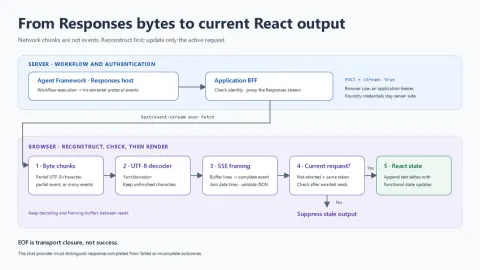
Build a Streaming React Chat with Microsoft Foundry Responses
Build a React chat interface that consumes Microsoft Foundry Responses streams, safely parses SSE events, appends text deltas, and suppresses stale output after cancellation or sign-out.
- Article · AI Agents
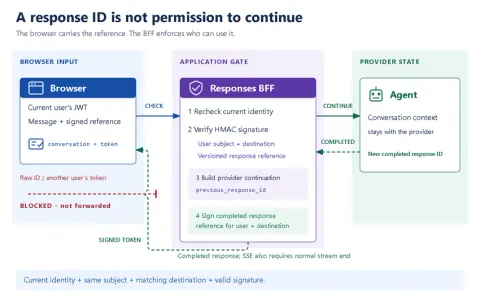
Bind Microsoft Foundry agent conversations to authenticated users with a BFF
Learn how a BFF uses signed continuation tokens to bind Microsoft Foundry Responses conversations to authenticated users and prevent unauthorized reuse of response IDs.
- Article · Azure
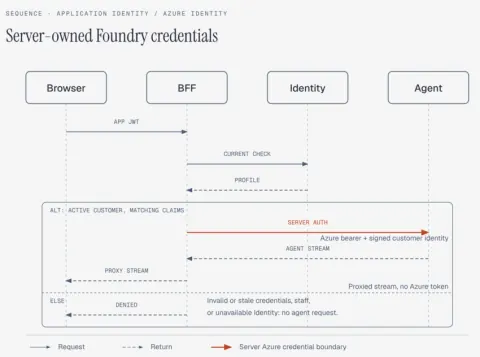
Keep Azure Foundry Hosted Agent credentials out of the browser with a BFF (Backend for Frontend)
Learn how a Backend for Frontend keeps Azure Foundry credentials out of a React app by validating application JWTs and acquiring server-owned Azure tokens.
- Article · AI Agents
Enabling Microsoft Agent Framework multi-turn sessions with GraphRAG router checkpoints
Keeping conversational memory inside a single session is what makes GraphRAG answers actionable, because every turn depends on the classifier understanding the history it already routed. The earlier installments supplied those building blocks—routing patterns that coordinate sequential, concurrent, and handoff workflows; evaluation gates that locked in TaskAdherence 80% and IntentResolution 100%; and the Azure AI Foundry model router that selects Balanced, Cost, or Quality modes per request Use model router with Foundry agents. This part finishes the arc by layering checkpoint-aware session storage on top, letting Microsoft 365 Agents Playground resume the same conversation while the router contract stays intact.
- Article · AI Agents
Building Prompt-Routed Workflow Selection with Azure AI Foundry Model Router and Microsoft Agent Framework for GraphRAG
Build deterministic, observable, and resilient prompt-routed workflows with Azure AI Foundry Model Router and Microsoft Agent Framework for robust orchestration.
- Article · AI Agents
Measure Agent Quality and Safety with Azure AI Evaluation SDK and Azure AI Foundry
Ensure agent reliability with Azure AI Evaluation SDK & Foundry. Measure quality, safety, & traceability for production GraphRAG agents. Detect regressions early!
- Article · AI Agents
From Single Agent to Multi-Agent Workflows: Three Orchestration Patterns for GraphRAG
Explore GraphRAG workflows: chain, parallelize, and route agents for complex queries. Learn prompt engineering, MCP concurrency, and optimize search strategy.
- Article · AI Agents
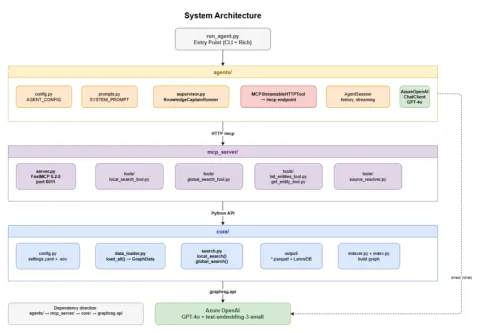
From MCP Server to Conversational Agent: GraphRAG Meets Microsoft Agent Framework
Build an intelligent conversational agent from your GraphRAG MCP server using Microsoft Agent Framework! Automate knowledge graph searches with GPT-4o and streamline tool routing.
- Article · AI Agents
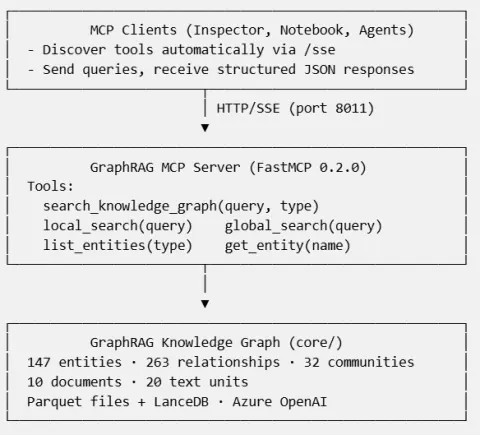
Turning your Knowledge Graph into an MCP Server with FastMCP
Expose your GraphRAG knowledge graph as an MCP server using FastMCP! Enable AI agents to discover & query it automatically. Build a universal AI tool connector.
- Article · LLMs
Building Knowledge Graphs with Microsoft GraphRAG and Azure OpenAI
Unlock AI's potential with GraphRAG! Build knowledge graphs using Microsoft GraphRAG and Azure OpenAI to answer complex questions beyond standard RAG. Learn how!
- Article · Azure
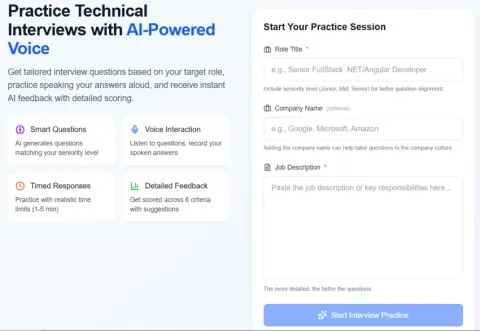
Building a Voice-Powered AI Tech Interviewer with Next.js and Azure AI
Ace your tech interviews with AI Tech Interview! Practice communication skills using Next.js, Azure AI, and voice. Get instant, detailed feedback. Land your dream job!
- Article · AI Agents
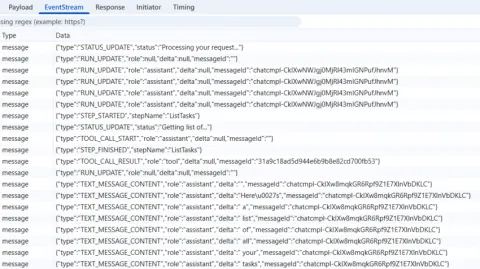
Real-Time Streaming for AI Agents: Implementing AG-UI Protocol with Microsoft Agent Framework and Azure OpenAI
In this article, we'll transform our agent into a real-time streaming experience, similar to ChatGPT. Users will see text appearing progressively as the AI generates it, creating a more engaging and responsive user experience.
- Article · Web Development
Building a Modern Task Management AI Agent: Separating Backend and Frontend with Next.js and Azure Static Web Apps
Modernize your AI Task Agent! Learn to separate .NET backend from a Next.js frontend with Azure Static Web Apps. Boost UX, scalability, and development speed.
- Article · .NET Aspire
Real-Time Observability for AI Agents with .NET Aspire, Application Insights & OpenTelemetry
Master AI agent observability with .NET Aspire, Application Insights, and OpenTelemetry. Monitor performance, debug issues, and ensure production readiness. From local dev to Azure!
- Article · LLMs
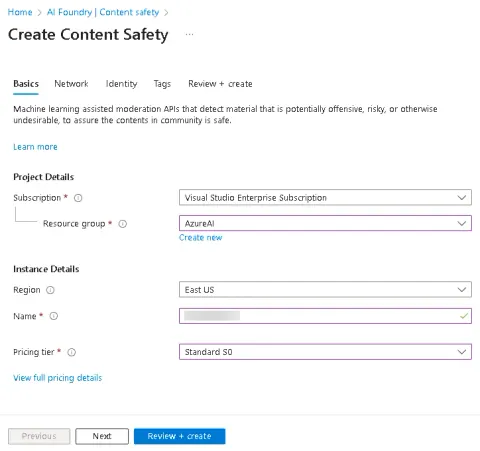
Securing your AI Task Agent with Azure AI Content Safety
Secure your AI Task Agent with Azure AI Content Safety! This article details how to implement a two-layer defense against prompt injection attacks and harmful content. Learn to protect your AI applications with prompt shields and content moderation, ensuring responsible AI development and user trust. Optimize performance with parallel execution and configurable thresholds for hate speech, violence, sexual content, and self-harm.
- Article · AI Agents
Building an AI Task Management Agent using Microsoft Agentic AI Framework
Discover how to build intelligent AI agents using the Microsoft Agentic AI Framework and Azure OpenAI. This guide covers setting up Azure resources, deploying models like gpt-4o-mini, creating function tools, and building production-ready web applications. Learn to leverage autonomous function calling and tool orchestration for adaptive, scalable AI solutions, reducing complexity and enhancing user experiences.
- Article · Cognitive Services
Enhancing Language Learning with Azure AI Speech Pronunciation Assessment
Discover how the Azure AI Speech Pronunciation Assessment enhances language learning by providing real-time feedback on pronunciation accuracy, fluency, and intonation.
- Article · Cognitive Services
Azure AI Video Indexer: A Powerful Tool for Video Analysis
Azure AI Video Indexer (VI) is a cloud-based service that helps businesses and developers extract valuable insights from videos using artificial intelligence (AI). This tool can automatically analyze video content, recognize faces, detect emotions, extract speech-to-text transcriptions, and even generate summaries.
- Article · Cognitive Services
Bringing Digital Voices to Life: Azure AI Text-to-Speech Avatar
Azure AI Text-to-Speech Avatar is a tool designed to create digital avatars that can speak in a remarkably human-like manner. This innovation is changing the way we interact with AI, making virtual assistants, automated customer service, and even gaming characters more lifelike than ever.
- Article · Cognitive Services
Document Translation Solution Using Azure AI .NET and React
This guide covers integrating Azure Cognitive Services for seamless language translation, enabling real-time multilingual support. Discover how to use AI-powered translation for efficient and scalable applications.
- Article · Cognitive Services
Detecting Harm Content in Text and Images using Azure AI Content Safety
This article explores how we built a demo application using Azure AI Content Safety to detect harmful content like hate speech, sexual content, and violence within a social media platform. We combined the power of an Angular frontend and a .NET backend API to create a system that analyzes text and images for potential harm