Loading
Articles by dhana gani
- Threading
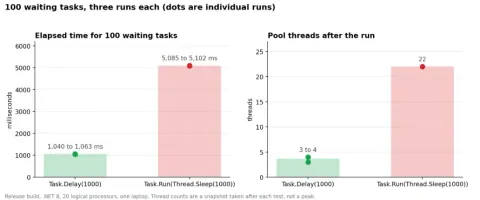
Blocking Threads vs Awaiting: 100 Waits Took 1 Second or 5 Seconds
A .NET 8 experiment comparing 100 Task.Delay calls with blocking Thread.Sleep tasks, explaining thread-pool limits, starvation, and why await scales better.
- Threading
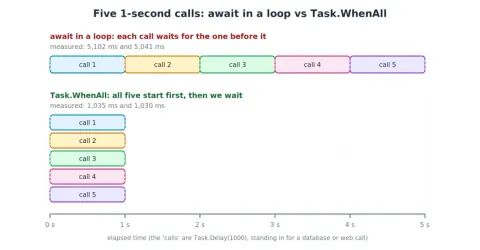
Why Await Inside a Loop Can Make Your Async Code 5x Slower
Learn why awaiting independent async calls in a loop runs them sequentially, and how Task.WhenAll, throttling, and error handling enable safe concurrent execution.
- Threading
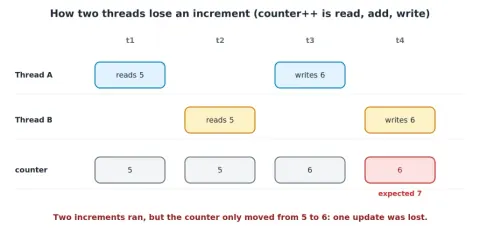
Why Parallel Code Loses Updates: lock, Interlocked, and Thread-Local State, Measured
Concurrency advice is usually delivered as rules: "use lock ", "prefer Interlocked ", "avoid shared state". Rules are easier to remember when you have watched them fail. So I built a deliberately small experiment, incrementing one counter 100,000 times with Parallel.For , and measured what happens w
- Threading
The One Structural Change That Makes Multithreaded Batch Processing Safe
Learn how to safely parallelize C# batch processing by giving each thread its own database connection and transaction, while controlling workload distribution and concurrency.
- ASP.NET Core
Choosing Between Minimal APIs and Controllers: A Question of Fit, Not Age
Compare ASP.NET Core Minimal APIs and Controllers, and learn how API size, endpoint relationships, and shared dependencies influence the right choice.
- Design Patterns & Practices
The Unit of Work Pattern Doesn't Need a Dedicated Class to Be Real
Why a simple two-step database saves, sharing one connection and transaction, is a genuine instance of the Unit of Work pattern - even without a dedicated class or explicit naming
- .NET
Transactional Correctness Isn't the Same as Accurate UI Feedback
Why a correct database transaction doesn't guarantee accurate UI communication — and why showing a success message before a multi-step save fully commits can mislead anyone reconciling data later.
- C#
Committed but Unconfirmed: Handling a Lost Response After a Successful Save
Learn how to handle lost responses after database commits using idempotency, operation IDs, state-based guards, and clear retry messaging in payroll systems.
- Design Patterns & Practices
Recognizing Design Patterns Accurately: A Repository I Had, and a Template Method I Didn't
Learn how to accurately identify Repository and Template Method patterns in C# by examining real enterprise .NET code and avoiding misleading pattern labels.
- ASP.NET Core
Interface or Concrete Class in DI Registration: A Small Choice That Decides Whether Your Code Can Be Tested
Learn how ASP.NET Core dependency injection interfaces improve unit testing, dependency substitution, and maintainability compared with direct concrete class registration.
- ASP.NET Core
ASP.NET Core Dependency Injection Lifetimes: Avoiding Shared State Bugs
Learn how ASP.NET Core dependency injection lifetimes affect concurrency, shared mutable state, and request safety, with practical Singleton vs Scoped guidance in production.
- Design Patterns & Practices
Why a Simple Controller/Data Access Split Is Real Architecture, Not a Shortcut
Learn how a 2-layer Controller and Data Access architecture applies OOP principles like abstraction and encapsulation while keeping enterprise applications maintainable.
- .NET Core
Why "Delete" Isn't Always DELETE: Choosing HTTP Verbs in Real ASP.NET Core APIs
Learn how to choose HTTP verbs in ASP.NET Core Web APIs based on resource semantics, including when to use GET, POST, PUT, PATCH, and DELETE for real business operations.
- Design Patterns & Practices
Object-Oriented Programming in C#: Real-World HR Leave Approval Workflow
Learn OOP concepts in C# with a practical HR and Payroll leave approval example covering classes, objects, abstraction, encapsulation, inheritance, polymorphism, and interfaces.
- ASP.NET
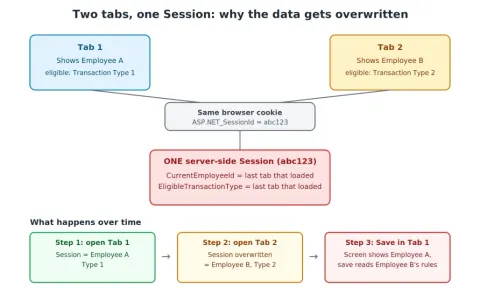
Why Multi-Tab Browsing Can Silently Corrupt Data in ASP.NET Applications
Learn how ASP.NET Session state can cause multi-tab bugs, why record-specific data should not rely on Session, and how to use request context and server-side validation.
- Databases & DBA
PLS-00201 in Multi-Schema Oracle Applications: A Verification Approach, Not a Permissions Reflex
Troubleshoot Oracle PLS-00201 errors in .NET ADO.NET applications by checking object names, schema, package status, procedure signatures, privileges, and synonyms.