Loading
Nidhi Sharma's contributions
- Article · AWS
AWS Lambda SnapStart Now Supports Container Images
Learn how AWS Lambda SnapStart reduces cold-start latency for container image functions, supported runtimes, and the considerations for snapshot-based initialization.
- Article · Claude
Claude Code Is Now Available on Amazon Bedrock GovCloud
Learn how to run Claude Code with Amazon Bedrock in AWS GovCloud, including model availability, endpoint choices, IAM permissions, and compliance considerations for regulated workloads.
- Article · Cosmos DB
GitHub Spec Kit Gets an Azure Cosmos DB Extension
Learn how the Azure Cosmos DB extension for GitHub Spec Kit brings partitioning, access-pattern, and data-modeling guidance into AI-assisted spec-driven development.
- Article · DevOps
Azure DevOps Moves Audit Events to Microsoft Entra Authorization
Learn how Azure DevOps audit-event authorization is moving to Microsoft Entra ID and how to review service principals, tokens, and integrations for continued audit access.
- Article · DevOps
Azure DevOps Remote MCP Server: What It Can Actually Do
Learn how the Azure DevOps Remote MCP Server lets AI agents access repositories, pull requests, work items, and pipelines, including permissions, workflows, and limitations.
- Article · Copilot
GitHub Is Retiring Some Copilot Models: What Developers Should Check
Learn how GitHub Copilot model retirements affect developers and organizations, and how to review model selections, policies, integrations, and replacement-model behavior.
- Article · Copilot
GitHub Copilot Dynamic Workflows: A New Way to Run Coding Tasks
Explains how GitHub Copilot dynamic workflows adapt planning, repository exploration, code changes, and testing to complete multi-step development tasks.
- Article · AI Agents
Azure DevOps Remote MCP: What Can an AI Agent Do With Your Repositories?
Learn how AI agents use Azure DevOps Remote MCP to explore repositories, analyze pull requests, manage work items, and apply safe approval boundaries for write operations.
- Article · DevOps
Azure DevOps Hosted Agents: What Changes With Pay-as-You-Go Pricing?
Learn how GitHub-hosted agents for Azure Pipelines use pay-as-you-go per-minute pricing, differ from parallel-job capacity, and affect agent selection and pipeline cost management.
- Article · .NET Aspire
Aspire 13.6: How to Debug a Container Without Leaving the Dashboard
Learn how to use the .NET Aspire 13.6 Dashboard terminal to inspect containers, troubleshoot configuration, and debug database connectivity in distributed applications.
- Article · .NET Aspire
Aspire 13.6 Terminals: How to Run Commands Inside Your Distributed App
Learn how to use .NET Aspire resource terminals to inspect containers, run diagnostics, check configuration, and troubleshoot services in distributed applications.
- Article · AI Agents
AG-UI and .NET: How to Connect AI Agents to Interactive Applications
Learn how to connect AI agents to interactive .NET applications using structured events, ASP.NET Core streaming, Blazor, SignalR, and asynchronous agent workflows.
- Article · AI Agents
AI Security Agents: How GitHub Found 24 Android Vulnerabilities
Learn how AI security agents can analyze Android repositories, identify attack surfaces, trace data flows, validate findings, and support vulnerability discovery.
- Article · Cyber Security
GitHub Advanced Security Trials: What Teams Can Test Before Enabling GHAS
Introduction Security tooling is easier to evaluate when developers can test it against real repositories instead of judging it from feature lists. GitHub Advanced Security, commonly called GHAS, brings several application security capabilities into the GitHub development workflow. These include cod
- Article · LLMs
How KV Cache Routing Can Make LLM Inference Faster
Learn how KV cache-aware routing reuses cached transformer attention states to reduce repeated prompt processing, lower latency, and improve GPU efficiency in LLM inference.
- Article · AI Agents
How to Build Agentic UIs With Blazor AI Components
AI applications are moving beyond simple chat interfaces. Modern AI agents can call tools, retrieve information, execute workflows, ask for additional input, and perform multiple steps before producing a final response. However, many applications still present all of that activity through a basic te
- Article · AI Agents
OpenAI Codex Cloud Environments: How to Run the Same Development Task Across Devices
Learn how OpenAI Codex cloud environments support remote, multi-device coding workflows, reproducible setups, dependency management, and test validation.
- Article · AI Agents
Can an AI Coding Agent Work Without Sending Your Code to the Cloud?
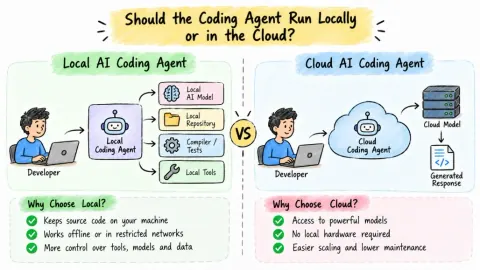
Learn how AI coding agents can work without sending source code to the cloud using local models, private repositories, network controls, sandboxing, and secure C# workflows.
- Article · AI Agents
Running AI Coding Agents on Local Hardware: When Does It Make Sense?
Learn when running AI coding agents locally makes sense, including hardware needs, code privacy, offline development, security, model limits, and C# workflows.
- Article · AI Agents
What Should Happen When a Long-Running AI Agent Loses Its Connection?
Learn how long-running AI agents can recover from connection loss using durable state, retries, idempotency, checkpoints, and resilient C# workflow design.