Loading
Articles by Praveen Kumar
- Cryptography
🔐 What is Cryptographic Agility?
Cryptographic agility is crucial for modern security. Learn how to adapt to evolving threats, broken algorithms, and quantum computing by design. Stay secure!
- Quantum Computing
🚀 What Are Storage and Transit Quantum Attacks on Blockchains?
Explore quantum attacks on blockchains: storage attacks (harvesting data for future decryption) and transit attacks (real-time transaction hijacking). Prepare now!
- Blockchain
🔐 What Are Post-Quantum Cryptography (PQC) Methods Relevant for Blockchain?
Explore post-quantum cryptography (PQC) methods like lattice-based and hash-based cryptography to future-proof blockchain against quantum computer threats.
- Cryptography
What is the difference between symmetric and asymmetric cryptography in Blockchains?
Explore symmetric vs. asymmetric cryptography in blockchain. Understand key differences, use cases, and why asymmetric encryption is vital for blockchain security.
- Blockchain
🔐 How Do Public/Private Key Pairs Work in Blockchain (e.g., ECC)?
Unlock blockchain security! Learn how public/private key pairs (ECC) enable secure transactions and ownership verification. Protect your private key, protect your funds!
- Blockchain
What is Segregated Witness (SegWit)?
Segregated Witness (SegWit) is one of the most important upgrades in Bitcoin’s history. It solved the problem of transaction malleability, increased block efficiency, and laid the foundation for technologies like the Lightning Network. This article breaks down what SegWit is, how it works, and why it matters.
- Bitcoin
What is Transaction Malleability and Why is it a Security Concern?
Transaction malleability is a long-standing issue in blockchain networks like Bitcoin, where attackers can modify transaction IDs without changing their actual effect. This article explains what it is, why it’s dangerous, and how the crypto community has worked to mitigate it.
- Blockchain
🔢 What is a Nonce in Blockchain?
Unlock the mystery of blockchain nonces! Discover how these 'numbers used once' secure networks, power Proof of Work, and ensure a trustless environment.
- Blockchain
What are Merkle Trees and How Do They Reinforce Integrity?
Learn what Merkle trees are and how they reinforce data integrity using cryptographic hashing. Explore their role in blockchain, distributed systems, and secure data verification.
- Blockchain
🔐 How Does Cryptographic Hashing Ensure Blockchain Security?
This article explains how cryptographic hashing plays a vital role in securing blockchain technology. It covers what hashing is, how it works, and why it guarantees integrity, immutability, and trust in decentralized systems.
- Blockchain
🔗 How is a Block’s Hash Generated, and What Does It Represent?
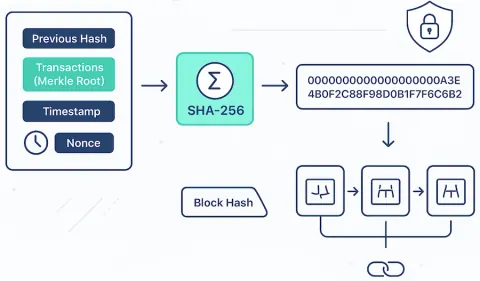
In blockchain technology, every block is uniquely identified by its hash. This article explains how a block’s hash is generated, what it represents, and why it is critical for maintaining the integrity and security of blockchain systems.
- Cryptography
🔐 What is Homomorphic Encryption?
Homomorphic Encryption is a powerful cryptographic technique that allows computations to be performed directly on encrypted data without needing to decrypt it first. This article explains what homomorphic encryption is, how it works, its types, use cases, and challenges.
- Cryptography
🔐 What is Multi-Party Computation (MPC)?
Multi-Party Computation (MPC) is a cryptographic technique that allows multiple parties to jointly compute a function over their inputs while keeping those inputs private. This article explains the concept of MPC, how it works, its role in blockchain and Web3 security, and real-world use cases.
- Blockchain
🔐 Cryptography in Blockchain
This article explores the role of cryptography in blockchain technology, explaining how hashing, digital signatures, and elliptic curve cryptography (ECC) ensure security, trust, and decentralization. Developers, engineers, and blockchain enthusiasts will learn why cryptography is essential for protecting data integrity and enabling trustless systems.
- Cryptography
What is Code-based Cryptography?
Learn how code-based cryptography uses error-correcting codes, how the McEliece cryptosystem works, and why it is a leading approach to post-quantum security.
- Cryptography
What is Lattice-Based Cryptography?
Lattice-based cryptography is one of the most promising areas of post-quantum cryptography. This article explains what it is, how it works, why it’s important for blockchain and modern encryption, and its future in a quantum-driven world.
- Cryptography
🔐 What is Zero-Knowledge Proof?
Learn what Zero-Knowledge Proof (ZKP) is, how it works, and why it’s becoming a core part of blockchain and Web3 security. Explore real-world use cases, advantages, and examples explained simply for developers and techies.
- Cryptography
What is Post-Quantum Cryptography?
Post-Quantum Cryptography (PQC) refers to cryptographic algorithms designed to secure digital communication against attacks by quantum computers. Conventional algorithms such as RSA, Diffie–Hellman, and Elliptic Curve Cryptography (ECC) are vulnerable to Shor’s algorithm, which allows efficient factorization and discrete logarithm solving.
- Blockchain
💸 What is Double-Spending in Blockchain?
Double-spending is one of the biggest threats to digital currencies. This article explains what double-spending is, why it’s dangerous in blockchain, how attackers attempt it, and the cryptographic and consensus mechanisms blockchains use to prevent it.
- Cryptography
🔒 How Does Cryptography Prevent Double-Spending?
Double-spending is one of the biggest threats in digital money systems. This article explains how cryptography — through hashing, digital signatures, and consensus mechanisms — prevents attackers from spending the same coin twice, making blockchain secure and trustworthy.
- Cryptography
What is elliptic curve cryptography?
A deep dive into elliptic curve cryptography: discover why ECC powers blockchain, how modern curves like Curve25519 and BLS12-381 offer performance and security benefits, the emerging GPU-based acceleration (gECC), and how to implement ECC in C#. Plus, stay quantum-ready with a look at post-quantum cryptographic alternatives.
- Cryptocurrency
What is the EU MiCA regulation?
An in-depth exploration of the European Union’s Markets in Crypto-Assets Regulation (MiCA), detailing its purpose, scope, timeline, key provisions, impacts on issuers and service providers, and emerging challenges—such as stablecoin loopholes and regulatory fragmentation.
- Cryptocurrency
What is the GENIUS Act (US stablecoin law)?
An in-depth exploration of the GENIUS Act—short for Guiding and Establishing National Innovation for U.S. Stablecoins Act—a landmark U.S. law enacted in 2025 that provides the first comprehensive federal regulatory framework for stablecoins. This article covers its provisions, goals, and potential implications for the crypto industry and broader financial system.
- Blockchain
What is Blockchain Interoperability?
Blockchain interoperability is the key to making different blockchain networks work together seamlessly, allowing users to transfer data, assets, and information across multiple platforms. This article explores what interoperability means, why it’s essential for the future of Web3, the challenges it faces, and the leading solutions in the market today.