Master GraphQL mutations in .NET & React! Learn to create, update, and delete data, implement input types, handle errors, and optimize cache for a seamless user experience.
Build a full-stack Library Management System with React & .NET using GraphQL. Learn foundations, queries, mutations, & subscriptions. Zero to production!
Explore a modern .NET backend architecture using Vertical Slice Architecture and CQRS. This article dives into a practical Todo API implementation, showcasing validators, CQRS, and feature-focused design.
Explore Feature-First Architecture in .NET using Vertical Slice and CQRS! Learn how to build scalable and maintainable applications with a practical ToDo API example.
Demystifying Transformers in AI! Forget robots, this guide breaks down the genius model architecture that powers AI like ChatGPT. Learn about self-attention, positional encoding, encoder-decoder structure, and how transformers predict the next word using vectors and probabilities. Understand the magic behind AI text generation!
Explore the captivating journey of Artificial Intelligence, from Alan Turing's groundbreaking vision to the deep learning revolution and generative AI marvels like ChatGPT. Discover the key figures, pivotal moments like AlphaGo's victory, and the future of AI in shaping our world. Uncover the Nobel Prize recognition and the ongoing evolution of intelligent machines.
This article breaks down these powerful AI systems, explaining their architecture, pretraining, adaptation, and multimodal capabilities. Learn about transformers, prompt engineering, RAG, and guardrails. Explore real-world examples like GPT and LLaMA, plus platforms like AWS, Azure, and Google Cloud for powering your own FMs.
Explore how deep learning powers voice assistants, self-driving cars, and even Netflix recommendations. Discover the difference between deep learning and machine learning, and understand why deep learning is revolutionizing AI with computer vision and natural language processing.
This article breaks down ML into easy-to-understand concepts, perfect for beginners. Learn about training data (labeled vs. unlabeled, structured vs. unstructured), supervised, unsupervised, and reinforcement learning. Plus, discover how inferencing works (batch vs. real-time) and the cloud services offered by AWS, Azure, and Google Cloud.
Explore the multifaceted world of Artificial Intelligence! This article breaks down AI's core concepts, including Machine Learning (ML), Deep Learning (DL), and the exciting realm of Generative AI. Discover practical applications and cloud platform examples from Azure, AWS, and Google Cloud.
In this article, I share my 6-month journey working with AWS, 3 months of focused exam preparation, the resources I used, practice exam scores, and my in-person exam day experience. Expect hands-on tips, key services explained in simple one-liners.
I am here to address a common challenge in React + TypeScript apps: managing asynchronous HTTP requests when they become irrelevant, especially when components unmount or props change during data fetching.
Delve deeper into React's useState hook! This guide explores advanced patterns like lazy initialization, object state management (spreading!), and avoiding common pitfalls such as incorrect updates and using useState in loops. Understand how React optimizes state updates and ensures efficient re-renders. Master useState for robust and performant React components. Learn how to initialize state only once and the importance of using functional updates.
Unlock the power of CSS Custom Properties (CSS variables) in your React applications! This guide covers everything from defining global and scoped variables to using them with CSS Modules, inline styles, and Styled-Components. Learn best practices for naming conventions and dynamic updates to create maintainable and themeable React UIs. Discover how to effectively manage colors, spacing, and typography for a consistent design system.
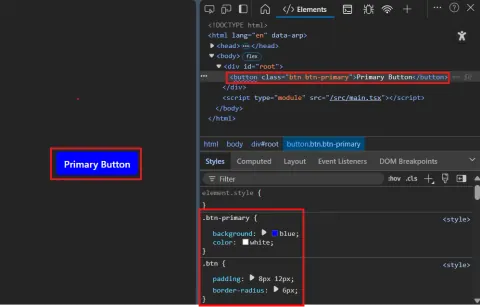
Explore diverse React styling techniques: global CSS, CSS Modules, styled-components, and inline styles. Learn the pros and cons of each approach, including scoping, dynamic styling, and maintainability. Discover best practices for organizing CSS in React projects, combining styles, and managing conditional class logic. Choose the right method for scalable and maintainable React applications. Optimize your React styling workflow today!
React Fragments are essential for grouping multiple elements in React without introducing unnecessary DOM nodes like extra divs. This prevents layout and styling issues. Learn how Fragments solve the common "one root element" React limitation, explore the short syntax (<>), and discover advanced use cases like rendering lists with keys and conditional rendering. Improve your React code's efficiency and maintainability!
Understand React's key prop and when to use it effectively! This article explains why using the index as a key can lead to unexpected re-renders and potential bugs in dynamic lists. Learn best practices for assigning keys, including using unique and stable IDs whenever possible. Discover when it's acceptable to use the index and see a practical example of managing keys in a dynamic todo list component to optimize performance and avoid common pitfalls.
Understand the Dumb vs Smart component pattern in React for cleaner, more maintainable code. Dumb components focus on UI and receive data via props, while Smart components handle logic, data fetching, and state management. Learn how this separation of concerns improves reusability, testability, and adheres to the Single Responsibility Principle, even with modern React hooks blurring the lines.
Unlock the power of functional components in React! This guide covers everything from basic syntax and props to hooks and advanced patterns. Learn how to write clean, reusable React components using function declarations, arrow functions, and TypeScript with React.FC. Discover best practices for structuring your code, including when to keep multiple components in one file and how to use named and default exports for optimal organization. Master the art of building dynamic and interactive user interfaces with React's functional approach.
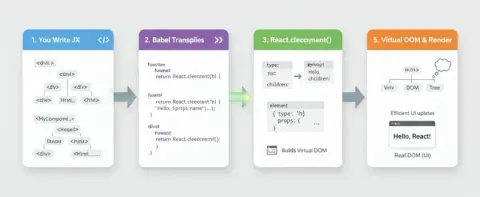
JSX is a powerful syntax extension in React that allows developers to write HTML-like structures within JavaScript code. This makes React components more readable and easier to maintain. Babel transforms JSX into standard JavaScript using React.createElement(), which React then uses to build and efficiently update the Virtual DOM, ultimately rendering changes to the Real DOM. Learn how JSX simplifies component creation and enhances the React development experience.
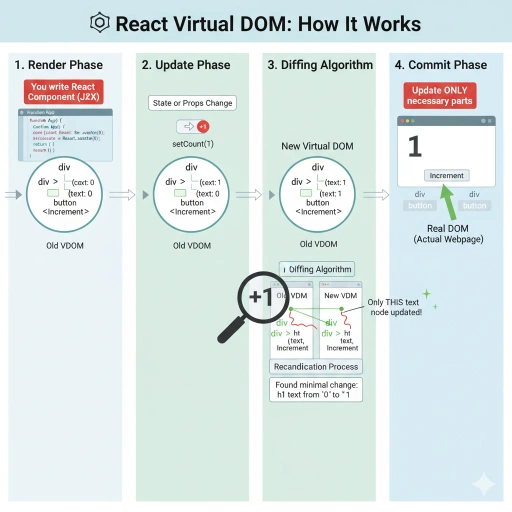
React utilizes a Virtual DOM to optimize UI updates. Instead of directly manipulating the Real DOM, which is slow, React creates a lightweight copy in memory. It then efficiently identifies the minimal changes needed and updates only those specific parts of the Real DOM, resulting in faster and more performant user interfaces.
This article breaks down how wrapper components work in React, showing you how to build flexible, reusable UI pieces without losing your mind or your types. Learn how to pass props, handle refs, and keep your components clean and powerful.
Learn how React’s useRef hook helps you persist values and directly access DOM elements across renders. Perfect for managing focus, timers, or mutable state without triggering UI updates.