Loading
Articles by Tuhin Paul
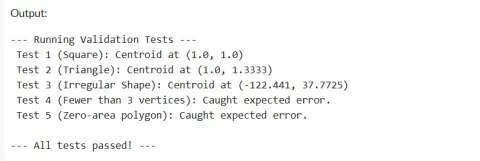
Finding the Centroid of a Polygon: Powering Real-Time Wildfire Response Systems
Discover how to calculate the centroid of a polygon using the shoelace formula in Python, with a focus on its critical role in real-time wildfire response systems. Learn to implement a robust centroid calculator, validate results, and handle edge cases. Explore best practices for geospatial applications, including coordinate systems and degenerate shapes. See how this geometric calculation aids emergency teams in placing command posts and predicting fire spread, ultimately saving lives and property.
Calculating 3D Distance Between Two Points: Enabling Real-Time Collision Avoidance in Autonomous Mining
Explore the 3D Euclidean distance formula and its vital role in autonomous mining. Learn how precise distance calculations prevent collisions in GPS-denied underground environments, ensuring safety and operational efficiency. This article provides a Python implementation, validation tests, and best practices for safety-critical systems, highlighting the importance of accuracy in real-world applications.
Building Real-World Data Models in Python: From Structs to Smart Classes
Learn how to build robust and reliable data models in Python using data classes, a modern alternative to C-style structs. This guide demonstrates how to manage IoT sensor readings in smart agriculture, including data validation, error handling, and JSON serialization.
Real-Time Array Initialization in Python: Powering Live Disaster Response Systems
Master array initialization in Python for real-time systems like wildfire prediction. Learn efficient techniques using lists and NumPy to optimize speed, memory, and correctness. Avoid common pitfalls like shared references and dynamic allocation. Implement robust code with test cases and best practices for building resilient disaster response systems. Crucial for time-sensitive applications!
Debug Like a SRE: Build a Real-Time JSON Log Aggregator for Critical Systems Using Python
This article demonstrates how structured logging with JSON transforms debugging from a nightmare into a streamlined process. Learn to parse, filter, and color-code logs for instant insights, enabling rapid diagnosis and resolution of issues in distributed environments. Ideal for SREs and developers managing complex systems.
From Farm to Shelf: Build a Real-Time Fruit & Vegetable Classifier with TensorFlow Lite
Build a TensorFlow Lite fruit and vegetable image classifier with MobileNetV2 and the Fruits-360 dataset. Learn to prepare data, fine-tune the model, and export it for edge-device inference.
Generate and Verify TOTP (Time-Based One-Time Passwords): Securing Banking Transactions Against Real-Time Fraud
Protect banking transactions from real-time fraud with Time-Based One-Time Passwords (TOTP). This guide explains TOTP, the technology behind Google Authenticator, and provides a secure, dependency-free Python implementation. Learn how TOTP stopped a $250,000 wire fraud and implement robust 2FA for your banking systems.
How to Apply Gamma Correction to Enhance Low-Light Images Using Python
Enhance low-light images with gamma correction using Python and NumPy! This guide provides a step-by-step implementation, complete code with test cases, and performance tips. Learn how to brighten dark regions, reveal hidden details, and improve image visibility without complex AI. Perfect for wildlife surveillance, security, and more.
How to Anonymize Geospatial Data Using k-Anonymity Using Python
Learn how to anonymize geospatial data using k-anonymity in Python to protect sensitive location information. This article provides a step-by-step guide, complete code with test cases, and best practices for ethical data publishing. Discover how to safeguard vulnerable populations by generalizing GPS coordinates and preventing re-identification, crucial for humanitarian aid and conflict zones. Implement a practical solution for privacy-preserving data sharing.
Count Every Car: Build a Traffic-Smart Vehicle Counter with Connected Component Labeling in Pure Python
Build a real-time vehicle counter using Connected Component Labeling (CCL) in pure Python. This guide provides a step-by-step implementation from scratch, ideal for edge devices and traffic management systems. Learn how to accurately count vehicles, even in dense traffic, without relying on external libraries like OpenCV or deep learning.
Simulate Distributed Consensus with the Raft Protocol (Simplified) Using Python
Explore distributed consensus with a simplified Raft protocol simulation in Python. Learn core concepts like leader election and log replication through a practical drone swarm coordination scenario. This article provides a complete, error-free Python implementation, ideal for understanding Raft's fundamentals and building fault-tolerant systems. Discover best practices for real-world applications and delve into the world of distributed systems.
Implement Rate Limiting Using the Token Bucket Algorithm Using Python
This article provides a complete, thread-safe Python implementation, demonstrating how to prevent outages and ensure fair access during traffic spikes. Learn how it saved a weather API during a hurricane, and implement best practices for production use, including per-user buckets and async handling, to keep your services available when it matters most.
Extract Dominant Colors from an Image Using K-Means Clustering Using Python
Unlock the power of dominant color extraction using k-means clustering with Python and NumPy! This guide provides a step-by-step implementation from scratch, ideal for resource-constrained environments like retail edge devices. Discover how to analyze images, identify key colors, and build real-time brand compliance monitoring systems without external dependencies.
Rate Limiting Using the Token Bucket Algorithm for API Gateway Protection Using Python
This article provides a complete, error-free Python implementation for rate limiting, demonstrating how it stopped a credential-stuffing attack on a banking API. Learn best practices for production deployment, including Redis integration and header standardization, to safeguard your systems and users.
Protecting Riders, Not Just Rides: How k-Anonymity Safeguards Privacy in Mobility Data Using Python
This article demonstrates how to implement k-anonymization with Python to prevent re-identification from ride-hailing data. Learn to generalize location data, suppress sparse areas, and ensure GDPR/CCPA compliance. Includes a real-world stalking scenario, code, tests, and best practices for ethical data handling.
How to Implement Connected Component Labeling for Object Counting Using Python
Implement Connected Component Labeling (CCL) in Python from scratch using NumPy for object counting in images. This guide provides a step-by-step implementation of the two-pass algorithm with union-find, ideal for resource-constrained environments. Learn to count objects, like wildlife in remote areas, without relying on external libraries like OpenCV.
How to Filter Noise from ECG Signals Using a Butterworth Filter Using Python
Learn how to implement a Butterworth bandpass filter in pure Python to remove noise from ECG signals, crucial for remote cardiac monitoring in telemedicine. This guide provides a step-by-step implementation from scratch using NumPy, ensuring transparency and reliability for medical applications. Optimize ECG data on resource-constrained devices without external libraries, improving diagnostic accuracy in rural areas. Zero-phase filtering preserves critical waveform timing.
Generate and Verify TOTP (Time-Based One-Time Passwords) Using Python
Learn how to generate and verify Time-Based One-Time Passwords (TOTP) in Python, enhancing security for applications. This guide covers the TOTP algorithm, its real-world importance in scenarios like healthcare, and provides a step-by-step Python implementation using built-in libraries. Discover best practices for secure TOTP usage and understand how it surpasses traditional passwords and SMS-based 2FA, ensuring robust authentication even offline.
Decode QR Codes from Binary Images Without Libraries Using Python
Unlock offline QR code decoding with pure Python! This guide provides a step-by-step implementation to read QR codes from binary images without external libraries like OpenCV or PIL. Ideal for resource-constrained environments like rural clinics, learn to build resilient, dependency-free systems for vaccine verification and more.
Perform Edge Detection Using Sobel Operator from Scratch Using Python
Unlock the power of edge detection by implementing the Sobel operator from scratch in Python using NumPy. This article provides a step-by-step guide, complete with code, test cases, and performance tips. Learn how to apply Sobel to real-world scenarios like autonomous wheelchair navigation, optimize for low-power devices, and gain a deeper understanding of image processing fundamentals.
Design a Circuit Breaker for Microservices (Like Hystrix) Using Python
Prevent cascading failures in your microservices with a Python circuit breaker! This article guides you through building a lightweight, production-ready circuit breaker (like Hystrix) from scratch, without external dependencies. Learn how to implement the CLOSED, OPEN, and HALF_OPEN states, test its resilience, and integrate it into your ride-sharing app to gracefully handle service outages and maintain a smooth user experience.
Stopping Ghost Commands: How to Detect Replay Attacks in Life-Critical IoT Devices Using Python
Learn how to detect replayed IoT commands with timestamp validation, monotonic nonces, and command-hash checks in Python, using a smart insulin pump scenario.
Build a Drone-Ready Edge Detector from Scratch: Sobel Operator in Pure Python & NumPy
Build a Sobel edge detector from scratch using pure Python and NumPy! This article provides a step-by-step implementation, perfect for resource-constrained environments like drones. Learn how to detect edges without OpenCV, enabling real-time crop health monitoring and other edge-aware applications.
Build a Log Aggregator with Structured JSON Parsing Using Python
Build a Python log aggregator that parses JSON log entries, filters them by fields such as service and level, and formats matching results for the terminal.
Compute FFT for Audio Pitch Detection: Real-Time Vocal Coach for Singers Using Python
Build a real-time Python vocal coach that captures microphone audio, uses FFT to detect pitch, and maps frequencies to musical notes for live feedback.