Loading
Articles by Tuhin Paul
- AI Agents
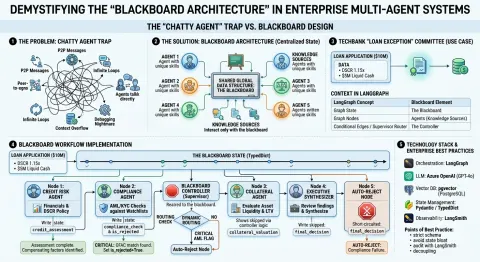
Demystifying the "Blackboard Architecture" in Enterprise Multi-Agent Systems
Learn how to implement the Blackboard Architecture with LangGraph for multi-agent AI systems using centralized state, dynamic routing, RAG, and enterprise workflows.
- Langchain
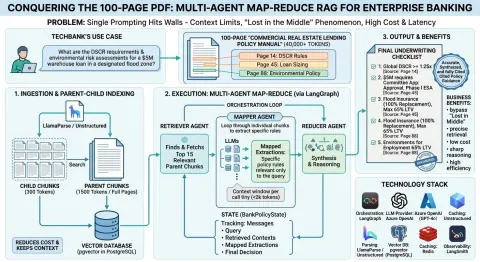
Conquering the 100-Page PDF: Multi-Agent Map-Reduce RAG for Enterprise Banking
Learn how to build large-document RAG with LangGraph using parent-child indexing and Map-Reduce agents to process complex PDFs with efficient context management.
- AI Agents
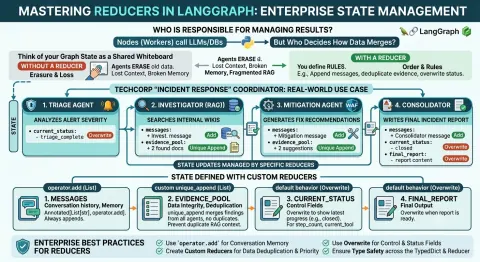
Mastering Reducers in LangGraph: The Secret to Enterprise State Management
By carefully choosing between appending, merging, and overwriting, you ensure that your RAG application doesn't just "work" it remembers, it learns, and it maintains a consistent view of the world across multiple agents. In the high-stakes environment of SOC, that consistency is the difference between a resolved incident and a security breach.
- AI Agents
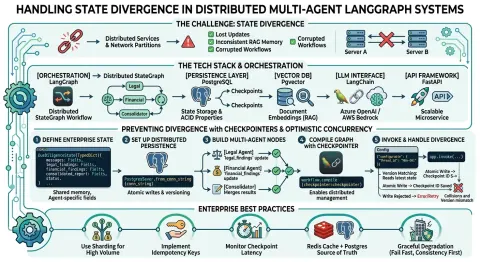
Handling State Divergence in Distributed LangGraph: A Guide for Enterprise RAG
Handling state divergence in a distributed LangGraph setup isn't about avoiding conflicts—it's about managing them through strict versioning and persistent storage.
- AI Agents
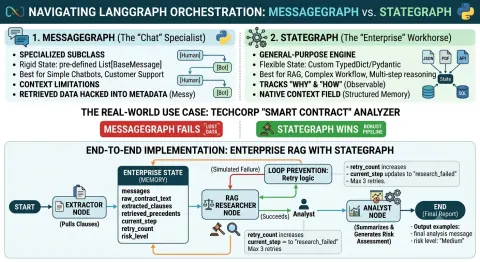
StateGraph vs. MessageGraph: Choosing the Right Foundation for Enterprise AI
In the TechCorp example, the ability to explicitly track retrieved_precedents and retry_count allowed us to build a system that was not only intelligent but also resilient and observable. In the enterprise, where every decision must be traceable and every failure must be handled gracefully, the flexibility of StateGraph is not just a feature it's a requirement.
- AI Agents
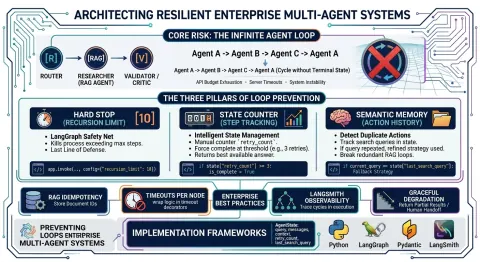
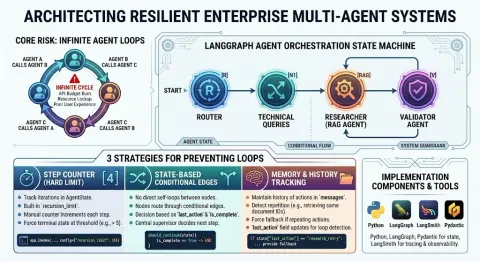
Preventing Infinite Loops in Enterprise Multi-Agent LangGraph Systems
In the enterprise, AI agents are no longer isolated scripts; they are collaborative teams. When you build a Multi-Agent System using LangGraph, you are orchestrating a complex dance where a "Router" might send work to a "Researcher," who then passes it to a "Validator."
- AI Agents
Preventing Infinite Loops in Enterprise Multi-Agent LangGraph Systems
Preventing infinite loops in multi-agent systems isn't about hoping for the best; it's about designing for the worst. By combining hard step limits, state-aware routing, and semantic loop detection (checking if we're doing the same thing twice), you can build an Enterprise RAG system that is not only intelligent but also incredibly resilient.
- AI Agents
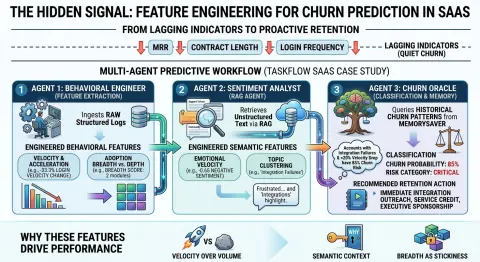
The Hidden Signal: Feature Engineering for Churn Prediction in SaaS
In the Subscription and SaaS world, churn is the silent killer. Most companies rely on standard structured metrics to predict it: Monthly Recurring Revenue (MRR), contract length, and login frequency. While these are useful, they are often lagging indicators. By the time a user’s login frequency drops by 50%, they have already mentally checked out. To build a truly predictive churn model, we must look beyond the database rows. The biggest impact on classification performance comes from behavioral and semantic feature engineering.
- AI Agents
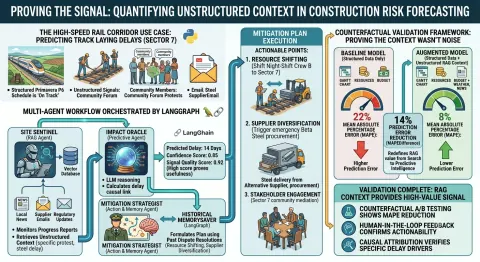
Quantifying Unstructured Context in Construction Risk Forecasting
In the Construction and Infrastructure domain, project delays are rarely caused by a single factor. They are the result of complex interactions between structured schedules (Gantt charts, resource allocation) and unstructured realities (weather anomalies, supply chain disruptions, regulatory changes, and on-site labor sentiment).
- AI Agents
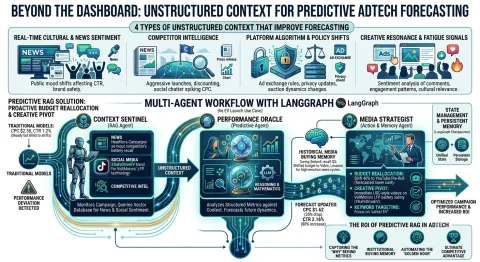
How Unstructured Context Drives Predictive AdTech Forecasting
In the Advertising and AdTech industry, structured data historical Click-Through Rates (CTR), Cost-Per-Click (CPC), impression volumes, and bid prices—is the foundation of media buying. But structured data is inherently backward-looking. It tells you what did happen, not what will happen when the market shifts. To build truly predictive intelligence, we must answer a critical question: What unstructured context actually improves forecasting performance in AdTech?
- AI Agents
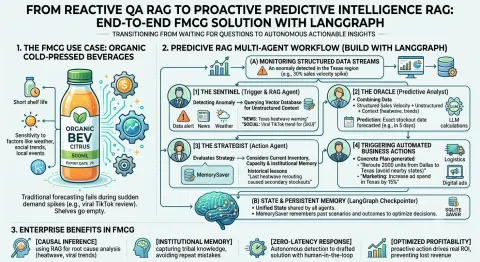
Building Predictive Intelligence with Multi-Agent RAG in FMCG Retail
In the high-margin, low-tolerance world of FMCG retail, the difference between reacting to a stockout and predicting it days in advance is the difference between lost revenue and optimized profitability. Predictive RAG is the bridge to that future.
- AI Agents
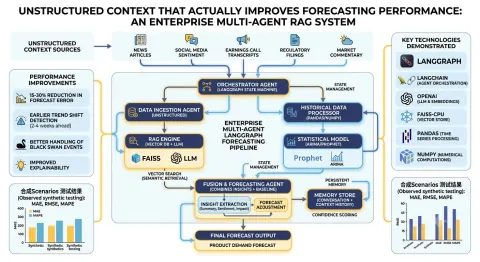
Unstructured Context That Actually Improves Forecasting Performance: An Enterprise Multi-Agent RAG System
Traditional forecasting models rely heavily on structured historical data—time series, numerical metrics, and categorical variables. However, **unstructured context** such as news articles, social media sentiment, earnings call transcripts, regulatory filings, customer support tickets, and market commentary often contains leading indicators that significantly improve forecast accuracy when properly integrated.
- AI Agents
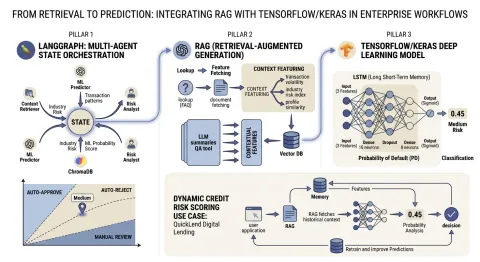
How to Integrate RAG with TensorFlow for AI-Powered Credit Risk Prediction
Most developers treat Retrieval-Augmented Generation (RAG) as a "lookup" tool for Large Language Models (LLMs). You ask a question, it fetches a document, and the LLM summarizes it. This is a QA (Question-Answering) Workflow.
- AI Agents
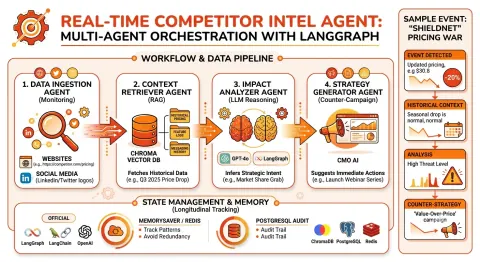
I Built an AI Agent That Monitors Competitors in Real Time
In the fast-paced world of B2B SaaS and digital services, competitive intelligence is no longer a quarterly report—it’s a real-time necessity. Waiting for a monthly newsletter to learn that a competitor has dropped prices or launched a new feature is too late.
- AI Agents
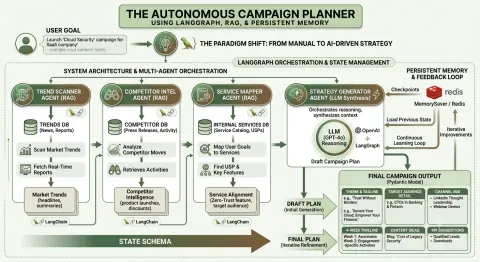
Enterprise Multi-Agent LangGraph enabled Autonomous Campaign Planner
Learn how to build an autonomous AI campaign planner using LangGraph, RAG, and persistent memory to analyze market trends, competitor activity, internal services, and generate enterprise marketing strategies.
- AI Agents
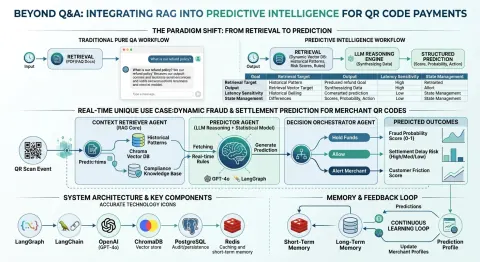
Integrating RAG into Predictive Intelligence for QR Code Payments
Most developers view Retrieval-Augmented Generation (RAG) as a tool for answering questions: "What is our refund policy?" or "Show me the transaction history." In high-frequency domains like QR Code Payments, RAG can be integrated into a Predictive Intelligence Workflow. Here, retrieval doesn't just fetch facts; it fetches contextual patterns, historical anomalies, and dynamic risk rules that feed into a predictive model. The LLM then acts not as a chatbot, but as a reasoning engine that synthesizes retrieved data to predict outcomes (e.g., fraud probability, merchant churn, settlement delay) before they happen.
- AI Agents
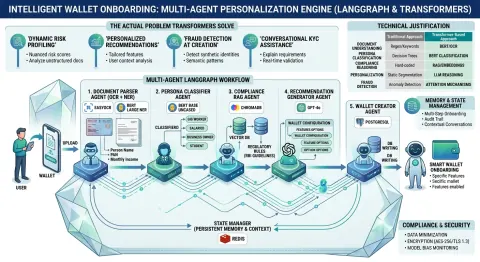
Why Transformer-Based Architectures for Digital Wallet Creation
First, let's address a critical misconception: Transformer-based architectures are NOT typically used for the core "Wallet Creation" module (which is usually a simple CRUD operation involving user registration, KYC verification, and database record creation). However, transformers ARE uniquely valuable in the Intelligent Wallet Onboarding & Personalization Engine that runs during wallet creation. This is where the real enterprise value lies.
- AI Agents
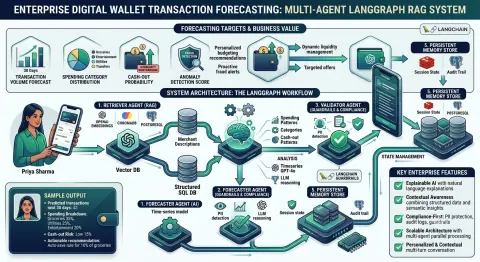
Forecasting Transaction Patterns in Digital Wallets
Learn how to build an enterprise-grade digital wallet transaction forecasting platform using LangGraph, RAG, Prophet, persistent memory, and AI agents for explainable spending predictions and anomaly detection.
- AI Agents
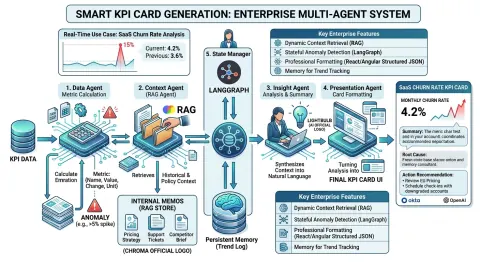
Building Professional KPI Cards with Enterprise Multi-Agent AI
Learn how to build smart KPI cards with LangGraph, RAG, and persistent memory to detect anomalies, explain SaaS churn trends, identify root causes, and generate actionable business insights.
- AI Agents
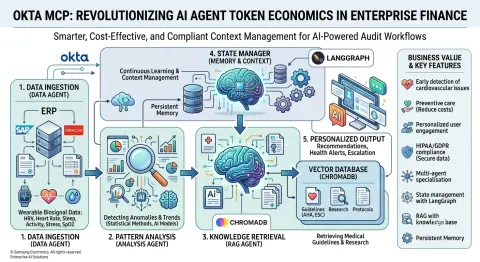
Okta MCP: Revolutionizing AI Agent Token Economics in Enterprise Finance
Learn how to build an enterprise financial audit system using Okta, MCP-style context optimization, LangGraph, RAG, and persistent memory to reduce token usage and improve security, compliance, and auditability.
- AI Agents
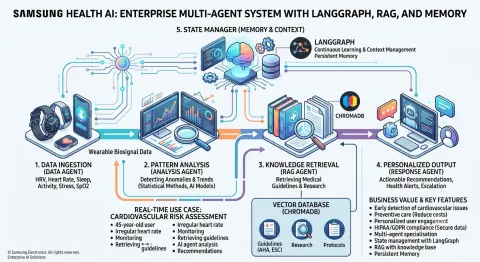
Samsung Health AI: Enterprise Multi-Agent System with LangGraph, RAG, and Memory
Build a LangGraph multi-agent system that uses RAG and persistent memory to analyze Samsung Health wearable data, generate health recommendations, and escalate critical alerts.
- AI
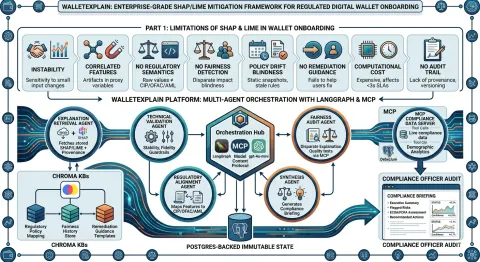
Validating Explainability in Regulated Digital Wallet Onboarding with Multi-Agent RAG, MCP, and LangGraph State
Digital wallet onboarding requires explainable, fair, and auditable AI decisions. Explore SHAP and LIME limitations and a LangGraph, RAG, and MCP framework for compliant, validated, and actionable explanations.
- AI Agents
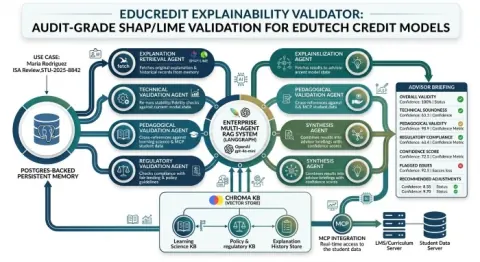
Validating Explainability in EduTech Credit Models: A Multi-Agent RAG Framework with SHAP/LIME Verification, MCP Integration
Learn how to build a domain-specific explainability validation framework for EduTech credit models using SHAP, LIME, LangGraph, Chroma, persistent memory, and Model Context Protocol (MCP). This article explores how to validate AI-generated explanations across technical soundness, pedagogical validity, regulatory compliance, and historical consistency. It demonstrates a multi-agent architecture that combines learning-science knowledge, live student performance data, policy guidance, and explanation history to identify unstable or misleading explanations before they reach students, advisors, or compliance teams.
- AI Agents
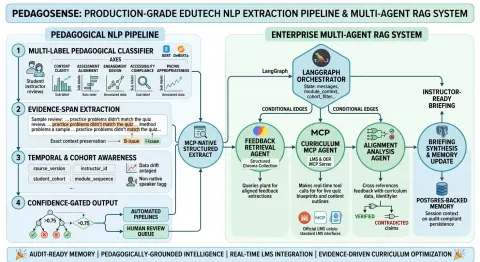
An NLP-to-MCP Pipeline for EduTech RAG with LangGraph Multi-Agent Orchestration
Extracting value from EduTech reviews requires moving beyond sentiment analysis toward pedagogically-grounded structured extraction. The NLP pipeline described here combining domain-specific classification, evidence-span preservation, confidence gating, and MCP-native output formatting transforms unstructured student voice into machine-actionable curriculum intelligence.
- AI Agents
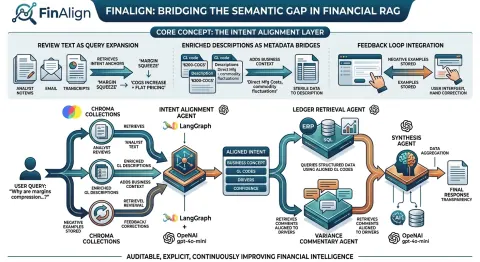
Aligning User Intent with Financial Data via Review-Style Feedback and Ledger Descriptions in Multi-Agent RAG
Intent alignment is the missing layer in financial RAG systems. By treating analyst review text as semantic anchors and enriched ledger descriptions as structural bridges, organizations can transform vague business questions into precise financial queries without requiring users to learn GL codes or accounting terminology.