Loading
Tuhin Paul's contributions
- Article · AI Agents
Graceful Degradation in Enterprise Multi-Agent RAG Systems
Graceful degradation transforms fragile AI systems into resilient enterprise solutions. By implementing circuit breakers, fallback strategies, caching, and clear user communication, your multi-agent RAG system maintains value delivery even during service disruptions. The key is designing multiple degradation levels that progressively simplify functionality while preserving core utility. Monitor your circuit breakers, test failure scenarios regularly, and always prioritize user experience over perfect accuracy when systems are under stress. This approach ensures your manufacturing AI assistant remains a reliable tool, not a single point of failure.
- Article · .NET Core
Optimizing Retrieval in Manufacturing: A Multi-Agent Graph RAG Approach with Hybrid Search and Reranking
Our system combines vector similarity, keyword matching, and knowledge graph relationships to provide contextually accurate answers while maintaining conversational memory across multiple interactions.
- Article · AI Agents
Accelerating Intelligence: Optimizing Graph RAG Performance for High-Frequency Fintech Applications
Optimizing Graph RAG for fintech requires a shift from simple retrieval to intelligent, parallelized reasoning. By leveraging the structural power of Neo4j, the orchestration capabilities of LangGraph, and the speed of async FastAPI, we can build systems that provide deep, accurate insights in real-time. As financial markets become increasingly complex, the ability to quickly traverse and understand these connections will be a definitive competitive advantage.
- Article · AI Agents
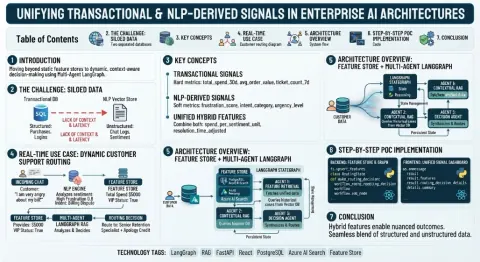
Unifying Transactional and NLP Signals: Building a Feature Store with Multi-Agent LangGraph RAG
Unifying transactional and NLP-derived signals within a feature store transforms raw data into actionable intelligence. By integrating this store with a Multi-Agent LangGraph RAG system, enterprises can move beyond static rules to dynamic, context-aware decision-making. This POC illustrates how hybrid features enable more nuanced outcomes, such as empathetic support routing.
- Article · AI Agents
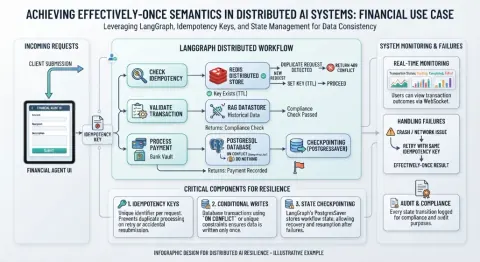
Building Exactly-Once Semantics in Enterprise Multi-Agent LangGraph RAG Systems
Building exactly-once or effectively-once semantics in multi-agent LangGraph RAG systems requires a combination of idempotency patterns, distributed state management, and transactional databases. By leveraging unique identifiers, conditional writes, and checkpointing, enterprises can ensure data consistency even in the face of failures.
- Article · AI Agents
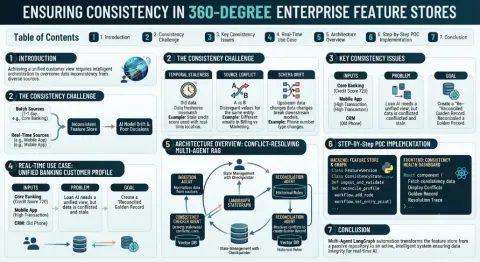
Solving Consistency in 360-Degree Customer Feature Stores: A Multi-Agent LangGraph Approach
Learn how to build a consistent 360-degree customer feature store using LangGraph, RAG, multi-agent orchestration, conflict detection, and reconciliation.
- Article · AI
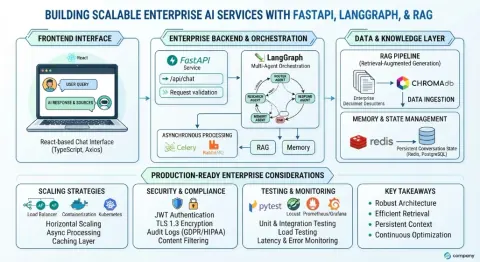
Building Scalable Enterprise AI Services with FastAPI, LangGraph, RAG, and Multi-Agent Architecture
Learn how to build scalable AI services with FastAPI, LangGraph, RAG, persistent memory, and multi-agent orchestration for enterprise LLM applications.
- Article · AI Agents
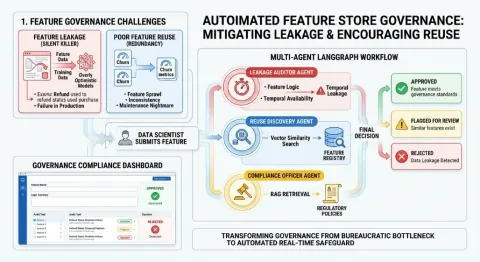
Governing the Feature Store: Preventing Leakage and Enforcing Reuse with Multi-Agent LangGraph
Governance in a feature store is not about restricting innovation; it is about ensuring sustainability and reliability. By automating the detection of feature leakage and encouraging reuse through intelligent multi-agent systems, enterprises can protect their ML investments from technical debt and regulatory risk.
- Article · AI Agents
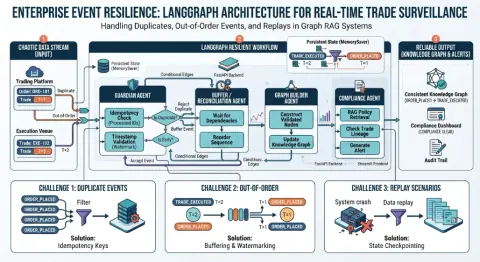
Resilience in Real-Time: Handling Duplicates, Reordering, and Replay in Enterprise Graph RAG
Handling the chaos of real-time data streams is not optional for enterprise Graph RAG systems it is a foundational requirement. By leveraging LangGraph’s persistent state, we can implement robust idempotency checks to kill duplicates, buffering logic to handle out-of-order events, and checkpointing to support safe replays.
- Article · AI Agents
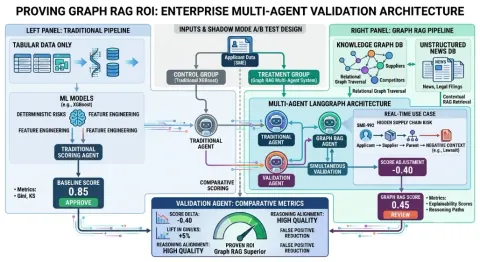
Quantifying Graph RAG Impact on Credit Risk Assessment
In our POC, the Graph RAG agent successfully identified a hidden supply chain risk that the traditional model missed, resulting in a significant score adjustment and a "Superior" verdict. This demonstrates that Graph RAG is not just a technological upgrade, but a risk-mitigation tool that provides tangible, measurable value to enterprise lending portfolios.
- Article · AI Agents
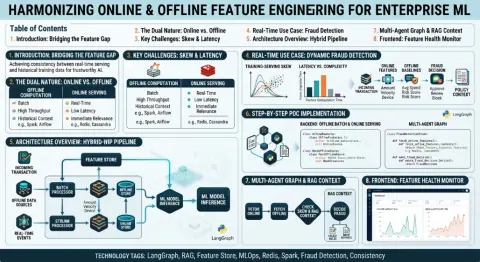
Bridging the Gap: Online Serving vs. Offline Computation in Enterprise Feature Stores with Multi-Agent LangGraph
Handling the dichotomy between online serving and offline computation is one of the most significant hurdles in enterprise MLOps. While offline features provide the statistical depth required for robust model training, online features provide the temporal relevance needed for real-time action. By implementing a Multi-Agent LangGraph architecture, organizations can bridge this gap effectively. This system not only serves features but also actively monitors for training-serving skew and applies contextual policies to manage data inconsistencies. As AI systems become more autonomous, the ability to maintain this balance will be crucial for ensuring both performance and reliability in production environments.
- Article · AI Agents
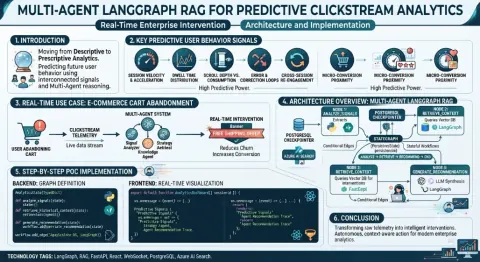
Predictive Clickstream Analytics: Building an Enterprise Multi-Agent RAG System with LangGraph
Predictive clickstream analytics requires moving beyond descriptive dashboards to prescriptive, real-time systems. The most valuable signals—session velocity, error loops, and cross-session re-engagement—are inherently contextual and benefit from multi-agent reasoning. By implementing a LangGraph-based RAG architecture with persistent state, enterprises can transform raw telemetry into intelligent interventions.
- Article · AI Agents
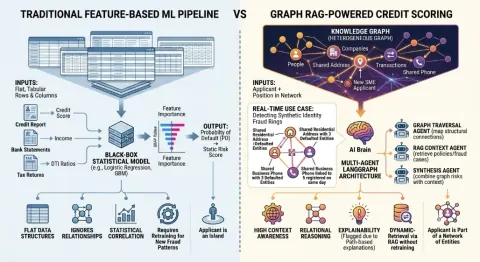
From Flat Features to Connected Insights: Graph RAG-Powered Credit Scoring vs. Traditional ML
By leveraging LangGraph, we created a system where the Graph Traversal Agent maps the structural landscape, the RAG Agent provides the regulatory and historical context, and the Synthesis Agent delivers a decision that is both mathematically grounded in graph theory and explainable through natural language. This architecture ensures that enterprises can detect sophisticated synthetic identity fraud rings that would otherwise slip through the cracks of flat, tabular data pipelines.
- Article · AI Agents
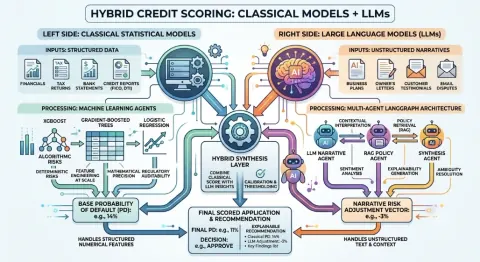
Hybrid Credit Scoring: Where Classical Models End and LLMs Begin in Enterprise Fintech
In our hybrid architecture, the classical XGBoost model produces a deterministic probability of default from tabular features. The LLM layer then analyzes business plans, owner letters, and other unstructured documents to identify qualitative risk signals that classical models cannot see. Through RAG, the system retrieves relevant underwriting policies to ensure the LLM's adjustments align with institutional guidelines. The synthesis agent combines these outputs into a final decision with full explainability.
- Article · AI Agents
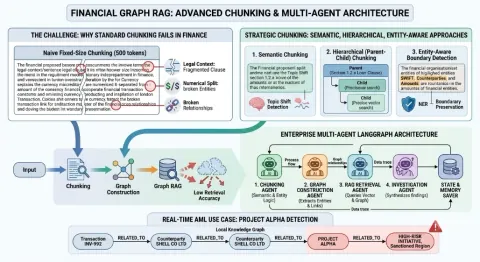
Advanced Chunking Strategies for Graph RAG in Transaction Narratives
Our Multi-Agent LangGraph POC demonstrates how specialized agents can handle the complexity of chunking, graph construction, and contextual retrieval, resulting in highly accurate and explainable AML investigations. This approach transforms raw, fragmented data into a coherent web of financial intelligence.
- Article · AI Agents
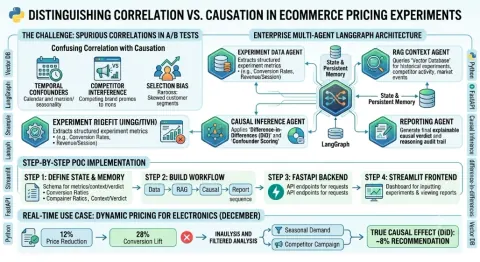
Distinguishing Correlation from Causation in Ecommerce Pricing Experiments: An Enterprise Multi-Agent LangGraph RAG Approach
By architecting a Multi-Agent LangGraph system with RAG, we empowered specialized agents to collaboratively investigate causality. The Data Agent extracts metrics, the RAG Agent surfaces critical historical and market context, the Causal Inference Agent applies rigorous Difference-in-Differences methodology, and the Reporting Agent delivers an explainable verdict.
- Article · AI Agents
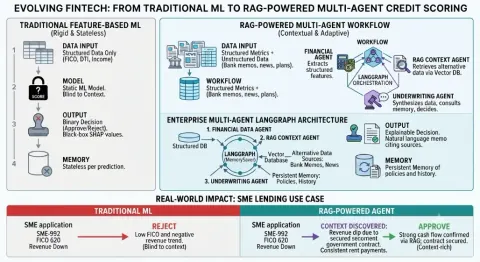
RAG-Powered Credit Scoring vs. Traditional ML
The transition from traditional feature-based ML pipelines to RAG-powered multi-agent workflows marks a critical evolution in Fintech credit scoring. While traditional models are fast and mathematically rigorous, they are inherently blind to context. By integrating LangGraph, we created a system where the Financial Agent handles the math, the RAG Agent provides the real-world context, and the Underwriting Agent synthesizes both.
- Article · AI Agents
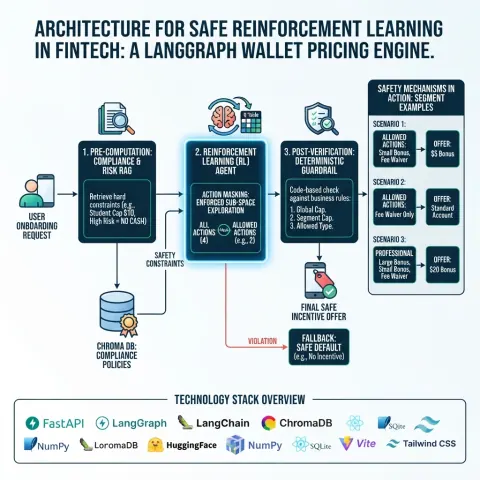
Safe Exploration: Guarding RL-Based Pricing in Digital Wallet Onboarding
Unsafe exploration is not an RL problem it is an architecture problem. By combining RAG-driven constraint retrieval, action masking, and deterministic guardrail nodes within a LangGraph workflow, we create a system where the RL agent can learn and optimize within a provably safe boundary. For digital wallet onboarding, this means better conversion rates without regulatory nightmares.
- Article · AI Agents
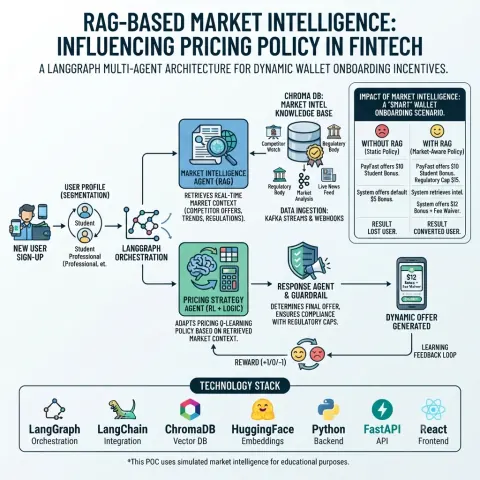
Context is King: How RAG-Based Market Intelligence Drives Dynamic Wallet Pricing
RAG-based market intelligence transforms a pricing engine from a reactive calculator into a proactive strategist. By grounding decisions in real-time external data, we ensure that wallet creation incentives are not just mathematically optimal, but competitively viable. This POC illustrates the power of combining LangGraph, RAG, and RL to build intelligent, context-aware financial systems.
- Article · AI Agents
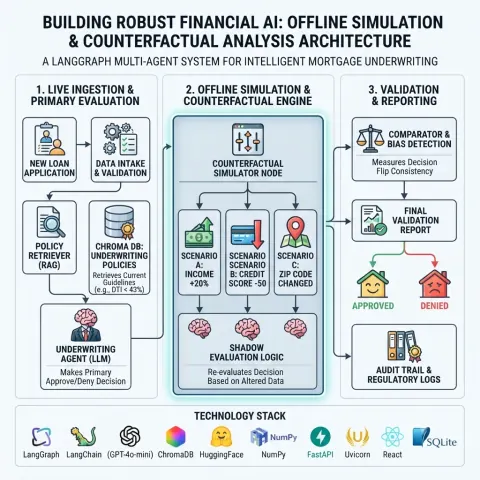
From Simulation to Production: Counterfactual Analysis in AI-Driven Loan Processing
Offline simulation and counterfactual analysis are not just "nice-to-haves"; they are essential safeguards for AI in finance. By integrating these techniques into a LangGraph workflow, we create a loan processing engine that is not only efficient but also transparent, fair, and robust. This approach allows institutions to deploy AI with confidence, knowing that every decision has been stress-tested against a myriad of "what-if" scenarios.
- Article · AI Agents
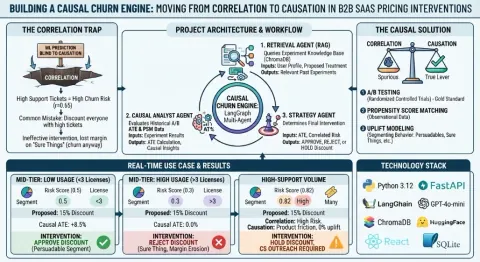
Beyond Correlation: Causal Inference in AI-Driven Churn Prediction and Pricing
Correlation tells you what is happening; causation tells you what to do about it. In churn prediction and pricing, acting on correlation leads to margin erosion and ineffective interventions. By integrating Causal Inference and Uplift Modeling into a LangGraph multi-agent architecture, supported by RAG over historical experiments, enterprises can build pricing engines that are not just predictive, but truly prescriptive.
- Article · AI Agents
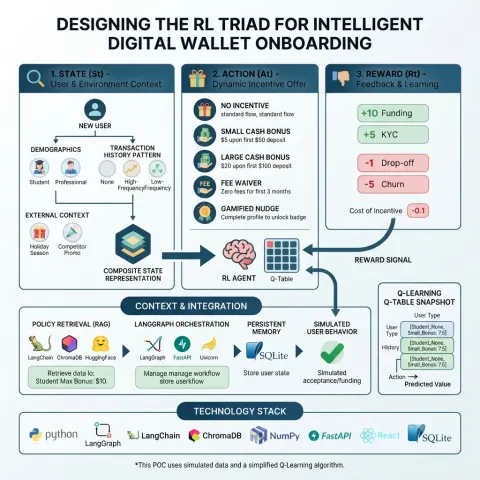
Designing the RL Loop: State, Action, and Reward in a Digital Wallet Onboarding Engine
Designing the State, Action, and Reward is the most critical step in building an RL-powered pricing or onboarding engine. By defining these clearly and wrapping them in a LangGraph multi-agent architecture, we can create systems that are not only intelligent but also compliant and context-aware. This POC demonstrates how to move from static marketing to dynamic, learning-driven user engagement.
- Article · AI Agents
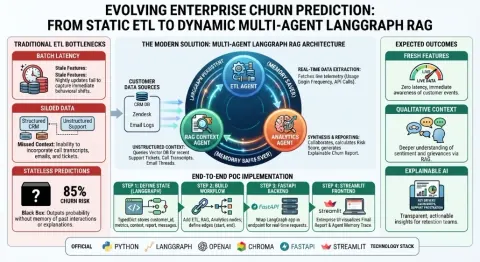
Overcoming ETL Bottlenecks in Churn Prediction: An Enterprise Multi-Agent LangGraph RAG Approach
The transition from traditional, batch-oriented ETL pipelines to dynamic, Multi-Agent LangGraph architectures represents a paradigm shift in enterprise data science. By addressing the core bottlenecks of latency, unstructured data silos, and stateless predictions, we can build churn prediction systems that are not only highly accurate but deeply explainable.
- Article · AI Agents
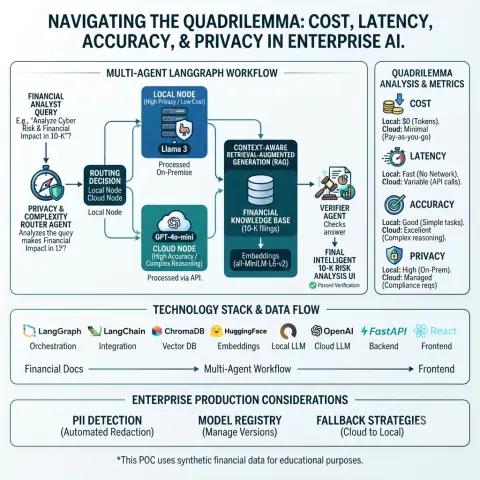
The Four Pillars of Enterprise AI: Balancing Cost, Latency, Accuracy, and Privacy in Financial Reporting
Selecting models for financial reporting is not a binary choice between "cheap" and "accurate." By implementing a Multi-Agent LangGraph architecture with intelligent routing, we can optimize for all four pillars: Cost, Latency, Accuracy, and Privacy. This POC demonstrates how to build a system that is both economically viable and compliant, ensuring that your enterprise AI strategy is robust, secure, and ready for production.
- Article · AI Agents
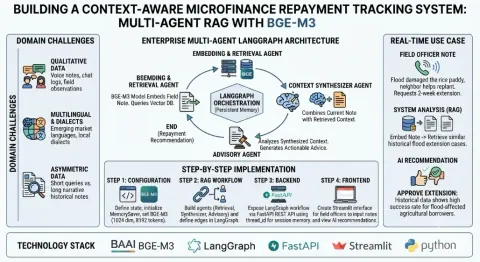
Selecting the Right Embedding Model for Microfinance: An Enterprise Multi-Agent RAG Approach to Repayment Tracking
Selecting the right embedding model is the most critical architectural decision when building RAG systems for specialized domains like microfinance. By choosing BGE-M3, we ensured our system could handle the multilingual, long-context, and asymmetric nature of field officer notes.