Loading
News by Web3 Universe
Robinhood Debuts Prediction Markets Hub
Robinhood has introduced a prediction markets hub in its trading app, allowing users to trade event-based contracts. Partnering with CFTC-regulated Kalshi, Robinhood offers contracts on topics like Federal Reserve decisions and major sports events. This expansion diversifies its platform beyond stocks and crypto, providing new ways for users to engage in financial markets and event-driven opportunities.
Microsoft Warns of New RAT Targeting Crypto Wallets
Microsoft's Incident Response Team has identified a new remote access trojan (RAT) called StilachiRAT, targeting cryptocurrency wallet extensions for Google Chrome. First detected in November, the malware steals sensitive data like credentials, wallet details, and clipboard contents. It affects 20 popular wallets, including MetaMask and Coinbase Wallet. StilachiRAT uses advanced evasion techniques and requires enhanced security measures to protect against potential risks.
Musk says he found ‘magic money computers’ printing money ‘from thin air’
Elon Musk claims to have discovered 14 “magic money computers” within U.S. government agencies, allegedly capable of generating and distributing funds without clear sources. He suggests these systems could miscalculate budgets by 5-10%. Bitcoin advocates argue this highlights the need for decentralized currency. The allegations remain unverified but could have significant financial implications.
Arbitrum Devs Launch ‘Onchain Labs’ Incubator Program
Offchain Labs, creators of Arbitrum, partnered with the Arbitrum Foundation to launch Onchain Labs, an incubator supporting innovative DApp projects. The program offers product and go-to-market guidance, emphasizing fair launches and collaborative development. With Onchain Labs, Offchain aims to grow Arbitrum’s application ecosystem, ensuring user-focused solutions while addressing challenges from the expanding and fragmented Ethereum layer-2 landscape.
OKX Halts DEX Aggregator to Prevent Lazarus Misuse
OKX has temporarily suspended its DEX aggregator after detecting misuse by North Korea’s Lazarus Group. The move follows regulatory discussions and aims to enhance security. While crypto wallets remain accessible, new wallet creation is paused in some regions. OKX refuted media claims of misconduct, emphasizing its anti-crime efforts and security upgrades, including hacker detection and blocking malicious addresses.
Bank of Korea adopts cautious stance on Bitcoin reserve
The Bank of Korea clarified it is not considering Bitcoin as part of its foreign exchange reserves due to its high price volatility. Officials emphasized a cautious approach, citing concerns over market instability and conversion risks. Despite South Korea's active role in cryptocurrency markets, the central bank prioritizes financial stability amid evolving regulations.
Crypto Users Report Scam Emails Spoofing Coinbase, Gemini
Crypto users report a surge in scam emails impersonating Coinbase and Gemini. These emails trick users into setting up wallets with compromised recovery phrases, giving scammers access to their funds. The scams falsely claim court rulings require asset transfers. Coinbase and Gemini warn users never to trust pre-generated recovery phrases. Phishing remains a major Web3 security threat in 2024.
Starknet to Settle on Bitcoin and Ethereum, Unifying Chains
Starknet, an Ethereum Layer 2, plans to integrate Bitcoin and Ethereum into a unified layer. By scaling Bitcoin’s transactions, enabling smart contracts, and supporting DeFi use cases like staking and lending, Starknet aims to unlock Bitcoin’s utility. Partnering with Xverse and leveraging OP_CAT, Starknet envisions transforming Bitcoin from digital gold to a programmable, scalable financial ecosystem.
SEC Postpones Decision on XRP, Solana, Litecoin, Dogecoin ETFs
The US SEC has delayed decisions on several cryptocurrency ETFs, including XRP, Solana, Litecoin, and Dogecoin. Announced on March 11, the postponement extends reviews until May. Bloomberg analyst James Seyffart views the delay as routine, with final deadlines set for October. These decisions are crucial for the future of crypto investment and regulatory clarity in the US.
Coinbase Approved to Relaunch in India After FIU Registration
Coinbase has re-entered the Indian cryptocurrency market after securing registration with the Financial Intelligence Unit (FIU), signaling a major step forward. Following past regulatory hurdles, this move ensures compliance with anti-money laundering laws. Coinbase plans to launch retail trading services and expand its crypto offerings, aiming to empower India's tech-savvy population while adhering to local regulations.
California regulator warns of 7 new crypto, AI scams
The California DFPI reported 2,668 complaints in 2024, identifying seven new crypto and AI-related scams. These included fake BTC mining schemes, deceptive gaming platforms, fraudulent job offers, and phishing attacks. AI-driven frauds and crimeware-as-a-service also surged. Authorities shut down multiple scam websites, recovering millions. Officials urged caution and website verification to prevent financial losses.
Binance Introduces Community Voting for Token Listings
Binance has introduced a community voting system for token listings, empowering users to influence which assets appear on the platform. The initiative includes a “Vote to Delist” option and balances user input with Binance’s due diligence. This move reflects the exchange’s commitment to decentralization and adapting to the growing number of digital assets in the crypto market.
Trump signs executive order for Strategic Bitcoin Reserve
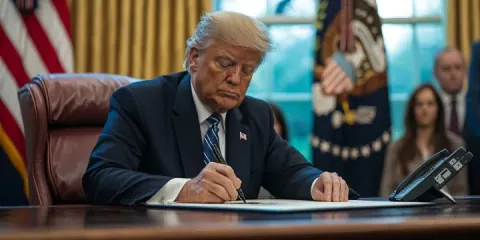
US President Donald Trump has issued an executive order to create two new digital asset reserves: the Strategic Bitcoin Reserve and the U.S. Digital Asset Stockpile. The Bitcoin reserve will be funded with seized assets and act as a store of value. The stockpile will manage broader crypto holdings, excluding new purchases. The order also mandates a complete audit of federal crypto assets.
Bitwise's First Institutional DeFi Investment via Maple Finance
Bitwise Asset Management has entered decentralized finance (DeFi) by investing in Maple Finance’s Bitcoin loan offerings. While the investment amount is undisclosed, Maple’s total value locked (TVL) rose by $5 million. This move reflects the growing institutional interest in on-chain lending. Maple offers a 9% APR, far surpassing traditional rates, highlighting DeFi’s expanding role in finance.
SafeWallet Published Bybit Hack Report
The SafeWallet developer released a report on the Bybit hack, revealing that attackers exploited an AWS session token to bypass MFA security. North Korean state actors spent 19 days executing the breach, stealing $1.4 billion. The FBI warned node operators as hackers laundered the stolen funds. Bybit recovered 77% on-chain, while $280M remains untraceable.
US Sanctions Crypto Addresses Tied to Nemesis Darknet Marketplace
The US has sanctioned Iran-based Behrouz Parsarad, operator of the darknet marketplace **Nemesis**, freezing his crypto assets, including 44 Bitcoin and Monero addresses. Nemesis facilitated illegal activities like drug trafficking and hacking tools before its shutdown in March 2024. Despite crackdowns, darknet markets earned $1.7 billion in 2024, with Russian platforms dominating the space.
Bitcoin Secures Local GOP Convention Election Results
The Bitcoin network was used to securely store election results for the Williamson County, Tennessee Republican Party Convention on March 4. Simple Proof recorded data on block 886,370. Blockchain’s transparency and immutability enhance election integrity, though challenges remain. While recent advancements improve security, concerns about centralization and cybersecurity risks must be addressed for wider adoption.