
AWS Web Answer returns a sourced response through an AgentCore Gateway.
AWS announced the general availability of Web Answer on Amazon Bedrock AgentCore on November 5, 2026. The managed tool lets an AI agent submit a natural-language question and receive a synthesized answer with citations to current web sources through one tool call; at launch, it is available in US East (N. Virginia), or us-east-1.
For developers building beginner-friendly agent applications, Web Answer is intended to replace much of the custom work normally required to search the web, retrieve pages, ask a model to summarize them, and attach sources to the result. AWS prices Web Answer at $10 per 1,000 tool calls, while AgentCore Gateway usage can also be billed separately.
Key takeaways
- Web Answer is generally available as a managed Amazon Bedrock AgentCore Gateway connector as of November 5, 2026.
- An agent sends one question and receives a completed answer with citations rather than a list of search links.
- Web Answer is called through the Model Context Protocol (MCP) and uses AWS Identity and Access Management (IAM) for access control.
- Developers can restrict sources with domain allowlists, denylists, and publish-date filters.
- The launch price is $10 per 1,000 Web Answer tool calls in US East (N. Virginia).
What did AWS announce?
Web Answer is a managed tool for agents that need timely public-web information. Instead of asking an agent model to interpret a collection of search results, the agent can call Web Answer and receive a ready-to-use response that includes inline citations and structured citation data.
AWS positions the release as the next step after Web Search on AgentCore, which became generally available in June 2026. Web Search returns ranked links, titles, snippets, and metadata. Web Answer performs the search-and-answer workflow itself and returns the final cited response.
How does Web Answer work?
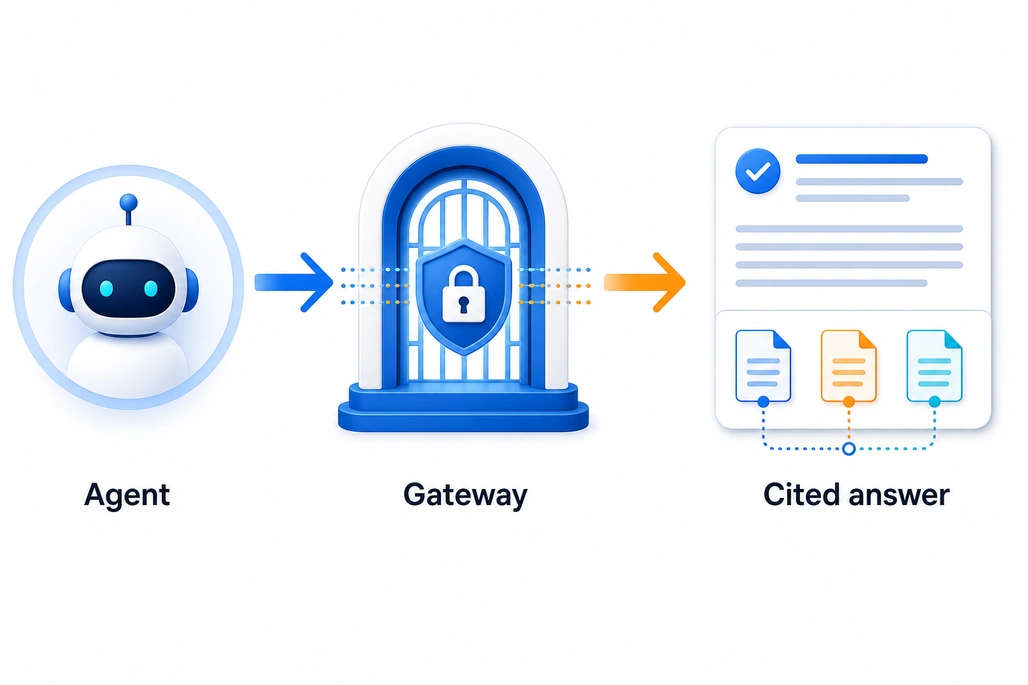
Web Answer is exposed to agents as an MCP tool through AgentCore Gateway.
Web Answer is added as a target to an existing Amazon Bedrock AgentCore Gateway. The gateway exposes it to attached agents as an MCP tool, meaning an MCP-compatible agent can discover the tool and call it programmatically.
For each question, AWS says Web Answer plans searches, runs multiple searches in parallel, reads relevant pages, and decides whether it has enough evidence to answer. It can search again when the first set of material does not sufficiently support an answer. The result is returned to the agent as an MCP tool response.
The response includes readable answer text and a structured list of citations. This gives an application a choice: it can display the response directly, show citations beside claims, or use the sourced response as input to another step in a larger agent workflow.
What do MCP and IAM mean for beginners?
MCP, short for Model Context Protocol, is a standard way for AI applications to discover and call tools. In this case, MCP is the connection between an AI agent and Web Answer through AgentCore Gateway.
IAM is AWS’s permissions system. Rather than requiring developers to create and rotate a separate Web Answer API key, the gateway uses an AWS service role. AWS documentation says the role needs the bedrock-agentcore:InvokeWebAnswer permission to invoke the AWS-managed tool.
How is Web Answer different from Web Search?
The main distinction is who performs the final reasoning and synthesis. With Web Search, an application receives raw search results and its own model or code decides which results to use and how to write the answer. With Web Answer, AWS operates the retrieval loop, synthesis, and citation process.
| Capability | Web Search on AgentCore | Web Answer on AgentCore |
|---|---|---|
| Primary output | Ranked URLs, snippets, titles, and metadata | Synthesized answer with citations |
| Who writes the answer? | The developer’s model or application | Web Answer |
| Best fit | Workflows needing raw results and custom reasoning | Factual sub-questions that need a finished cited response |
| Launch price | $7 per 1,000 queries | $10 per 1,000 tool calls |
The services can be used together. For example, an agent could use Web Search for a broad research task where it needs to inspect many sources, then use Web Answer to verify a focused factual question before replying to a user.
What controls do developers and administrators have?
A gateway administrator sets the Web Answer target and its policy boundaries. Available controls include domain include lists, domain exclude lists, and publish-date filters. These settings can help limit answers to approved publishers or focus retrieval on recently published material.
AWS says agents can narrow the source boundaries configured by the administrator for an individual request, but they cannot expand them beyond the target’s configuration. The tool also accepts a country setting to localize results.
According to AWS, Web Answer searches an Amazon-operated web index and Amazon’s knowledge graph rather than sending the agent’s question to third-party search engines. AWS also says queries and results are not stored or used to train models. Developers should still validate whether the service’s controls, sources, and output meet their organization’s security, compliance, and accuracy requirements.
When is Web Answer available, and what does it cost?
Web Answer became generally available on November 5, 2026, in the US East (N. Virginia) Region. AWS says additional Regions are planned, but it has not announced dates for them.
The listed Web Answer price is $10 per 1,000 tool calls, which equals $0.01 per call before other applicable AWS charges. AWS’s launch guidance also notes that gateway and Web Answer invocations are billable, so teams should review AgentCore Gateway pricing when estimating a full application cost.
At launch, AWS documents a per-account limit of 10 transactions per second for Web Answer in us-east-1. AWS directs customers who need a higher limit to contact AWS Support.
What should beginners build with Web Answer?
Web Answer is most useful when a current, sourced web answer is one small part of a larger agent task. Examples include a customer-support agent checking a current public policy, a research assistant verifying a regulation, or an internal copilot confirming a recently changed product specification.
It is not an end-user chat interface by itself. A developer still builds the agent experience, chooses when the agent should call the tool, controls how citations appear, and decides whether a response requires human review. Citations help users trace claims to sources, but they do not eliminate the need to test agent behavior or review important answers.
Frequently asked questions
What is Web Answer on Amazon Bedrock AgentCore?
Web Answer is an AWS-managed AgentCore Gateway tool that accepts a natural-language question and returns a synthesized answer with citations to current web sources.
How is Web Answer different from Web Search on AgentCore?
Web Search returns raw ranked search results for an application or its model to process. Web Answer performs the retrieval and synthesis workflow and returns a completed cited answer.
Where is Amazon Bedrock AgentCore Web Answer available?
As of its November 5, 2026 general-availability launch, Web Answer is available in US East (N. Virginia), us-east-1. AWS has said that more Regions are planned.
How much does Web Answer cost?
AWS lists Web Answer at $10 per 1,000 tool calls, or $0.01 per call. AgentCore Gateway and other AWS services used by an application may add separate charges.
Can developers control the sources Web Answer uses?
Yes. Administrators can configure domain include lists, domain exclude lists, and publish-date filters on the Gateway target. An agent can narrow those limits on an individual call but cannot broaden them.
Based on reporting by Amazon Web Services, Inc., Amazon Web Services, AI Agent News and New Runtime.

Join the conversation! Your thoughts help the community grow.